
Stinking Giant Fans: “Hold my beer”
Har

Source Facebook post here.
Y2Kyoto: Schadenfryin’
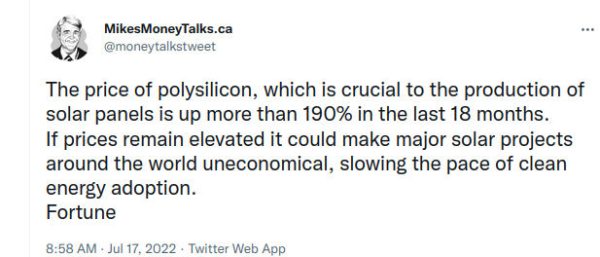
There’s such a thing as too much sun for solar panels, and Europe’s solar industry is starting to buckle.
We Don’t Need No Flaming Sparky Cars
…at this point, I owe the universe an apology. A few weeks ago, The Wall Street Journal published a piece about an EV road trip gone awry. The headline says it all: “I Rented an Electric Car for a Four-Day Road Trip. I Spent More Time Charging It Than I Did Sleeping.”
As a smug EV evangelist and self-proclaimed EV expert, I rolled my eyes. “They just didn’t plan well enough,” I thought to myself, not realizing I was merely hoisting myself on my own petard. A few weeks later, it was time to drive from DC to Watkins Glen in the Finger Lakes region of New York, this time in a BMW iX. And despite plenty of planning, I still spent almost as much time stationary, arguing with charging machinery, as I did actually pulling electrons into the car’s battery pack throughout the 600-mile journey.
Higher, Please
Y2Kyoto: The Art Of Theatre
the EU is in serious trouble on power grids. they chased a made up green dream where over-priced and under-reliable power sources like wind and solar were subsidized and mandated into adoption while longstanding and effective nuclear was shut down (though france did mostly keep theirs). and now, as they rapidly discover their newfound dependence on geopolitical rival russia and desperately need solutions, what is the grand plan of france?
We Don’t Need No Burning Rings Of Fire

Y2Kyoto: Schadenfrozen
The German Economy Is On The Brink
The economist Herbert Stein once wrote that if something cannot go on forever, it will stop. It seems like the German — and with it probably the European — economy is reaching that point. Most of Europe’s 100 largest companies were founded in the 1980s or before, which means that the old continent has entirely slept through the digital revolution of the 1990s and 2000s. There is no European counterpart to American corporations like Facebook, Amazon, E-Bay or China’s Alibaba or WeChat.
This became painfully clear during the Covid pandemic, when the once vaunted German bureaucracy was revealed to rely on paper, pens and fax machines in its health care system due to a complete lack of digitalisation in key areas. Not surprisingly, the German economy shows cracks elsewhere as well. Measured by market capitalisation, only one German company makes it into the top 100 worldwide, and German market capitalisation as a share of global market capitalisation has shrunk to 1.97%, an all-time low. These are devastating numbers for a country that just a few years back was seen as a model for the world with its transition to Green energy and the planned exodus from nuclear power.
In fact, to add insult to injury, one of the largest German producers of rotator blades for wind turbines has announced it will close down production in Germany and move to India. Similarly, Villeroy & Boch, a company that has produced tiles in the German city of Merzig since 1879 will retire its factory and move manufacturing to Turkey, quoting high energy and labour costs as the main reason. One could argue these are just anecdotes, but it is probably no coincidence that for the first time in 30 years Germany posted a trade deficit of over one billion euros, meaning that Germans are importing more than they are exporting.
More: Germany Is Quietly Shutting Down As Energy Crunch Paralyzes Economy
According to the FT, Germany is now rationing hot water, dimming its street lights and shutting down swimming pools as the impact of its energy crunch begins to spread like the proverbial Ice-Nine wave, from industry to offices, leisure centers and residential homes.
Just Light A Fire And Burn It
A joint project, brought to us by the people who fail at water treatment: Feds announce $10M for Indigenous-led clean energy projects in Sask.
We Don’t Need No Stinking Giant Fans
A scorching heat wave is pushing the Texas grid to the brink. Power demand is surging as people crank up air conditioners. But meanwhile, wind speeds have fallen to extremely low levels, and that means the state’s fleet of turbines is at just 8% of their potential output. […]
Depressed wind power during heat waves isn’t a new phenomenon. Powerful high-pressure systems that cause intense heat often squelch wind production — just when more power is needed to meet higher electricity demand. The mass of air overhead stifles wind near the surface, until the mass moves elsewhere.
A “phenomenon”. Here’s another: wind doesn’t blow when it’s cold, either.
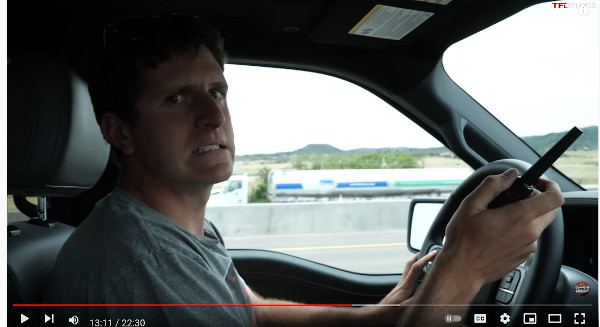
Fast Lane Truck tested electric and gas-powered trucks to see how far they could haul a trailer…
We Don’t Need No $60K Paperweights
All is proceeding according to plan.
Still want to buy an EV? Here's a Tesla charging line in California:#EV #Charging #Tesla #EVLife #ElectricVehicles #Cars #Autos #ElonMusk pic.twitter.com/ThrewJNvFi
— laurenfix (@laurenfix) July 2, 2022
Ring Of Fire
Is there NOTHING they won’t strap a lithium firestarter to?
More than 400,000 solar-powered patio umbrellas sold at Costco have been recalled by authorities after it was announced that the product can overheat and potentially burst into flames. […]
Batteries used in the umbrella to create that sought after “ambiance” are what the agency believes to be causing trouble. They received six reports of the lithium-ion batteries overheating, with three of those reports resulting in “solar panels catching fire while charging via the AC adapter indoors” while two other incidents ended with the umbrella itself becoming ablaze when the solar panel puck overheated and caught fire while attached to the umbrella.
We Don’t Need No Flaming Sparky Cars
What size battery does it take to start a battery?
On Monday, Ford Motor Co. notified dealers that it would be issuing a stop-sale notice for the all-electric “Mustang” Mach-E. The note made mention that the high-voltage contacts on the battery could overheat and cause malfunctions — potentially causing the vehicle to lose power while in operation or even fail to start.
Considering how absolutely wicked battery fires can become, this was likely a prudent move on the part of Ford. Over the last several years, EVs have been getting some negative attention for fires related to charging or battery failures of late and Blue Oval is likely aware that any mishaps with the Mach-E will be amplified as a result. Nipping this in the bud immediately is wise. However, the resulting recall has defaulted to the industry standard solution of issuing a software update on the affected models.
While tweaking the software can help mitigate problems, manufacturers have started leaning on the strategy as a way to buy time until a more comprehensive hardware fix is developed. This may also be the situation with Ford, as it doesn’t even want dealers to demonstrate the Mach-E to potential customers and used capitalized letters to make that point. Transcripts of the dealer notice shared on the relevant Mach-E forums have likewise mentioned that parts pertaining to the subsequent recall were unavailable. However, the phrasing used by the automaker makes the assumed lack of any parts interchangeable with the planned software update a corporate spokesperson said should be available next month.
They Can’t Power A Smartphone For More Than A Day
But the battery scam geniuses would power the grid.
U.S. renewable energy developers have delayed or scrapped several big battery projects meant to store electrical power on the grid in recent months, scuttling plans to replace fossil fuels with wind and solar energy.
At least a dozen storage projects meant to support growing renewable energy supplies have been postponed, canceled or renegotiated as labor and transport bottlenecks, soaring minerals prices, and competition from the electric vehicle industry crimp supply. […]
The delays, some of which have not been previously reported, range from several months to a year, according to the Reuters reporting.
“I have not seen a nascent industry challenged on so many fronts,” said Jamal Burki, president of IHI Terrasun Solutions, the U.S. energy storage arm of Japanese heavy equipment maker IHI Corp.
We Don’t Need No Flaming Sparky Cars
“CEO”
General Motors CEO virtue signaling how “clean” the new Chevy Volt is.
Then a reporter asks where the charging electricity comes from.
Oh my…. Wait for it.
Awkward. pic.twitter.com/wcMNhHVSK9
— Benny Johnson (@bennyjohnson) June 8, 2022
(Yes, it’s old, but it’s worth the reminder).
“Go At Throttle Up”
… the public transport operator (RATP) in Paris temporarily suspended on the use of 149 electric buses made by Bollore’s Bluebus brand after two of the vehicles caught fire.
Solar Firm Charged With ‘Massive’ Fraud
The U.S. Securities and Exchange Commission said Jeff Carpoff and his wife Paulette promised investors who purchased solar generators made by DC Solar that they would profit from tax credits and lease payments from end-users of the generators.
But according to the SEC, most of the generators did not exist and most of the company’s revenue came from investor funds. The Carpoffs allegedly raised approximately $910 million from 17 investors between 2011 and 2018.
“In reality, the vast majority of investor funds was not being used to manufacture, place into service, and maintain the thousands of generators that DC Solar was using as the basis for investment contracts, but was instead being pilfered by defendants Jeff and Paulette Carpoff for their personal benefit,” the SEC said in a civil complaint.
“Join The Green Revolution!”, They Said
We’ll all be RICH!, they said.

We Don’t Need No Frozen Sparky Cars
A class action lawsuit is being brought before a Quebec court alleging that the battery performance of the Chevrolet Bolt – 2017’s “Green Car of the Year” – isn’t as advertised.
As reported by Blacklock’s Reporter, General Motors boasted that the 2017 Chevrolet Bolt was able to drive up to 383 kilometers before needing to be charged. However, plaintiffs in the lawsuit are alleging that the vehicle’s range during winter before requiring a charge is a lot lower than advertised.
“The range of the Bolt electric vehicle does not even reach 300 kilometres,” they claim.
They also say that colder weather drastically increases the battery’s charging time and that General Motors was “(a)ware of this situation as early as 2017 but knowingly omitted to mention it to the plaintiff and other members of the class.”
They deserve to have the suit thrown out. Anyone who would pay $38K for a vehicle with an advertised three hours of highway range is an idiot.