
Coal injunction appeal decision expected Oct. 19. Here’s how it went in court
The fate of Saskatchewan’s coal-fired power generation industry, including two mines and three power plants, comes down to one word: “justiciability.”

Coal injunction appeal decision expected Oct. 19. Here’s how it went in court
The fate of Saskatchewan’s coal-fired power generation industry, including two mines and three power plants, comes down to one word: “justiciability.”
Ottawa announces $100 million toward Nova Scotia offshore wind project
EverWind says $10B AI data centre proposal largest private investment in N.S. history
Hitachi announces $479M plan to build transformer insulation factory in London, Ont.
FYI I am working on that coal injunction story from a few weeks ago. The court’s ruling is expected Monday. This is what led up to it. Watch for it.
Given the litany of idiocies perpetrated under America’s tort law system, the last thing anyone needs is for this latest gambit to gain traction.
The Supreme Court grappled Monday with whether local governments can sue oil and gas companies in state court to help cover costs associated with climate change, an issue with potentially billions of dollars at stake.
Governments from largely blue-leaning areas around the country have filed similar lawsuits seeking damages that could total billions of dollars, part of a wave of legal action worldwide seeking to leverage action through the courts.
For every step forward that the Carney government takes regarding energy policy they seem to take two steps back by subsidizing bird choppers.
The federal government is committing $100-million toward development of a Nova Scotia offshore wind energy project with the potential to power homes and businesses in Quebec, Ontario and New England.
Too bad they didn’t scrap the requirements entirely. But it’s a step in the right direction.
The Department of Transportation and the National Highway Traffic Safety Administration estimated that the finalized standards would correspond to a combined industry fleetwide average of roughly 34.9 miles per gallon for passenger cars and light trucks in the 2031 model year. That’s up from 30.1 miles per gallon for model year 2024, but down from a projected 50.4 miles per gallon in 2031 under rules put in place by the Biden administration.
So Doctor Fruit Fly is frustrated and angry with our new PM? If only Carney would give him a lot more to get angry about.
Suzuki, 90, retired from hosting the show four years ago, but still wants to talk to Canadians about the environment. This time though, the educational message is tinged with exasperation.
Canadians and people around the world have their priorities wrong, he said.
“So if that doesn’t tell you right there what kind of a f–ked-up system we have, that is exploiting the very things that keep us alive. And we don’t put any value on it.”
A group housed at the New York University School of Law and backed by billionaire climate activist Michael Bloomberg quietly closed its doors in late August amid congressional scrutiny into its funding and operations. The so-called State Energy and Environmental Impact Center’s signature initiative involved placing paid, climate-focused “fellows” in Democrat-controlled state attorney general offices nationwide as those offices sued the oil industry and other energy providers.
The center’s sudden closure comes as a surprise: It continued to update its public database tracking state attorney general actions relevant to its climate priorities until Aug. 31, the date of its apparent closure. […]
The House Oversight and Government Reform Committee opened an investigation into the center last year, stating that its activities “raise questions as to whether participating state attorneys general are acting on independent judgement to best serve the interests of their states’ citizens.”
“The Bloomberg-NYU program effectively offers states partisan money from a billionaire to carry out official functions of their offices,” the panel wrote at the time. Bloomberg, it continued, “disguises his donations as ‘philanthropy'” and uses the impact center as a mechanism “to skirt legislative bodies and effect partisan policy.”
The 21st century version of the Springfield Tire Fire. I can’t wait for the day when solar arrays dot the landscape. Can you?
A fire at a solar farm in western P.E.I. is out after some battery cells burned, smouldered and flared up for two weeks.
On the day the fire started, which was the Labour Day holiday, a shelter-in-place order was issued, as well as a voluntary evacuation notice, and some roads were closed. Two schools were closed the following day.
Don Surber follows the science.
Congratulations, comrades. You have defeated climate change. We know this because there have been no hurricanes so far in the Atlantic this hurricane season, for the first time in at least 60 years.
Gray News reported, “The Atlantic hurricane season is already one for the record books. It has been 103 days since the hurricane season started, and no hurricanes have formed in the Atlantic Ocean. That is a new record.
“Since the satellite era began in 1966, the latest date that the first hurricane formed in the Atlantic hurricane season was Sept. 11. Hurricane Gustav formed on Sept. 11, 2002, and Humberto formed on Sept. 11, 2013.”
It’s now been 106 days. This means the crisis has passed.
And there is more. No Atlantic hurricanes made landfall in the continental United States during the 2025 season—the first time that had happened since 2015.
Whitehorse Yukon Canada
$30,000,000 Wind Turbine Facility
4 units: 1MW wind turbines
Producing ZERO ⚡️ kW
Sept 11/26 12:25pm
Conditions:
Wind: 1.4m/s WSW
5.04 km/h (3.13 mp/h)— ™ Climate of Dawn (@DawnTJ90) September 11, 2026
So I just posted this on Facebook. I wonder what sort of response I’ll get?
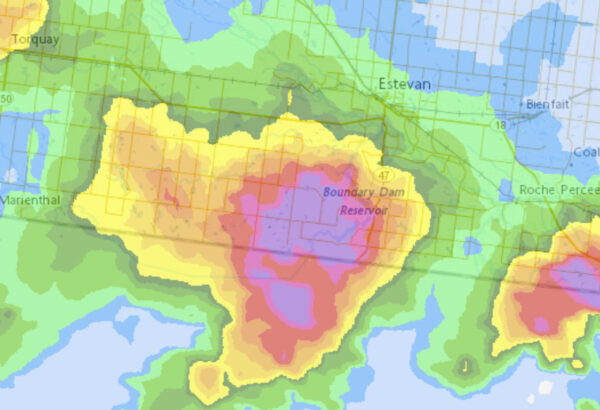
So that purple area is right over the Turning Sun solar array under construction southwest of Estevan. This is at 11:50 p.m. on Friday. I feel bad for the farmers, for sure, as that purple is likely hail. The question is, how will the array fare? I’m not nearby this weekend, so if anyone notices any damage, please let me know.
This is what Environment Canada says: “At 11:46 PM CST, a line of severe thunderstorms is located from about Oungre to Estevan then to 25 km south of North Portal. These severe thunderstorms are moving northeast at 35 km/h. Damaging wind gusts, up to quarter size hail and heavy rain are possible.”
A big question I’ve been asking for years is this: Show me one place in Saskatchewan where you can guarantee it will not be hit by toonie sized hail over the next 25 years? I asked SARM’s board this. They all laughed, because they have a hail insurance company for that exact reason. My own place has been hit by toonie to baseball sized hail twice in 18 years. My dad’s farm was wiped out by the white combine around 1987. So how will hundreds of millions of dollars of solar panels hold up when the inevitable happens? This array is supposed to pivot vertically to reduce damage, something fixed arrays can’t do. Maybe that’ll help. This particular area in the image has hit hard several years ago by hail. I hope it’s just rain, for the farmers’ sake. If you know what happens, please comment below or let me know.
The new guy doesn’t sound a whole lot different than Starmer. Good luck with your voting choices, Britain. You’ll soon be back to the dreary 70’s at this rate.
He said that greater public control over water, energy and transportation can drive economic growth and ease households’ financial burden, though it’s unclear to what extent he plans to reverse decades of privatization of key pillars of the economy.
NDP release Pembina Institute paper on costs of coal refurbishment, but the paper leaves out a lot of context. The report puts a lot of faith in wind and solar, but real world examples over the last two weeks bring that faith into doubt. Using the scenarios the Pembina Institute outlines in the report quoted by the NDP, on Aug. 12, Saskatchewan would have run out of batteries six times in 24 hours.
And just after I finished writing this at 2 a.m., I got an email alert that Alberta wind generation fell to less than 1 per cent output, again. But they have no use for baseload power. Good grief.
In their Goss et al (2020) paper Climate Change Is Increasing the Likelihood of Extreme Autumn Wildfire Conditions Across California, those alarmist scientists clearly stated their intention was to make climate change the culprit by presenting an investigation that “only considers changes in climatic contributions to wildfire risk, irrespective of changes in fire ignitions, vegetation, land use or management strategies.”
Here’s an idea: tell water and sewer utilities to levy sufficient charges to cover the cost of capital improvements and replacement of infrastructure. Then the federal and provincial governments can put their money into real infrastructure projects such as twinning the trans-Canada highway in northern Ontario and BC. We ought to be ashamed of the fact that Mexico has more sensible highway systems than we do.
Ontario and Ottawa are announcing up to $1 billion to help municipalities in the province build infrastructure for more homes.
The money will go to municipalities that do not collect development charges for things like roads, bridges and water systems.
What’s the point of such half-measures? Do the Tories think that voters would reject the idea of permanent tax relief? Why does the idea of strongly differentiating themselves from the Liberals seem to fill them with dread? In fact, why not openly call for the elimination of the industrial carbon tax and lower gas prices by taking that route?
Conservative Leader Pierre Poilievre says the federal government should give Canadians at least another 10 months of relief at the pumps.
Alberta’s fleet of 1,760 wind turbines hardly put out any power since mid-afternoon on Friday leading into at least late-morning on Saturday. And one, again, is the loneliest number when that’s the total amount of megawatts produced from the fleet of 1,760 turbines.
Hear my prayer…
…from somewhere out there in the dark.
Faced with widespread backpedaling on the most useless aspects of the climate science cult, hacks like Gwynne Dyer just double down: since we can’t jettison fossil fuels fast enough, let’s just embark on an attempt to do nothing less than geoengineer the weather as if the earth were connected to a house thermostat. What could possibly go wrong?
Cutting our carbon dioxide and methane emissions, while it is still vital, cannot act fast enough….
What can act fast enough is Solar Radiation Management (SRM for short). That includes any technique that reflects some incoming sunlight back into space and cools the planet, but the most promising one involves putting some reflective substance into the stratosphere.
