Via Ed Driscoll, who knows a great post title when he sees one.

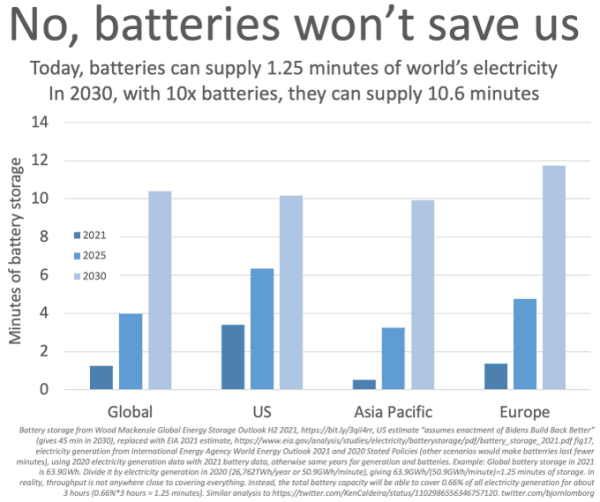
Via Ed Driscoll, who knows a great post title when he sees one.
There’s ZERO percent chance of reaching “Net Zero”.
[We] have a hundred-trillion-or-so dollar effort that under presidential directive must be fully up and running by 2035, with everybody’s light and heat and everything else dependent on success, and not only don’t we have any feasibility study or demonstration project, but we haven’t started the basic research yet, and the building where the basic research is to be conducted won’t be ready until 2025.
h/t Watcher
Automakers like General Motors and Ford have wowed Wall Street with flashy EV designs, technical prowess and plans to invest tens of billions of dollars. Yet they’ve literally put the cart before the horse: the lithium batteries needed to power the electric vehicle revolution.
Now investors are starting to say: “Show me the metal.” Among many key materials, lithium is the most indispensable.
Traditional automakers have hastily announced plans to build 13 lithium-ion battery plants in the U.S. by mid-decade. The planned ramp of EV production will triple demand for the light, silvery white metal by 2025. Yet supplies of lithium have little chance of keeping up.
Growing doubts about aggressive EV targets have contributed to a dive in General Motors (GM) and Ford Motor (F), along with shares of upstarts like Rivian and Lucid. Meanwhile, unquenchable demand and soaring prices have sent EV materials stocks including Albemarle (ALB), Lithium Americas Corp. (LAC) , MP Materials (MP) and Sociedad Quimica y Minera de Chile (SQM) on a wild ride.
It’s probably a bad idea to let environmentalists do your energy planning…
Buried in the hoopla regarding the latest EV component plant being constructed in Ontario is one minor detail. Minor, that is, to everyone except those taxpayers who are going to receive the invoice. Not only is Ford not concerned about that, but he seems to believe that the bigger the subsidy invoice, the louder he can trumpet the news.
“I know between Ontario and Canada, we’re putting in hundreds of millions of dollars,” Ontario Premier Doug Ford said at a press conference on Wednesday morning. “I can’t divulge (how much), that would compromise negotiations with other companies going forward, but massive investment, hundreds of millions of dollars.”
“Chinese companies, particularly CATL, have secured vast supplies of the raw materials that go inside the batteries,” The New York Times reported in December. “That dominance has stirred fears in Washington that Detroit could someday be rendered obsolete, and that Beijing could control American driving in the 21st century the way that oil-producing nations sometimes could in the 20th.”
By increasing our use of electric cars, the United States will require more lithium batteries and will further rely on China to sustain our supply. While the current energy crisis could be an opportunity for America to increase our energy independence, the current administration refuses to take advantage.
As The Federalist’s Tristan Justice reported in August, Biden’s electric vehicle plan “is a big win for Beijing.” Despite our capability to become independent and profit from American-made energy, Biden has no plans to trump China’s mass energy production, even as China continues to flaunt the rigid “green” standards that hold our own producers back.
Funny that Biden would do that.
If the cost of hydroelectricity was the advantage that it is typically claimed to be, Manitoba would have become the manufacturing hub of Canada decades ago. The fact that this never happened has not dissuaded journalists from promoting green energy bromides by focusing on the cost of just one input among thousands.
Setting aside the hoopla, even the allegedly low cost of that input cannot offset a lot of other hurdles without a big infusion of tax dollars:
As both provinces look to woo automakers and battery makers with financial incentives and subsidies, the situation may raise a new quandary for Canada. In their zeal to grab a piece of the burgeoning EV supply chain, will Quebec and Ontario end up competing against one another in a race to the bottom, in which all the purported benefits of industry, from jobs to tax revenue, fly out the window as companies secure lucrative deals?
https://twitter.com/QuickDickMcDick/status/1502127477937737733
BP’s decision to dump Rosneft stock will cost it up to $25 billion
Following days of intense pressure from the U.K. government, UK energy giant BP Plc said it will exit its 19.75% stake in Russian oil company Rosneft, a dramatic reversal after Russia’s invasion of Ukraine as Western nations are trying to inflict as much economic pain as possible on Moscow. BP had held its stake in Rosneft since 2013. BP is Rosneft’s biggest private shareholder, according to the Russian company.
Additionally, BP chief executive officer Bernard Looney is resigning from the board of Rosneft with immediate effect. The other Rosneft director nominated by BP, former BP group chief executive Bob Dudley, is similarly resigning from the board.
Via reader and industry insider Adrian;
Honest you could not make this shit up.
I wonder how those of my old colleagues feel about their BP pension being a play thing for children. There will be only one winner and one long term loser, actually a loser now, in the future and forever.
Utter utter madness.
I have said it for years Russian plays the long game, Russia will continue to dominate as the supplier of Hydrocarbons and she will reap the rewards and get to say exactly what she wants. I remember the Russian contingency being asked how low the price of oil needed to get before Russia stopped producing. The answer was it can get to $1/Bbl and we will still be producing and selling. That is how you obtain and keep a monopoly. The west is no longer a serious proposition.
Oil, gas, aluminum, copper, nickel, and cobalt: Russia’s SWIFT Ban Could Send Shockwaves Through Oil And Commodity Markets”
Hyundai and Kia are recalling nearly half a million vehicles in the U.S. over a fire risk.
The issue is deemed so serious that the automakers are telling affected owners to park their vehicle outside and away from buildings until a repair has been carried out.
The problem centers on a component inside the antilock braking system (ABS) that could short-circuit and cause a fire.
Hyundai, which owns 34% of Kia, has yet to work out the cause.
h/t roaddog
All the kilojoules came out at once.
h/t Antonio
1h UK energy regulator Ofgem lifts the price cap on retail gas and electricity prices **by 54%** from April 1, from £1,277 to £1,971 per year […]
And here’s the government response to the £700 per year increase in retail energy costs: millions of households will receive £350 of government support (subsidies, it’s called subsidies) to offset the hike in electricity and gas prices.
And with a snap of the fingers — EU classifies nuclear power and natural gas as ‘green’
And this just in.
🚨NEW 🚨
Bank of England says UK households must brace themselves for the biggest annual fall in their standard of living since comparable records began three decades ago, as it:
– Raises interest rates to 0.5%
– Says inflation will surpass 7%
– Slashes GDP forecast— Ed Conway (@EdConwaySky) February 3, 2022
GM Delivered Only 26 EVs In Q4 2021
Our attention is focused on GM’s electric vehicle sales and, as it turns out, the fourth-quarter results are the weakest since the introduction of the Chevrolet Volt in December 2010 when the company handed over 326 cars.
In Q4 2021, GM delivered in the U.S. only 26 all-electric vehicles (down almost 100% year-over-year). The number includes 25 Chevrolet Bolt EV/Bolt EUV and 1 GMC Hummer EV Pickup (the first one delivered in December). We thought that more electric Hummer EVs would be delivered before the end of the year, but it was just this one symbolic unit.
h/t Canadian Friend – “During the same 3 months GM sold 440,745 GASOLINE cars”
How Many Kamala Harris’s Does It Take To Plug in an Electric Car?
"There's no sound or fume," Kamala Harris remarks at an event highlighting the Biden administration's obsession with electric vehicles.
"So… how do I know it's actually working?" pic.twitter.com/qKvWp37KRH
— Jake Schneider (@jacobkschneider) December 13, 2021
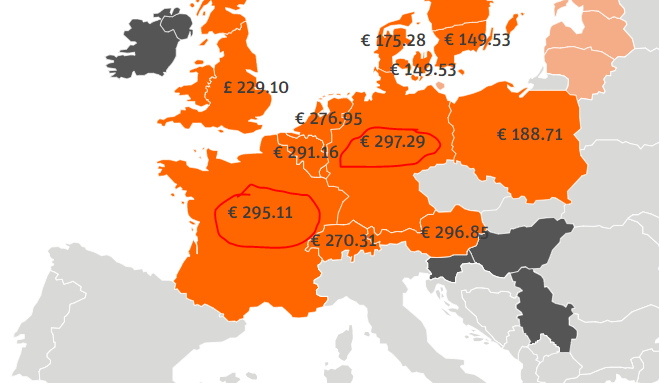
EUROPEAN ENERGY CRISIS: Short-term day-ahead power prices across Europe surge again toward €300 MWh. despite relatively mild temperatures. Gas is very expensive, and the wind isn’t blowing today or tomorrow. Germany, France, Belgium and Austria all above €290 per MWh for Tue.
E-car from VW needs 13 hours for 650 kilometers – without heating
Even under the best conditions, many electric cars are still a long way from being suitable for long journeys. As a car comparison test recently showed, no electric car can cover more than 440 kilometers at a time at a speed of 130 *. The car reporter Lisa Brack and EFAHRER.com author also had to experience this painfully. She dared an electric car long-distance experiment. Because to buy her new VW e-Up, she drove from Munich to the VW Autostadt in Wolfsburg to pick up her car personally.
Brack needed 12 hours and 45 minutes for the return journey from Wolfsburg to Munich, covering a distance of 654 kilometers. The route would normally take around six hours. But it wasn’t just the duration of the journey that was appalling – the temperature during the journey was anything but funny: the heating stayed off for almost the entire return journey in freezing temperatures: Because the colder it is, the more the operation of the heating systems puts a strain on the electric car battery. Recently, the electric car cold problem was also evident at a large German company, because in Berchtesgaden in Bavaria , Deutsche Post is withdrawing its expensive e-vans due to snow and cold and is back to combustion models for the winter months.
Lisa Brack wanted to avoid Volkswagen’s expensive service costs of 700 euros and also report on her long-distance experience. To do this, she sends her electric car straight to the endurance test, because the temperatures on the way back are freezing. At 0 to minus 5 degrees she starts the journey home to Bavaria. These are unfavorable conditions for electric cars, because low temperatures paralyze the batteries in electric cars*, especially in winter.
For the trip, Brack covered himself with a hat, scarf, gloves and generally warm clothing, because after the first full charge, the VW e-Up shows a range of just 216 kilometers. And even this information is not guaranteed, which is why Brack opts for the so-called Eco-Plus mode and, of course, for the heating to be switched off. When the windscreen is frosty, heating wires ensure a clear view, so the reporter driving the test can do without the power-guzzling fan heater completely.
In order to install an appropriate app for the model, she asks a VW employee when the car is handed over. However, he immediately blocked it: “Don’t ask me that. The digital services are not included in our training courses.” So Brack has to take everything into his own hands. Then it’s on the way home, time 2:45 p.m.