

Indigenous Ways Of Child Sexual Mutilation
Shut up, racist. It’s their culture.
An Alberta First Nation says it aims to defy Premier Danielle Smith’s government by establishing a safe haven for gender-affirming medical care — contrary to provincial law.
The Saddle Lake Cree Nation, located northeast of Edmonton near St. Paul, says health care is a right under Treaty 6 and falls under its inherent jurisdiction.
The First Nation has invoked the “medicine chest clause” provision from the treaty signed in 1876, which Indigenous Peoples interpret as a promise to provide comprehensive health care.
“All children, including trans and two-spirit children and their family, will have safety under our treaty,” Saddle Lake Chief Dale Steinhauer said on Wednesday.
Indigenous Ways Of Sciencing
All federal scientific research should be Indigenous focused, says a Department of Natural Resources report. “How can we as public servants be actors in reconciliation?” it asked: “Ideally, the decolonization of research implies full Indigenous ownership of research. However it is still hard.”
(coding glitch fixed, sorry)
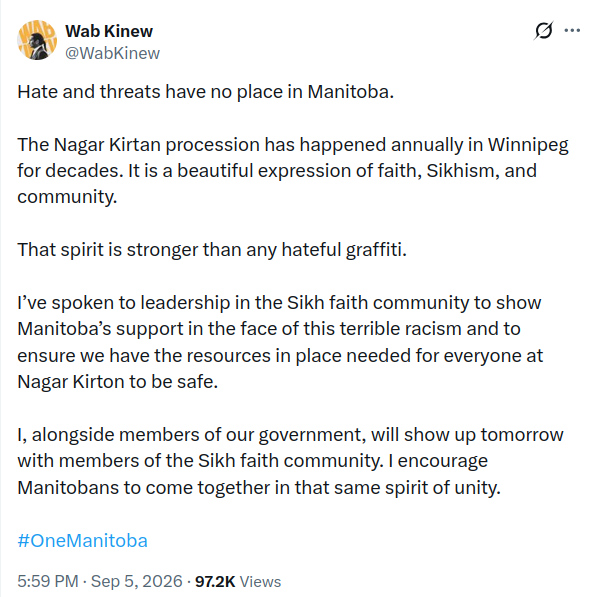
Who Kinew?
Big Chief Librano
The Department of Crown-Indigenous Relations says it doesn’t believe any managers meant to steal paintings, jewelry, sculptures or other works that vanished from a $14.4 million Indigenous art collection. It is not known what happened to scores of artworks used to decorate the department’s regional offices: “This went on for decades.”
More: Police were never called, and the department still cannot explain what happened to the paintings, jewelry, sculptures and other taxpayer-funded works…
Who Kinew?
I’m no expert on cultural appropriation or misogyny, but…
NEW –
The FULL LENGTH, previously scrubbed, 2005 music video for Manitoba Premier Wab Kinew's rap song "stank b*tch"
has emerged. pic.twitter.com/j6UgcEp0Px
— Tablesalt 🇨🇦🇺🇸 (@Tablesalt13) September 3, 2026
A Statement from the Office Of One Hundred Dollar Fines
The federal ethics commissioner has found that Nunavut MP Lori Idlout violated parliamentary conflict-of-interest rules by obtaining taxpayer reimbursements for purchases from businesses owned by herself and her spouse.
The finding is contained in the Idlout Report, released Wednesday by Conflict of Interest and Ethics Commissioner Konrad von Finckenstein.
Left Coast, Lost Cause
The humiliation they voted for.
Iconic castle in Greater Victoria to be transferred under B.C. treaty https://t.co/KHrzZnCalx
— CTV News Vancouver (@CTVVancouver) August 14, 2026
Corpus Derelicti
Heller’s saga began when he spoke up about the wording in the Indigenous competency course mandated for all lawyers by the B.C. Law Society. As things stood back then, all members of the profession had to read through materials endorsed by their professional overseers to maintain the ability to practice — only, the course materials were objectively false. The thousands of professionals gatekeeping everything from real estate deals to criminal sentencing — professionals from which the next generation of B.C.’s judges would be drawn — were being told to internalize the unproven claim that the bodies of children were found at the Kamloops residential school grounds.
Sorry, But I’m Turning My Brain Off Now
The answer to this question is obvious to any sane person, but then again you have to look at who we’re dealing with here.
The federal government’s hate speech legislation “hadn’t done the legislative analysis” on whether residential school denialism should be considered as such, Crown-Indigenous Relations Minister Rebecca Alty said on Thursday.
Left Coast, Lost Cause
We are governed by a secret cabal of our enemies.
Without legislative approval or a public mandate, the BC NDP government—apparently enabled by the federal government—is negotiating a secret agreement with a tiny, remote Indigenous community that aims to recognize legally unproven Aboriginal title, transfer lands, share revenue and cede unprecdented governance authority over 11 per cent of the province in one of Canada’s most mineral-rich districts, containing an estimated value of known deposits exceeding C$1 trillion.
That’s trillion with a ‘t.’
The end goal of the so-called “foundation agreement” is the recognition of Tahltan Nation rights and title over “Tahltan territory,” defined repeatedly as its entire legally unproven territorial claim spanning 96,000 square kilometres, according to public documents and other heavily redacted files obtained under a Freedom of Information request by the Public Land Use Society.
“The [foundation agreement] negotiations will be based upon recognition of Tahltan Aboriginal Title and Rights in Tahltan Territory,” reads a 2020 “shared prosperity agreement” that defines the geographic area as “the traditional territory identified by the Tahltan.”
Tahltan’s territorial claim spans an area larger than Portugal, including 70 per cent of the Golden Triangle, one of the richest mineral districts in Canada, which the BC Geological Survey estimated in 2021 to hold a total contained metal value of C$1.28 trillion. […]
The Tahltan Central Government is the administrative governing structure for the Tahltan and Iskut Indian bands representing two clans who together make up the Tahltan Nation with 636 people living on reserve and 2,444 registered members living elsewhere.
The most stubborn obstacle to securing recognition of Tahltan title may might not be having to prove it in court—both senior levels of government appear inexplicably eager to dispense with the constitutional standard of proof, as they did with Haida title. Nor have governments openly expressed any concern for the public interests or the usurping of its governance authority over Crown land. Rather, the biggest pushback may come from neighbouring Indigenous communities.
Via Juno News.
Some Unmarked Graves Are More Equal Than Others
After purchasing a property in Port Colborne, Ontario and beginning construction of their future home, the Reios discovered ancient human remains on the site. Since then, they have been ordered to fund an archaeological investigation that could cost hundreds of thousands of dollars, or even exceed $1 million.
Despite legislation that allows the government to step in when compliance would impose an undue financial burden, provincial officials refused to provide assistance.
The Canadian Constitution Foundation is supporting their court challenge, toss a few bucks their way if you can afford to.
More Pavilions At Folkfest
One day, a Prime Minister Singh will rise in Parliament to announce “wasn’t us who stole your land.”

First Nations Accounting Principles
A useful explainer.
Leroy Little Bear: "Navajo doesn't have to refer to mathematics. Navajo language can explain [knowledge], Blackfoot can explain it, Cree can explain it, Mohawk can explain it without [mathematics]." So aboriginal groups didn't develop mathematics because they didn't need it? pic.twitter.com/COEPoOoXsB
— Frances Widdowson (@FrancesWiddows1) June 14, 2026
Indigenous Ways Of Graphics Processing
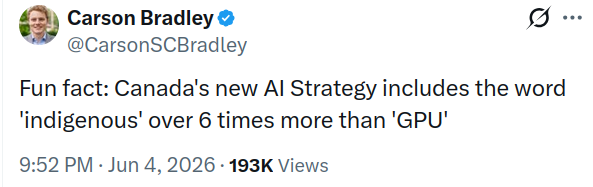
Randy Boissonnault, Call Your Teepee
The people who can’t keep a water treatment plant from catching fire: Mark Carney says Canada will build new data centers in full partnership with indigenous peoples.
Things You’re Gonna See On The CBC
The CBC is standing by its reporting on a self-described human rights tribunal that is “indicting” the Canadian government for alleged abuses and “genocide” in the residential school system, despite failing to note that the group’s lead prosecutor has a suspended law licence and that the organization has no legal authority in Canada.
Your Moral And Intellectual Superiors
Always interesting to see how Canada’s "unmarked graves" social panic (2021-2026) looks to people outside our borders https://t.co/z5xjSndoHT
— Jonathan Kay (@jonkay) June 1, 2026
Small Victories
I’d rather that the Supreme Court ruled that aboriginal title doesn’t apply to government land either, since the acceptance of that precedent has already saddled taxpayers with billions of dollars in undeserved payouts, but at least someone finally drew a line in the sand.
The Supreme Court of Canada has upheld a ruling that Aboriginal title cannot be declared over private land, in a decision the federal government says will have an impact on the Cowichan Tribes case in British Columbia.
Smoke Signals
When Winnipeg police laid out the largest drug seizure in Manitoba history last week — more than 525 kilograms of cocaine, methamphetamine and fentanyl, 14 firearms, and $825,000 in cash — the bricks of narcotics and the row of guns drew the cameras. A quieter item in the evidence locker did not: 1.35 million contraband cigarettes.
To a former senior Ontario Provincial Police (OPP) organized crime investigator who has spent decades tracing the illicit tobacco trade, that detail was perhaps the most revealing thing in the multi-agency probe. Illegal cigarettes, he told The Bureau, are the connective tissue of the networks that flood hard drugs from China and Mexico into Canadian communities. If tobacco produced on Indigenous lands fueling fentanyl production does not register with citizens, he says, the one billion in tax dollars lost every year in Ontario alone should at least raise eyebrows.