Category: New Governor

The Libranos: Business As Usual

Stephen Taylor: How Brookfield lobbies Ottawa without Brookfield

The parent is quiet because the screen makes its silence necessary. The work happens at the subsidiary level, where the lobbying registry does not automatically link a company like “Westinghouse Electric Canada LLC” or “Brookfield BRP Canada Corp. DBA Evolugen” back to the Brookfield parent. A member of the public searching the registry for “Brookfield” would find an active but dormant consultant registration and nothing else. You have to know the corporate structure to find the activity.

The Libranos: Partners In Crime

The Adopt-A-Journalist pilot program was a resounding success. Now, it’s time to buy the rest of them off.

The government is doubling down on its support for the Canadian news sector by proposing to massively expand the Labour Journalism Tax Credit to include television and radio news. The announcement in yesterday’s Spring Economic Update didn’t garner much attention, but it will mean tens of millions of dollars for Bell, Rogers, Corus and other broadcasters. The tax credit is the most important support for those who meet the standard of being a Qualified Canadian Journalism Organization (QCJO) as it provides a 35 percent refundable tax credit up to $29,750 per employee. The government paid out roughly $71 million for just over 3,000 journalists in 2024, but that would likely double if coverage extends to television and radio news.

Canadian Competitiveness

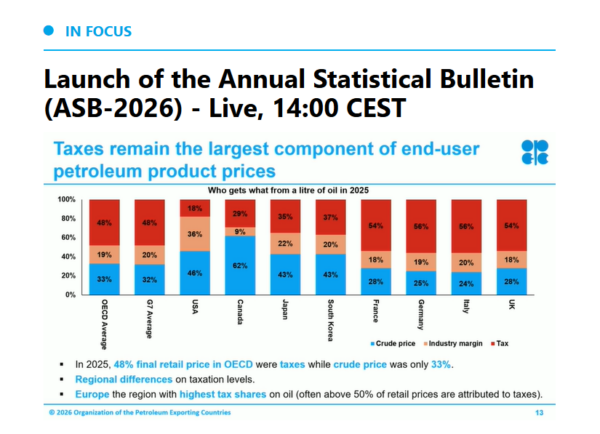
As I was sifting through the influencer pulp this morning on the UAE decision to leave OPEC (and decided to sit it out), I stumbled upon this chart from the just released OPEC Annual Statistical Bulletin.

Let’s zoom in.

Blue is crude price, red is tax, coral is industry profit margin.

Related.

Is Our Diversities Learing?

Keene Bexte;

Our Managing Editor, Cosmin Dzsurdzsa has obtained a secret, internal bombshell report from the Canadian Forces Leadership and Recruit School. This 15 page document exposes shocking military secrets that Mark Carney is not sharing with the public.

One critical platoon was revealed to be 83% non-citizen residents – many in Canada for just three months – and it descended into total dysfunction.

Cultural infighting between Cameroonian and Ivorian factions within the CANADIAN Armed Forces.

Repeated allegations of racism flying between squabbling tribes.

A shocking lack of respect toward female members and instructors.

Graduation rate? A catastrophic 48%.

“The National Observer record speaks for itself “

Yes, it does;

A Vancouver climate news site, the National Observer, is the nation’s heaviest user of Department of Canadian Heritage grants, newly-disclosed records show. The “independent news site” received more than $1.3 million in taxpayers’ aid to cover the equivalent of 23 employees’ salaries while its CEO served on a volunteer board responsible for approving grants: “The National Observer record speaks for itself regarding our independence from any government.”

@bcblueconYup. Tides owns the National Observer for example: Publisher Linda Solomon Wood

Gradually, Then Suddenly

How are them elbows working out for ya?

Rogers Communications is offering voluntary departure packages to roughly half of its employees, in what is believed to be the largest round of buyout offers in Canada’s telecom sector in recent years.

Rogers said about 50 per cent of its roughly 25,000 employees across numerous business divisions will be offered packages, according to the Globe & Mail.

“We are taking steps to adjust our cost structure to reflect the business realities of the current environment. As part of this, some teams have chosen to offer voluntary departure and retirement programs to give some employees the choice to decide whether they’d like to stay with the company or begin a new chapter,” said Rogers spokesperson Zac Carreiro in the report.

New Governor, Same As The Old Governor

Great moments in Liberal economics: This is akin to a man who’s in debt borrowing hundreds of thousands to buy stocks.

Prime Minister Mark Carney will announce plans to create a sovereign wealth fund Monday, a day ahead of the spring economic statement, according to a senior government official.

The fund will be used to invest alongside the private sector in major projects that the Carney government has committed to building over the coming years, and the government also plans to create a way for individual Canadians to contribute, the official said.

Mr. Carney will lay out the details of the fund at an event Monday in Ottawa, while Finance Minister François-Philippe Champagne will have a separate event in Montreal.

The Globe and Mail is not identifying the official as they were not authorized to publicly comment on the pending announcement.

A sovereign wealth fund is a state-owned investment account that is typically independently managed.

Maybe they should name it something like “Canadian Infrastructure Bank”.

New Governor, Same As The Old Governor

All I know about cutting trade ties with the US is how well it worked out for Cuba.

Under Mark Carney, Canada’s posture toward the United States has shifted with surprising speed—less theatrical than Trump’s, but no less consequential. In April 2025, we were promised a renewed economic and security partnership. By the summer, we were told the existing deal was already the best possible outcome. Fast forward to April 2026, and suddenly our reliance on the U.S. is framed as a strategic weakness. All of this, notably, after months without meaningful engagement or negotiation.

That messaging matters. Especially when delivered in a widely viewed address suggesting that CUSMA—the backbone of North American trade—is somehow on life support. It leaves industry asking a basic question: what exactly is the plan?

The Libranos: To Boldly Launder

Everything you need to know about the ‘spaceport’ in Nova Scotia

I write this from my home in Canso, Nova Scotia, less than three kilometres from Maritime Launch Services’ “launch pad.”

Little more than a concrete shed pad at the end of a gravel road with two sea cans, Maritime Launch’s “Spaceport Nova Scotia” was recently lavished $20 million a year for 10 years by our federal government to further develop its facility, and as it now boasts to investors — send rockets into space on “150+” launch days a year.

Seems legit.

Let’s start at the beginning with the company itself, an American-Ukrainian start up that called itself Maritime Launch Services, and registered with Nova Scotia Joint Stocks in October 2016. […]

A project of the Ukrainian Space Agency, MLS was created specifically to launch the Cyclone 4M, a rocket designed by Yuzhnoye, the Ukrainian agency’s design and business office.

Despite claims for years that they were “maturing the launch vehicle,” this rocket has never been built.

The Ukrainian Space Agency suffered a series of losses due to ongoing scandals, mismanagement, malfeasance and corruption Among them was a spectacularly failed 10-year project in Brazil, and allegations of deals with North Korea, a breach of contract case with Boeing that would cost them USD $200 million, and the theft of over $10 million from Export Development Canada funds provided in a deal with MDA, a scam that would span 2011-2017.

Despite this history, in 2017 the Government of Canada, including then President of the Canadian Space Agency, Sylvain LaPorte, signed an agreement to “co-operate in space.”

Read the whole thing.

@TraceyKentIt gets worse. Their entire FB page is promo shots of endless Liberal politicians and CGI pics of non-existent space travel

Faint Hope

So Canadians rewarded Carney with a majority government so that he can try to backfill a hole previously created by his own party?  Note that this is merely a discussion forum as opposed to the implementation of any actual business plans. The mind boggles.

A recent report from RBC says that last year was Canada’s first to attract more than $100 billion in foreign direct investment since 2015.

More than $1 trillion in foreign investment exited the Canadian economy between 2015 and 2024, what the report calls the “largest capital exodus in Canadian history.”

Navigation