We are governed by a secret cabal of our enemies.
Without legislative approval or a public mandate, the BC NDP government—apparently enabled by the federal government—is negotiating a secret agreement with a tiny, remote Indigenous community that aims to recognize legally unproven Aboriginal title, transfer lands, share revenue and cede unprecdented governance authority over 11 per cent of the province in one of Canada’s most mineral-rich districts, containing an estimated value of known deposits exceeding C$1 trillion.
That’s trillion with a ‘t.’
The end goal of the so-called “foundation agreement” is the recognition of Tahltan Nation rights and title over “Tahltan territory,” defined repeatedly as its entire legally unproven territorial claim spanning 96,000 square kilometres, according to public documents and other heavily redacted files obtained under a Freedom of Information request by the Public Land Use Society.
“The [foundation agreement] negotiations will be based upon recognition of Tahltan Aboriginal Title and Rights in Tahltan Territory,” reads a 2020 “shared prosperity agreement” that defines the geographic area as “the traditional territory identified by the Tahltan.”
Tahltan’s territorial claim spans an area larger than Portugal, including 70 per cent of the Golden Triangle, one of the richest mineral districts in Canada, which the BC Geological Survey estimated in 2021 to hold a total contained metal value of C$1.28 trillion. […]
The Tahltan Central Government is the administrative governing structure for the Tahltan and Iskut Indian bands representing two clans who together make up the Tahltan Nation with 636 people living on reserve and 2,444 registered members living elsewhere.
The most stubborn obstacle to securing recognition of Tahltan title may might not be having to prove it in court—both senior levels of government appear inexplicably eager to dispense with the constitutional standard of proof, as they did with Haida title. Nor have governments openly expressed any concern for the public interests or the usurping of its governance authority over Crown land. Rather, the biggest pushback may come from neighbouring Indigenous communities.
Via Juno News.


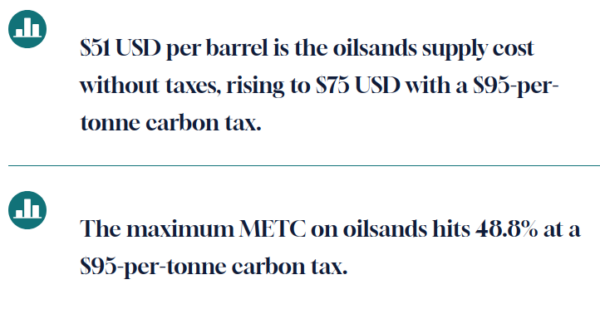 Canada’s industrial carbon tax pushes the cost of producing a marginal barrel of oilsands crude to $75 USD (at $95/tonne carbon tax)—well above what new projects in Texas or New Mexico face—stripping away the tax advantage Alberta needs to attract energy investment, according to a new Fraser Institute study by Jack Mintz, president’s fellow at the University of Calgary’s School of Public Policy.