Going Bust?
About 10 years ago I visited Monette Farms and I was intrigued by their aggressive business model. But now that a lot of their debt has to be refinanced at much higher interest rates, their creditors are knocking at the door. I can’t help but think that they’re not alone.
…company founder Darrel Monette put land up for sale to generate cash. His largest creditor, a syndicate of lenders led by Scotiabank, worked with him time and again to try to keep the Saskatchewan-based farm afloat.
It didn’t work.
Monette didn’t sell enough land, and the syndicate loan, originally $950 million with $830 million outstanding, came due April 15. Monette owes about $905 million in secured debt, and the nearly 500,000-acre operation faces massive restructuring if it hopes to survive.
Canada Strong
Gradually, then suddenly: Canada’s top general is shutting down a key operation keeping avalanches under control along the Trans-Canada Highway in the Rocky Mountains because of “significant resource pressures,” according to a letter obtained by the Ottawa Citizen.
Borrow Some More, Daddy!
Judging by the headline, you’d think that the United States was the only country facing this problem. It would be difficult, in fact, to find a nation that isn’t looking down the barrel of the same gun. Aside from Milei in Argentina, it would be just as difficult to find a government willing to turn down the spending taps in any meaningful way.
As of Tuesday, government debt held by the public is about $31.27 trillion, according to the US Treasury. Meanwhile, the US nominal gross domestic product (GDP) from April 1, 2025, to March 31, 2026, was an estimated $31.22 trillion, according to new Commerce Department data released Thursday.
What’s The Opposite Of Diversity?
Hundreds of universities are at risk of going out of business. Students and parents are voting with their feet.
“There are a large number of institutions that provide zero value”.
“The education is not being rewarded in the labor market”
“If you come out of school with… pic.twitter.com/PfETgZ6bev
— Wall Street Mav (@WallStreetMav) April 29, 2026
Overdue.
Circling The Drain
Two notable takeaways from Newfoundland’s recent budget: this is a record breaking deficit figure from an allegedly conservative government, and health care now eats up nearly half of all spending. We’ll be well on the way to two thirds before long and that will be the case for every province.
The budget forecasts a deficit of $688.5 million and a $20.8 billion net debt by the end of the 2026-27 fiscal year.
The province will spend $5.4 billion on health care — 42 per cent of its entire expenses — including more than $47 million to create 200 new long-term care beds.
Gradually, Then Suddenly
How are them elbows working out for ya?
Rogers Communications is offering voluntary departure packages to roughly half of its employees, in what is believed to be the largest round of buyout offers in Canada’s telecom sector in recent years.
Rogers said about 50 per cent of its roughly 25,000 employees across numerous business divisions will be offered packages, according to the Globe & Mail.
“We are taking steps to adjust our cost structure to reflect the business realities of the current environment. As part of this, some teams have chosen to offer voluntary departure and retirement programs to give some employees the choice to decide whether they’d like to stay with the company or begin a new chapter,” said Rogers spokesperson Zac Carreiro in the report.
Cubada
Ralph Goodale on Canada-US relations: "A relationship that has lasted for more than 80 yrs has come to an end. And we're now trying to build something to replace it. We need to make sure in building that replacement we are less vulnerable and less dependent than we used to be." pic.twitter.com/FG7shJ14RI
— Scott Robertson (@sarobertsonca) April 24, 2026
Who Kinew?
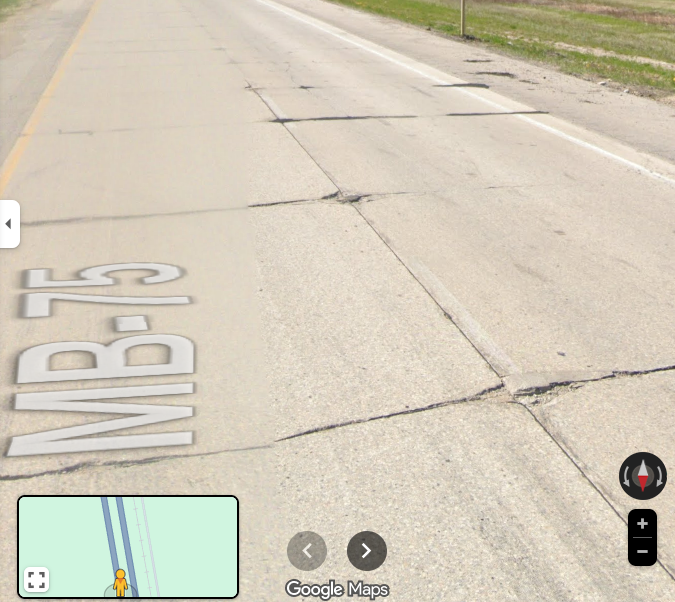
Now is the time at SDA when we juxtapose.
CTV News: Manitoba won’t put U.S. liquor on shelves until Trump drops tariffs, releases Epstein files
Google streetview: Manitoba’s primary trade artery with the US.

Update: A photo taken April 21st at the Emerson-Pembina border crossing, for the Manitoba highway deniers.
h/t Mike
New Governor, Same As The Old Governor
All I know about cutting trade ties with the US is how well it worked out for Cuba.
Under Mark Carney, Canada’s posture toward the United States has shifted with surprising speed—less theatrical than Trump’s, but no less consequential. In April 2025, we were promised a renewed economic and security partnership. By the summer, we were told the existing deal was already the best possible outcome. Fast forward to April 2026, and suddenly our reliance on the U.S. is framed as a strategic weakness. All of this, notably, after months without meaningful engagement or negotiation.
That messaging matters. Especially when delivered in a widely viewed address suggesting that CUSMA—the backbone of North American trade—is somehow on life support. It leaves industry asking a basic question: what exactly is the plan?
Circling The Drain
Unaffordable housing creates a lot more problems than declining provincial education funding as families move to cheaper abodes. But then again, the same people bemoaning this problem are likely the same ones who cheered for zero percent interest rates that sparked the housing bubble to begin with.
Families aren’t just moving to a different neighbourhood; they’re leaving the region entirely. Driven by a cost of living that has become unsustainable for many young parents, the “Surrey dream” is being packed into moving trucks and headed further east — out of the valley and, in many cases, out of the province.
The Canadian Investment Drought
Shocked, I tell you! Shocked! But I’m sure a Liberal majority will make it all better.
Small-business exit rates hit 5.6 per cent in the second quarter of 2025, while the entry rate fell to 4.8 per cent in the fourth quarter. The ratio between business starts and closures is among the worst since the COVID-19 pandemic, CFIB said in a report.
Gradually, Then Suddenly
Related: “Roughly 40% of Canadians whose underlying ability/human capital would place them in the top 1% of Canada’s income distribution if they had stayed — now reside outside Canada.”
Going Bust
For over a decade, Canadian real estate markets and their lenders have acted like the housing price ratchet could only go one way: up. Now they’re finding out that the price ratchet can go the other way too.
The result was a sudden stampede of buyers who triggered an unprecedented run-up that put the average sale price of a traditional, ranch-style, Brantford bungalow close to $900,000 at the market peak in 2022 compared to a mere $300,000 or so in 2016.
Flash forward, and the average home in Brantford in February sold for $625,135, according to the Canadian Real Estate Association, a 30 per cent drop from 2022 that has saddled homeowners there with an unexpected housing crisis that Canadians…are all too familiar with today.
Comedic Governance
When I first saw the headline, I thought maybe my provincial government was finally seeing the bigger picture. But again I was disappointed. We’re still at the “definition” stage of micromanagement.
Manitoba Premier Wab Kinew says his government is working on the definition of a grocery store as it considers where to apply a tax cut on food.
Circling The Drain
Nine years to fully end door to door mail delivery? There’s obviously no sense of urgency despite the mounting losses. And no obvious outrage among taxpayers. That’s Canada for you.
Joël Lightbound, minister of Government Transformation, Public Works and Procurement, said last fall that the process to eliminate most door-to-door service would take about nine years, with most of it expected to be completed in the first four.
Canada Post lost $841 million before tax in 2024.
The Vibe Economy
It’s my sense that interest rates are going to head down, not up, as the economy sours. While energy prices might be going up, their effect can be offset by slumping demand as businesses halt energy intensive projects. But in any case, David Rosenberg is spot on about there being no “vibrancy of demand” in the Canadian economy.
“But we are in a totally different orbit than we were back then,” Rosenberg said. “Where is the vibrancy of demand growth in a Canadian economy? It is nonexistent.”
First-quarter growth will likely come in below one per cent annualized, according to the latest gross domestic product data, well off the Bank of Canada’s forecast of 1.8 per cent, and core inflation has inched ever closer to the central bank’s two per cent target, though headline inflation is expected to accelerate on higher energy prices.
Tax Free Rotisserie Chicken
An unremarkable budget from what has become a have-not, unremarkable province.
Kinew, in a post on social media, says everything from rotisserie chicken to salads would be free of the provincial sales tax of the budget passes.
The government has promised to balance the budget by the 2027-28 fiscal year but has missed its annual targets so far.
Red Ink Aplenty!
Saskatchewan’s budget deficit will be up to a billion before long at this rate. And that’s for a resource rich province.
Finance Minister Jim Reiter tabled the 2026-27 budget on Wednesday. It projects a $819-million deficit this year with more deficits in the years that follow.