
SDA Exclusive. The two will be going to a province wide newspaper on first of January, 2017.
Per my source – CBC had the story of eight jobs disappearing in the Leader Post, but the word is that Les McPherson, Cam Fuller and some other senior SP people are being bought out and will be done.
Developing…
Crooked Justin
Foreign funds paid to Trudeau Foundation:
2015: $428,265
2014: $ 53,018
2013: ZERO
2012: ZERO
A trend? #cdnpolihttps://t.co/m1Pdf6YDic— Vivian Krause (@FairQuestions) November 24, 2016
Related! (h/t John Galt)
Those Moderate Muslims!
“Fake News”
Just another way of saying “it’s the voters who were stupid”.
Over the past week, the consensus Unified Theory from the media is this: Blame fake news. This explanation started with BuzzFeed’s analysis of Facebook over the past three months, which claimed that the top 20 best-performing “fake news” articles got more engagement than the top 20 “mainstream news” stories.
Nowhere in BuzzFeed’s article does author Craig Silverman demonstrate a correlation between that data and voter persuasion, let alone a causal connection. Instead, the analysis offers a look at how articles of potentially questionable provenance could go viral quickly. That leaves a lot of questions begging in the “fake news threw the election” explanation.
Re-education will be necessary.
Now Is The Time At SDA When We Juxtapose!
On the left: What @cbcasithappens says when they think Hillary will win the election.
On the right: What they say when Trump actually wins. pic.twitter.com/PIMSTDZjAj
— John Groves (@jfgroves) November 25, 2016
Reader Tips
Your tips are welcome in the comments.
Allahu Special!
It's a special kind of evil to go on a murderous attack in a retirement home for nuns. A despicable crime. https://t.co/kwYyRYAWfT
— Jason Kenney (@jkenney) November 25, 2016
Frankly, My Dear
Let’s start here, even though this should go without saying: We don’t think that all black people are inherently abusive or dangerous. Plenty of black people aren’t.
There are black people that we love very much – black people around whom we feel mostly safe and unthreatened; black people who, in fact, support, respect, and take care of us on familial, platonic, romantic, and sexual levels. Not every black person has violated us individually; for most of us, there are plenty of black people that we trust.
We know what you mean by “not all black people” – because on a basic level, we agree with you.
But the socialization of black people is such that even a good black person – a supportive black person, a respectful black person, a trusted black person – has within him the potential for violence and harm because these behaviors are normalized through black culture.
“Trump presidency poses ‘existential’ economic threat to Canada”
We already have Trudeau. They can’t kill us twice.
And… They’ve Learned Nothing.
The media spin on President Elect Donald J. Trump’s sit down with the New York Times on November 22, can only be described as dishonest. Trump appears to soften stance on climate change & Donald Trump backflips on climate change & Trump on climate change in major U-turn
The ‘fake news’ that Trump had somehow moderated or changed his “global warming” views was not supported by the full transcript of the meeting.
Reader Tips
Your tips thread is open.
The Company She Keeps
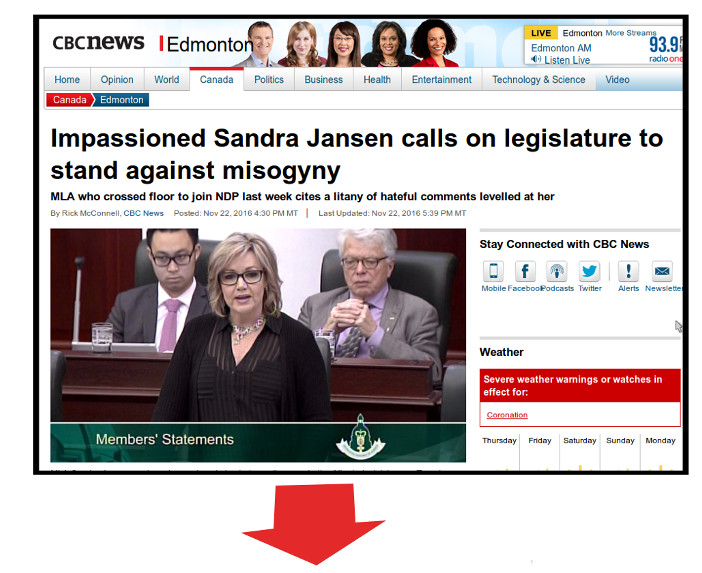
Sandra Jansen also follows him. Vile comments and harassment are a one way street, I guess @RobBreakenridge @SheilaGunnReid pic.twitter.com/g1J2E7BFu8
— Holly Nicholas (@ilikerox) November 24, 2016
The Company They Keep
That Borderless Utopia
Heather Mac Donald on open borders and indiscriminate immigration:
Demographics were now driving immigration policy, not vice versa. State and city jurisdictions with large numbers of illegal aliens passed law after law to minimise or eliminate the distinction between legal and illegal status. The most egregious of those policies — and the ones that jump-started Trump’s campaign — were so-called sanctuary laws. These rules forbid state and city employees to co-operate with the already listless efforts of federal officials to enforce the immigration laws, shielding even convicted criminals from any possible risk of deportation.
Although local activists had complained about sanctuary policies for years, no one with power paid attention — until a young woman was fatally shot in July 2015 on the San Francisco Embarcadero by a Mexican drug dealer with seven felony convictions and five previous deportations. Kate Steinle’s murderer had recently been released from jail back onto the streets by the San Francisco sheriff, despite a request from federal immigration agents to detain him for deportation proceedings. Yet despite the belated national outrage directed at San Francisco for its sanctuary ordinance, the city reaffirmed that ordinance in May 2016 in a breath-taking demonstration of the rule that immigration demographics are political destiny — at least until now.
Reader Tips
Puppies today, 2 boys and 3 girls via C-section. Everyone is healthy but we’re having a bit of a time getting the mother to accept the pups, a not unusual circumstance with a Cesarean. What it does mean is she and they have to be under constant touch supervision lest we wake up to dead pups. An early Reader Tips and it’s going to be slow here for the next few days as we won’t be getting much sleep.

Oh, Shiny Librano!
One potato, two potato, three potato, whore.
Prime Minister Justin Trudeau was the top draw at a $1,500 Liberal Party cash-for-access fundraiser at the mansion of a wealthy Chinese-Canadian business executive in May. One of the guests at the event was a well-heeled donor who was seeking Ottawa’s final approval to begin operating a new bank aimed at Canada’s Chinese community.
The Globe and Mail has learned that wealthy Chinese businessman Zhang Bin who, with a partner, donated $1-million to the Pierre Elliott Trudeau Foundation and the University of Montreal Faculty of Law weeks after the fundraiser, also attended the event. Mr. Zhang is a political adviser to the Chinese government in Beijing and a senior apparatchik in the network of Chinese state promotional activities around the world.
Truth To Power
Now is the time at SDA when we juxtapose!
CBC, November 21st – ‘Nothing to apologize for:’ Hamilton actor on Mike Pence shoutout
CBC, November 22nd – ‘All Lives Matter:’ The Tenors to sing O Canada at Grey Cup minus controversial ex-member
Here, Tell These People Something They Don’t Know About Me
Ok, one more time.
Here is what the cosmopolitan class still does not get: It’s not just Donald Trump you are making fun of it, is people outside your circle, it is the voters whose sentiments and values that have been the punch line of Hollywood’s jokes for their entire lives.
And along comes this guy who finally says enough is enough, and they like it, said retired business executive Bill Englert, of New Kensington, Penn. “Trump is standing up for the so called deplorables, intolerables and irredeemables excoriated by Hillary and the left,” he said.
At the Golden Dawn restaurant bar in Youngtown, a group of fraternity brothers, a mix of both Trump and Clinton supporters, all agreed that what people like about Trump is that he emotes strength, stands up for himself, and — most of all — irritates reporters.
There is no subtlety in the elite’s perception of the rest of the country; they don’t think you respect them, or view them as equal.
“Everybody from the 313, put your motherf***in’ hands up and follow me.”
Deep Impact
2016: The year everything changed for legacy media:
“Jared understood the online world in a way the traditional media folks didn’t. He managed to assemble a presidential campaign on a shoestring using new technology and won. That’s a big deal,” says Schmidt, the Google billionaire. “Remember all those articles about how they had no money, no people, organizational structure? Well, they won, and Jared ran it.”
The Tolerant Left
Peaceful transition of power: “I’ve had people talk about shoving a gun in my mouth and blowing my brains out. And I’ve received dozens and dozens of those emails. Even the non-threatening-my-life emails are very aggressive.”