Category: We Need A Famine

Let Them Eat Davos

World has 10-week supply of wheat, expert tells UN Security Council.

“This isn’t cyclical. This is seismic,” Menker said during a special meeting of the UN Security Council. “Even if the war were to end tomorrow, our food security problem isn’t going away anytime soon without concerted action.”

Before the Russia-Ukraine conflict began, the two countries supplied a combined one third of the world’s wheat exports and were in the top five exporters of corn. Coupled with widespread fertilizer shortages, supply chain issues and record droughts, the world has about 10 weeks worth of wheat on hand, Menker said.

China has been hoarding grains for over a year.

In Saskatchewan, overall spring seeding is running behind schedule, due to cold and wet.

Drip, drip, drip.

Beyond Broke

Reuters:

Beyond Meat Inc’s (BYND.O) quarterly losses ballooned, as the plant-based protein maker spent heavily on product launches and offered big discounts as it tried to guard its market share against deep-pocketed players and nimble upstarts.

The company’s stock slid 20% in extended trading on Wednesday, as Beyond Meat reported a gross margin of 0.2% for the first quarter ended April 2, a 30 percentage point slide from a year earlier.

They got millions worth of free product placement in the news cycle, and people still won’t eat the crap.

What Russia and Ukraine Mean for Your Operation

Farm Credit Services of America Webinar (March 22nd);

Fertilizers, fuels, feed grain and wheat – prices across the board have jumped in the wake of Russia’s invasion of Ukraine. What will happen going forward? To help you navigate these volatile and uncertain times, we offered a special edition webinar featuring geopolitical expert Peter Zeihan and his insights on what world events mean for U.S. agriculture, including what happens when food inputs are not only more expensive but also scarce, how an integrated world market changes when systems break down, and what disruptions in food production and transport mean for producers and consumers.

This video will go offline in a day or so, so if you’re interested watch it now.

Update: I posted this link in advance of watching the presentation. This is essential viewing for the broader perspective of the current and future risks to the global agri system.

I just had a thought part of the way through this — the era of converting food producing acres to fuel may soon go on hold. Not good news for all those canola crushing plants in the works. If anyone out there can download and save this, let me know. I’ll rehost it elsewhere.

h/t Snagglepuss

“Organic” Is The Latin Word For “Grown In Pig Shit”

Sri Lanka has announced compensation for more than a million rice farmers whose crops failed under a botched scheme to establish the world’s first 100-percent organic farming nation.

The island country is currently reeling from a severe economic crisis that has triggered food shortages and rolling blackouts as the COVID pandemic sent the tourism-dependent economy into a tailspin.

Agricultural chemicals such as fertiliser were among the imports banned last year as authorities tried to save dwindling foreign currency reserves. The restrictions were lifted months later after farmer protests and crop failures.

Where are they going to find that money?

“There will be a lot of trouble”.

China braces for effects of global fertiliser shortage;

China is largely self-sufficient in staple crops like wheat and rice, but the war is also driving up fertiliser prices.

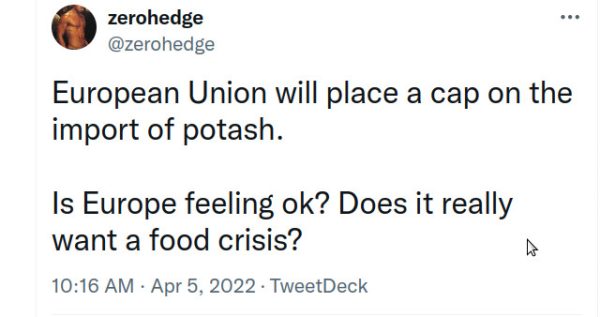
More than a half of the potash – a key nutrient for major commodity crops – that China consumes each year is imported, while customs data show that nearly 53 per cent of potassium purchases last year came from Russia and Belarus, the largest and third largest suppliers to China, respectively.

Moscow earlier this month recommended suspending fertiliser exports, while Lithuania and Ukraine have already banned transit of Belarusian potash through their ports. Ukraine, a major producer of agricultural products, also banned exports of fertilisers on Saturday.

“This will definitely have some impact [on food security],” said Xu Hongcai, deputy director of the economic policy commission under the China Association of Policy Science.

“If the trade of fertilisers and grain is interrupted, how can we do spring fieldwork? How can we hold the rice bowls of our 1.4 billion population in our own hands? There will be a lot of trouble.”

In local news: Nutrien to boost potash production by 1 million tonnes

The Virtuals vs. The Physicals

This is a fascinating article that frames the ongoing conflict in Canada, not so much as a Left/Right divide, but in a somewhat different way:

One problem remained: no amount of narrative control could move the trucks. The Virtuals needed to convince the Physicals to do that, but the towing companies in Ottawa refused to cooperate. In the end, a cornered Trudeau went nuclear and invoked Canada’s Emergencies Act for the first time in its history, seizing powers that allowed him to compel the tow companies into moving the trucks after he bussed police from around the country into Ottawa.

But the most striking new coercive measure Trudeau chose to wield was not the police crackdown. It was a government order for banks, credit card, insurers, companies and other financial infrastructure to stop “providing any financial or related services” to anyone designated as associated with the protests (including donors), effectively freezing them out of the modern economy without due process or means of appeal.

h/t David Murrell

“Organic” Is The Latin Word For “Grown In Pig Shit”

Boulder County allowing farmers to grow GMOs on open space after organic utopia didn’t materialize

Schlagel knows full well that farming public land in Boulder County is performative, visually and politically. As he wheels the John Deere around the cornfield he harvested in November, third-floor patients from UC Health’s Longs Peak Hospital on the east side of Longmont can watch him make the dust fly. He’s been willing to work within that constant judgment of Boulder County consumers.

But he’s not willing to lose his family farm raising crops that people won’t pay for.

“It’s hard for people living in the city of Boulder, and even on the western side of Boulder County, to understand what real agriculture even looks like,” Schlagel said. The crop bans were “a mandate from somebody that we’re going to transition to something better that is very naive. Because if there was something better, we would already be there.”

Now, after years of debate and voluminous series of reports and public comment, Schlagel and other Boulder County lease farmers can plant what they want. The farmers convinced Boulder County leaders that they couldn’t survive while adhering to prohibition of genetically engineered corn and pesticide coatings using controversial neonicotinoids.

Some Boulder County residents are still angry. They feel a new slate of Boulder County Commissioners sold them out after years of detailed public debate and a consensus to slowly restrict engineered farming methods. Based on staff recommendations and their own research, the commissioners voted 3 to 0 in December to reverse the scheduled bans and restore choice to the leasing farmers.

Via

Navigation