CNN- ‘Don’t Weigh Me’ cards aim to reduce stress at the doctor’s office
CBC- Need a healthy new year’s resolution? Don’t talk about weight, say health officials

CNN- ‘Don’t Weigh Me’ cards aim to reduce stress at the doctor’s office
CBC- Need a healthy new year’s resolution? Don’t talk about weight, say health officials
The full effect of lingering pandemic-related food supply chain disruptions, high inflation, labour and transportation issues, climate change and extreme weather events on next year’s grocery bills remains to be seen. But according to Canada’s Food Price Report 2022, they will only get higher.
In the latest edition of the annual report, Dalhousie University, University of Guelph, University of Saskatchewan and University of British Columbia researchers forecast a five to seven per cent increase in food prices — the highest in its 12-year history.
A family of four is expected to spend as much as $14,767 in 2022: up to $966 more than 2021, which amounts to an extra $80 a month and $20 a week.
“2022 will likely be a very difficult year for most Canadian families, unfortunately, because prices are going to rise significantly,” says Dr. Sylvain Charlebois, director of Dalhousie University’s Agri-Food Analytics Lab (AAL) and lead author of the report. “Canadians will have to accept the fact that they are going to have to dedicate a greater portion of their overall budget to food.”
In a sense, I can’t believe I’m writing this article. From a scientific perspective, this issue has been firmly settled. The answer is very clearly “NO!”. And yet, if I google “is saturated fat unhealthy?”, then seven of the top nine results proclaim with great certainty that “yes, it is”.
Here’s what the NHS says to people living in the UK: “Too much saturated fat can increase the amount of cholesterol in the blood, which increases your risk of developing heart disease.”
And here’s what the US government tells its citizens: “Eating too many foods high in saturated fats can be bad for your health. By replacing saturated fats with unsaturated fats, you may lower your risk of getting heart disease.”
To be fair, the US government doesn’t sound quite as confident as the UK health authorities. There’s a lot of “can” and “may” in that sentence. Which is actually a bit funny, when you consider that it was the US government that got the whole world to cut down on saturated fats in the first place.
Interestingly, none of the self-appointed fact checking organizations that have sprung up in recent years has yet tried to pull the NHS or the US government off the internet for spreading misinformation.
If you’re in a habit of subscribing to interesting newsletters, Rushworth’s a good one.
I have discovered a new Woke affliction, although I have no idea what it means. Civil service unions in Canada will soon be adopting it.
And battles of terminology at Woke universities.
Reuters- China calls for overhaul of farm subsidy rules under WTO
I’m not a fan of these either, but there’s nothing stopping China or any other country from dropping their subsidies and tariffs and moving to actual free and open trade. Everyone doesn’t have to hold hands you just do it.
Biden admin considering shutting down Michigan pipeline, drawing criticism and dire warnings as winter nears…
Seems like a lot of millennials are confused about their sexuality.
And Biden’s new woke ships.
Don’t laugh at the Brits, this is also happening in Canada.
More young women are getting sterilized because of global warming and racism.
Meanwhile a well known university professor thinks the unvaccinated should starve to death.
Zerohedge- Beyond Meat Implodes After Reporting Catastrophic Q3 Sales
Confirming yesterday’s observation that the market is quick and merciless to punish any and all stocks that miss expectations this quarter, moments ago (former growth stock) Beyond Meat plunged 14% after reporting preliminary net revenue for third quarter of about $106 million, missing the estimate of $134.3 million by about 30%, and a huge disappointment to the company’s prior guidance which was $120 million to $140 million.
People don’t like fake meat?
Bad enough that Trudeau was in a comic book, now apparently comic books are only for gays. Required reading material in the PM”s office.
Restauranteurs in California are getting very concerned that a meat staple of many dishes, especially in breakfast-centred restaurants, is going to be gutted from their menus in January. Beginning then, much of the U.S. pork production will be prohibited from sale in the state. In Iowa, for example, a major pork supplier for California, it is estimated only four per cent of the state’s hog production operations will be able to ship into California.
In 2018, voters passed a measure mandating more space where pigs, laying hens and veal calves were raised. Pig producers have been loath to spend the hundreds of millions of dollars required to overhaul production barns and systems to meet a law they didn’t believe would stand. The Commerce Clause of the U.S. Constitution prohibits one state from restraining trade among other states.
Many expected such a blatant move by California to set its own restrictive production standards and impose them on other states’ producers would be disallowed. But a lawsuit filed by the North American Meat Institute and joined by attorneys general in multiple states lost in California’s district court, lost at the very liberal Ninth Circuit Court of Appeals and the U.S. Supreme Court declined to hear the case.
Its not a complicated formula.
Europe’s energy crisis is spreading to the fertilizer industry and threatening the meat sector, risking tighter food supplies and even higher prices. Norwegian fertilizer maker Yara International ASA on Friday said record-high gas prices are hurting its production, and by next week will have curtailed about 40 per cent of its European ammonia output capacity. That comes after CF Industries Holdings Inc. said it’s halting two U.K. plants due to soaring energy costs.
And you’re not going to believe this… a CO2 shortage.
As well as curbing output of fertilizers crucial to feeding the world’s growing population, plant closures could further tighten supplies of carbon dioxide that’s produced as a byproduct. The gas is used to stun poultry and and pigs, and any shortages would be another headache for farms and processors already suffering from a lack of workers. The food sector also relies on CO2 for use in packaging to extend the shelf life of products such as meat and vegetables.
How Sri Lanka’s overnight flip to total organic farming has led to an economic disaster;
At the root of this economic catastrophe is a bizarre overnight flip by Rajapaksa’s government on 29 April to ban the import of chemical fertilisers and any other agrochemicals to make the Indian Ocean nation the first in the world to practice organic-only agriculture.
The result: prices of daily food items like sugar, rice and onions have soared over twice, with sugar even touching record Rs 200/kg; kerosene oil and cooking gas prices are surging; tea crops are predicted to fail in October; and there are fears over a hit to production of other crucial export crops like cinnamon, pepper, rubber, cardamom, cloves, nutmeg, betel leaves, cocoa, and vanilla.
These developments come amid a 30 basis points rise in the month-on-month inflation in the country, jumping to 6 per cent in August from 5.7 per cent in July. Its foreign reserves plunged 62% to $2.8 billion in July against $7.5 billion in November 2019. Moreover, the Sri Lankan rupee has fallen 7 per cent against the US dollar this year.
According to the Sri Lankan government, two primary reasons have driven the inflation — crashing tourism due to the pandemic, and hoarding of food items. The dip in tourism also hit the forex reserves.
The crisis has now reached such a proportion that a former army general has been appointed as ‘commissioner general of essential services’ to raid and seize food stocks. The officer has been tasked to ensure sale of products at government-named prices or on custom import costs. Sri Lanka is a net food importer.
Eco-fantasy, meet reality.
Sri Lanka is having Dictator induced food shortages thanks to organic ideology.
Video is queued up, relevant part is only the last 10 minutes.
More here. And this would be a good time to remind everyone what the Liberals have planned for Canada.
Uh oh…
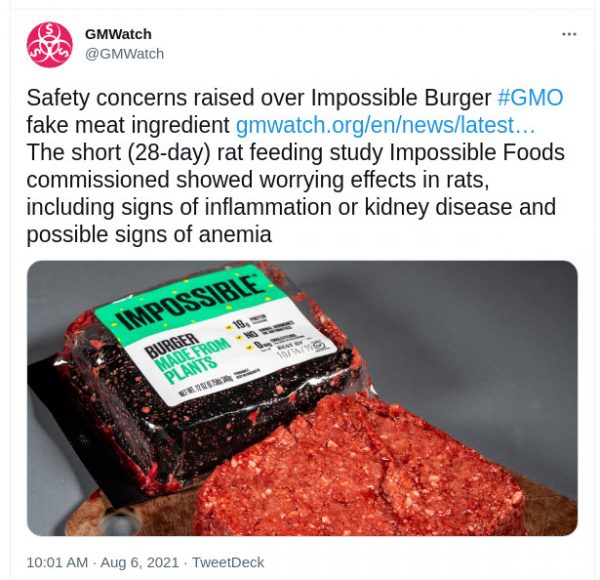
(When the anti-GMO people show up to protest the vegans, you don’t pick a side…)
June 28, 2021 — Ottawa rolls out aid program to help farmers adopt cleaner technology
“We saw a business opportunity because of all the chatter in agriculture with the expense of drying grain,” said chief executive Lyall Wiebe. His pitch to farmers was simple: You’re sitting on your own fuel source.
August 4, 2021 — Burn your scarce and expensive cattle feed

h/t KP
Breitbart -Bacon May Disappear in California as Pig Rules Take Effect
At the beginning of next year, California will begin enforcing an animal welfare proposition approved overwhelmingly by voters in 2018 that requires more space for breeding pigs, egg-laying chickens and veal calves. National veal and egg producers are optimistic they can meet the new standards, but only 4% of hog operations now comply with the new rules. Unless the courts intervene or the state temporarily allows non-compliant meat to be sold in the state, California will lose almost all of its pork supply, much of which comes from Iowa, and pork producers will face higher costs to regain a key market.
How do you destroy the breadbasket of the world?
In December 2020, the Government of Canada released A Healthy Environment and a Healthy Economy – a plan which pledges to reduce emissions from fertilizer by 30% below 2020 levels.
It doesn’t even do what they want it to do.
Policies that discourage fertilizer use can actually increase GHG emissions. A reduction in grain production in Canada through less fertilizer use, would not only have a significant negative impact on soil organic carbon, but would lead to carbon leakage to other jurisdictions
Farmers are pissed, you starve their plants, you starve their livelihood which is an extremely low margin business to begin with.
The only reason why these options are economical is because the federal government has made the other options uneconomical and is throwing $165 million at the ones it likes.
But up until recently, some farmers were hesitant to make the switch [to drying grain by burning corn stalks, straw, dust from oat hulls and wood chips]. The government’s offer to cover half the price of the upgrade has apparently changed that.
Any ideas out there as to what the true carbon footprint is for burning wheat straw as opposed to natural gas to dry grain?