On giant, motionless fan blades.


Running out of battery is as easy as running out of gas. The trick here would be to run out in a safe location. We planned to keep driving until the truck stopped moving, but we didn’t know exactly where that would be. Like gas-powered cars, some EVs have a little extra emergency range left after the gauge reaches zero.
That in mind, we struck out for the Santa Clarita River Valley north of Los Angeles, an agricultural community with only a pair of slow Level 2 wall chargers available for EV drivers and no Level 3 DC Fast chargers for 25 miles in any direction. Once we’d worn out the battery, we’d call Rivian Roadside Assistance and see what happened. Where would they tow us? How much would it cost? How long would it take to charge up enough to get home? We were going to find out.
Two people were injured Monday morning, one of them seriously, when an e-bike burst into flames in a Bronx apartment building, the FDNY said.
The e-bike caught fire just before 6 a.m. in the basement of 768 E. 187th St., a four-story building in Belmont.
Twelve FDNY units and 60 firefighters responded to the fire and were able to bring it under control around 6:30 a.m.
One civilian was rushed to St. Barnabas Hospital in serious condition but is expected to survive.
Germany is facing several tough years due to a combination of transitioning to sustainable energy sources and the rising costs of energy, warned Germany’s Green Economic Affairs Minister Robert Habeck.
The federal minister, who has long called for a radical energy policy change, said that Germany faces “five tough years ahead” and revealed the country will have to borrow to support companies’ energy costs or lose their industry.
Ford Motor Co.’s is throttling back on plans to ramp-up electric vehicle production, pointing the finger at a price war for battery-powered vehicles.
The automaker on Thursday said it would need another year to meet a year-end target to reach an annual production rate of 600,000 EVs, which it now expects to reach in 2024. Ford also abandoned plans to be making 2 million EVs a year by the end of 2026.
It now expects to see losses from EVs hit $4.5 billion this year, up from an earlier estimate of $3 billion. That’s more than double the $2.1 billion the company lost on EVs last year.
Voting with their wallets: Why EVs Are ‘Piling Up’ at Dealerships, Despite Massive Taxpayer Subsidies
[T]here are days like these when I’m not thinking renewables, wind turbines, solar or subsidies at all, and danged if they don’t pop out of the woodwork and smack me right upside the head.
Like this infuriating – and that’s the only word – email I got from Florida Power & Light. It’s chirpy, it’s Green, and it’s kinda pissing me off the more I think about it.
1) Data indicates that future demand for oil and gas is UNDERESTIMATED, while demand destruction is HYPED.
2) Global energy demand is increasing, making decarbonization more difficult to achieve, and the process of replacing fossil fuels slower.
3) Despite massive spending on renewables in the last two decades, fossil fuels remain the dominant source of energy in the world, even in Europe.
4) Coal remains the dominant source of electricity in India and China.
5) Oil is rarely used in power generation in the OECD, China, and India. Doubling or tripling solar and wind energy sources will have a very limited impact on oil demand. However, the failure of renewable energy, and consequent power shortages, will have a significant impact on oil demand.
6) As LNG prices reached a record high in 2022, oil use in power generation increased. The level of substitution among various energy sources last year was unprecedented.
Other than that, the fossil fuel industry is finished.
Gem Hunters Found the Lithium America Needs. Maine Won’t Let Them Dig It Up
Maine has some of the strictest mining and water quality standards in the country, and prohibits digging for metals in open pits larger than three acres. There have not been any active metal mines in the state for decades, and no company has applied for a permit since a particularly strict law passed in 2017. As more companies begin prospecting in Maine and searching for sizable nickel, copper, and silver deposits, towns are beginning to pass their own bans on industrial mining.
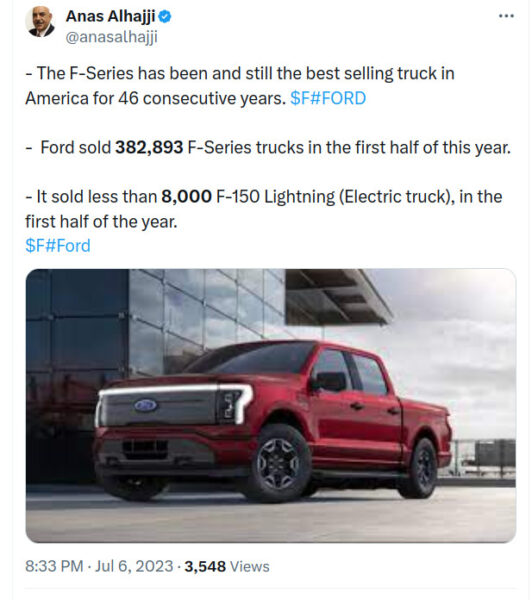
It couldn’t possibly be its complete and utter uselessness, no not that: Ford Slashes Price of Electric F-150 as Demand Weakens
Ford Motor on Monday reduced prices of its F-150 Lightning electric pickup truck by between $6,000 and nearly $10,000, the latest sign of sluggish demand for electric vehicles.
The price cuts come as inventories of unsold electric vehicles are rising on dealer lots, and follow several rounds of discounting by Tesla, the dominant seller of electric cars.
Ford is lowering prices after it temporarily halted production of the truck this year to upgrade its assembly line and increase output. By the fall, the company expects its Rouge Electric Vehicle Center near Detroit to be able to churn out 150,000 Lightnings a year, triple its current production capacity.
Competition in the electric vehicle business is growing more intense. Tesla said on Saturday that it had started producing its much delayed Cybertruck pickup, and General Motors is expected to soon begin delivering an electric version of the Chevrolet Silverado truck.
Ford began making the Lightning in the spring of 2022 and raised prices several times by a total of around $20,000, citing increasing cost of raw materials for its batteries.
In 2021, Jeremiah Thoronka was making a name for himself in clean-energy technology. The then 21-year-old Durham University masters student had invented a device that uses kinetic energy from traffic and pedestrians to generate electricity. It certainly sounded groundbreaking. In a pilot project in Thoronka’s native Sierra Leone, two devices had apparently provided free electricity to 150 households and 15 schools.
Thoronka’s work clearly impressed awards panel judges. In 2021, he picked up the Commonwealth Youth Award and the Global Student Prize, which was presented to him by filmstar Hugh Jackman at a virtual ceremony, broadcast from the UNESCO headquarters in Paris. Thoronka was the man of the moment. There was a profile by the BBC, an invitation to give TED talks and, in May 2022, an audience with the pope. He was celebrated as a green-tech innovator, someone setting a clean-energy example for the world to follow.
The accolades have continued to flow. Last month, at the Green Tech Festival in Berlin, he won the Youngster Green Award for 2023. It was this that prompted German journalists to ask if it might all be a little too good to be true. They contacted the organisers of the Youngster Green Award and Greentech Festival to find out a bit more about Thoronka’s pilot project. After all, it sounded incredible. But the organisers said that wouldn’t be possible because the pilot had since been dismantled. They asked if the device was being used anywhere else, and were told that it wasn’t. One journalist even asked if there were any videos, blueprints or other documentation of this unprecedented breakthrough. Again, nothing was forthcoming. In fact, no one could tell journalists much about the device or the pilot project at all.
It seems the Youngster Green Award and Greentech festival organisers, and potentially others, have been willing to take Thoronka’s achievement entirely at face value. Perhaps the pilot was a success; perhaps it wasn’t.
That no one really knows – or cares to know – is telling.
When they tell you who they are, believe them. “This really isn’t about them driving an electric car,” Morano said, highlighting how this is a top-down decision not based on popular demand. “This literally is — the banning of gas-powered cars — is being done just like a COVID lockdown without a vote.”
One of P.E.I.’s biggest provincially owned wind farms is operating at less than 40 per cent of its design capacity.
The wind farm at Hermanville, near the eastern tip of the Island, came online with 10 turbines at a cost of $60 million in 2014.
On Tuesday, the P.E.I. Energy Corporation said only four of those turbines remain functional — with no reason given as to why.
“It’s something that needs to be rectified quickly, because it’s standing in the way of our goals,” said Steven Myers, P.E.I.’s minister of environment, energy and climate action.
Just put your lips together, Steve – and blow.
We are inundated with claims about the “energy transition.”
In February, E&E News, reporting on the State of the Union speech said, “President Joe Biden laid out his vision for the energy transition Tuesday night.” In March, a reporter for Politico declared “The U.S. energy transition is well underway.”
Also in March, during a speech at the CERAWeek conference in Houston, Energy Secretary Jennifer Granholm said that “As this transition progresses, our energy mix will change.” Or consider the March 9 press release from the White House, which said “The Administration is continuing to implement the Inflation Reduction Act, which is already galvanizing our clean energy transition and making clean and energy efficient technologies more affordable for American families.”
I could list many more examples like the ones above. But the hard truth is this: the energy transition isn’t. The numbers from the just-released Statistical Review of World Energy show, once again, that despite rapid growth in wind and solar, those two forms of energy are not even keeping pace with the growth in hydrocarbons. That’s true both globally and in the U.S.
Related: Where has the wind gone?
To be fair, the fewer they sell, the less money they lose.
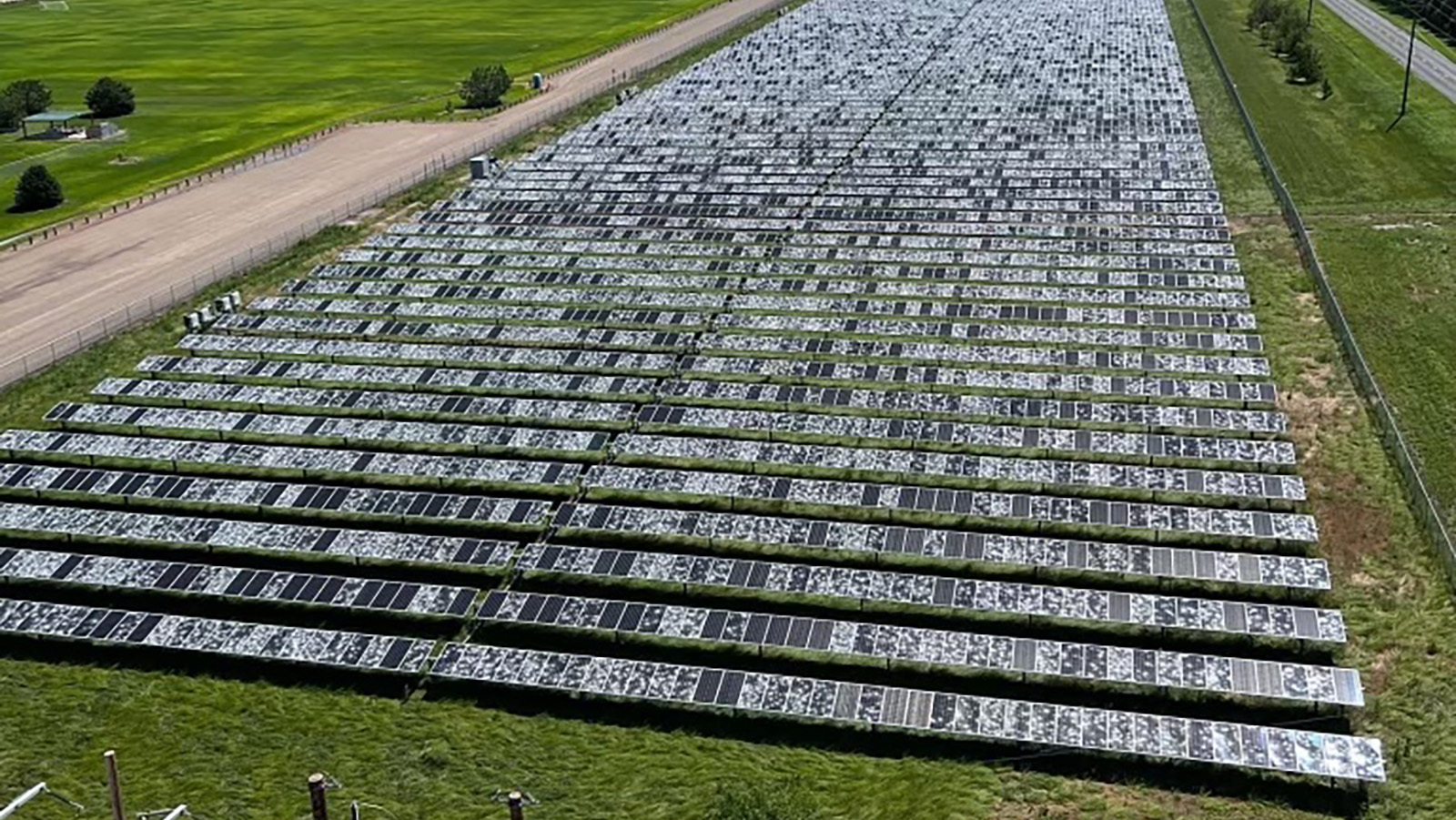 Miraculously, the pumpjacks emerged unscathed: Baseball-sized hail took out a solar farm in Scottsbluff, Nebraska, on Friday. The hail shattered most of the panels on the 5.2-megawatt solar project, sparing an odd panel like missing teeth in a white smile.
(h/t Lee M)
Scholz’s three-party alliance agreed on an ambitious agenda to decarbonize the European Union’s biggest economy: getting coal out of the electricity system faster, filling the autobahns with electric vehicles and weaning households off natural gas heating.
Those goals are starting to look ever more distant as Germany’s political mood shifts. First, Russia’s invasion of Ukraine turned the energy market upside down, forcing a dash to replace pipeline gas from Siberia and delaying the phaseout of coal. […]
Polls show Europe’s electorates still broadly support net zero goals, but faced with the pressure of higher inflation, that doesn’t mean they’re on board with the climbing costs of making the switch to a greener economy.
Germany’s right-wing and climate-skeptic AfD party has overtaken Scholz’s Social Democrats in popularity. In the UK, Rishi Sunak’s government is backtracking on the climate promises made by Boris Johnson. And France is reeling from riots that are likely to make the climate less of a priority.
The green revolution faces turbulence in Germany and beyond.