Category: Alternative Subsidy

Shocked, I tell you! Shocked!

If Rodriquez literally could not see this coming, he’s not fit to fill the role of municipal dogcatcher, much less a federal cabinet post. Either that, or this was the desired outcome and he’s feigning indignation.

“Well, Meta, I always said it was complicated; Google we still have conversations as recent as this morning,” Rodriguez told CTV’s Power Play Thursday afternoon. “I’m a bit surprised by Google’s reaction.”

What’s more surprising about this mainstream news item is that, for once, it solicited comments that were actually critical of the government:

“The government made a big bet, seemingly just based on the notion that somehow this was all just a big bluff; I don’t think it read the room,” he said. “I don’t think it fully appreciated the current circumstances and it put a fundamental principle of the internet – the notion of free flow of information through linking – at risk.”

We Don’t Need No Flaming Sparky Cars

David Harsanyi;

The left likes to treat skeptics of electrical cars as if they were Luddites. Truth is, making an existing product less efficient but more expensive doesn’t really meet the definition of innovation.

Even the purported amenities and technological advances EV-makers like to brag about in their ads have been a regular feature of gas-powered vehicles going back generations. At best, EVs, if they fulfill their promise, are a lateral technology.

Which is why there is no real “emerging market” for EVs in the United States as much as there’s an industrial policy in place that props up EVs with government purchases, propaganda, endless state subsidies, cronyism, taxpayer-backed loans, and edicts. The green “revolution” is an elite-driven, top-down technocratic project.

And it’s increasingly clear that the only reason giant rent-seeking carmakers are so heavily invested in EV development is that government is promising to artificially limit the production of gas-powered cars.[…]

In today’s real-world economy, though, Ford announced this week that it was firing at least 1,000 employees — many of them white-collar workers on the EV side. Ford projects it’s going to lose $3 billion on electric vehicles in 2023, bringing its EV losses to $5.1 billion over two years. In 2021, Ford reportedly lost $34,000 on every EV it made. This year it was losing more than $58,000 on every EV. In a normal world, Ford would be dramatically scaling back EV production, not expanding it. Remember that next time we need to bail out Detroit.

Then again, we’re already bailing them out, I suppose. Last week, the U.S. Energy Department lent Ford — again, a company that loses tens of thousands of dollars on every EV it sells — another $9.2 billion in taxpayer dollars for a South Korean battery project. One imagines no sane bank would do it. The cost of EV batteries has gone up, not down, over the past few years.

Jevons Paradox

“Every molecule of fossil fuel produced worldwide will be burned by somebody somewhere, and local efforts to restrict consumption merely relocate the enjoyment of that privilege.”

Prior to the widespread proliferation of the steam engine, mining for coal was back-breaking work. The industry relied on human and animal strength, with laborers using primitive tools, to extract the stuff from hand-dug mineshafts. The work was as dangerous as it was dirty, and fatalities were commonplace. Then, a revolution unfolded. A step-change improvement to existing steam engine design, engineered by James Watt, allowed miners to leverage machinery such as pumps, hoists, and ventilation systems to alleviate significant portions of direct human effort. Pumps that used Watt’s engines were particularly effective at draining water from deep mineshafts, making vast and previously inaccessible coal reserves economically viable. The genius of his invention was in delivering far more work per quanta of fuel.

What did these advances in energy efficiency do to the demand for coal? Did society limit itself to doing the same amount of work as it had done before, just more economically so? Quite the contrary.

This is a good one, worth sharing around. More discussion here.

Confusion Energy

World’s Largest Fusion Project Is in Big Trouble

It could be a new world record, although no one involved wants to talk about it. In the south of France, a collaboration among 35 countries has been birthing one of the largest and most ambitious scientific experiments ever conceived: the giant fusion power machine known as the International Thermonuclear Experimental Reactor (ITER). But the only record ITER seems certain to set doesn’t involve “burning” plasma at temperatures 10 times higher than that of the sun’s core, keeping this “artificial star” ablaze and generating net energy for seconds at a time or any of fusion energy’s other spectacular and myriad prerequisites. Instead ITER is on the verge of a record-setting disaster as accumulated schedule slips and budget overruns threaten to make it the most delayed—and most cost-inflated—science project in history.

Well, lots of people will have been paid lots of money to achieve mostly nothing, so there’s that.

Kicking the can

The steep rise in interest rates over the past year should be triggering a wave of foreclosures and price declines in the real estate industry by now, but if anything, the opposite is occurring. House prices are rising again in many cities. The reason is fairly straightforward: banks are simply extending mortgage terms to accommodate whatever monthly payment cash-strapped borrowers can afford. Belatedly, one of the other central planning authorities professes to be worried about this.

Canada’s financial regulator is urging lenders to tackle risks from mortgage extensions at the “earliest opportunity” as many borrowers try to navigate higher mortgage costs after the Bank of Canada’s surprise rate hike last week.

But judging by the content of the article, don’t expect any action anytime soon. The zero percent interest debacle is something that none of these folks want to actually tackle.

Feeding the voters

If Manitobans think their education taxes are already too high, they’ll seem like a bargain compared to the day that Wab Kinew introduces taxpayer financed meals (prepared by unionized staff, no doubt) for every school kid in the province.

NDP Leader Wab Kinew pledged Saturday to require all 690 Manitoba public schools to offer free meals to students before the end of the 2023-24 school year, should his party form government following an election slated for Oct. 3.

What’s even more troubling is that the provincial conservatives appear to be at least open to the idea, as opposed to roundly condemning it.

The Progressive Conservatives otherwise chose not criticize the NDP promise. Instead, the PCs repeated their contention the NDP will be forced to raise taxes in order to pay for promises if they’re elected this fall.

Now Is The Time At SDA When We Play “How It’s Going”.

How it started:

E-scooters are now available for rent in Saskatoon.

The City announced on Wednesday it has agreed to let Bird Canada and Neuron supply about 500 e-scooters for shared rentals. Personal e-scooters are still not allowed, according to a City of Saskatoon news release.

“We believe this shared e-scooter pilot will provide benefits to our community, and we look forward to seeing it in action,” Jay Magus, Director of Transportation, said in the release.

And how it’s going.

It’s Not Sleazy Being Green

No, not at all;

The unscrupulous recycling of cooking oil is a hazard China has long been all too familiar with. Merchants were once infamous for collecting waste to blend with clean edible oil, triggering scandals — and eventually crackdowns.

Today, with the waste-oil industry and westward exports booming thanks to Europe’s push for more green fuel, the questions are back.

European producers worry they’re being undercut by companies in Asia that are mixing fuels with cheaper feedstocks and mislabeling them in order to qualify for renewable-energy incentives.

There is circumstantial evidence for concern. A spike in Chinese exports to Europe over the past year has coincided with a significant increase in Chinese imports of palm waste and palm-based biofuel from Indonesia and Malaysia.

Those products have been shunned by European Union nations and their consumers, wary of encouraging deforestation and, in general, reluctant to use agricultural products for fuel.

We Don’t Need No Flaming Sparky Buses

Where I come from, we call this “gettin’ an education”.

Emile Lauzzana, the environmental sustainability director of Michigan’s fourth-largest school district, recently told the Ann Arbor Public Schools Board of Education that the district’s electric bus fleet has had “a lot of downtime and performance issues.” […]

“We’ve been learning a lot about this technology,” Lauzzana also said. “Electric buses are approximately five times more expensive than regular buses, and the electrical infrastructure, which was originally estimated to be only about $50,000, give or take, for those four buses ended up being more like $200,000.”

Lauzzana explained the district attempted to utilize “Vehicle to Grid” interconnection, which helps push energy back to the grid when buses are not being used, but that the “technology was not working.”

“I will say that I have a number of colleagues in different states who are facing similar challenges,” he added, noting the differences between electric cars versus buses. “For the school bus market, it’s been challenging for us.”

Y2Kyoto: Stop Making Sense

5 Things I Truly Don’t Understand About The ‘Inevitable Energy Transition’

In a world that is apparently getting both warmer and colder because of global warming, how is it that we can increasingly rely on non-dispatchable (i.e., intermittent, usually unavailable), weather-dependent electricity from wind and solar plants to displace, not just supplement, dispatchable (i.e., baseload, almost always available) coal, gas, and nuclear power? In other words, if our weather is becoming less predictable, how is it that a consuming economy like ours can, or should even try, predictably rely on weather-dependent resources? ERCOT exemplifies this: the Texas grid operator has around 31,000 MW of wind capacity but goes into winter expecting only 6,000 MW (just 20%) of wind farms to be available to generate electricity. Again, in the marketplace, the “alternatives” you keep hearing about are proving to be far more supplemental than alternative.

Further, good wind and solar spots are finite, based on geography, so new builds, naturally, will be forced into areas that are less windy and less sunny, lowering their already very low 35% capacity factors. And because they devour immense swaths of land, interrupting a whole host of things, that Renewable Rejection Database is mounting very quickly. If wind, solar, and electric cars too are as effective and low-cost as so many keep promising us, there would obviously be no need for government subsidies for broad adoption. Yet, there is, gigantically so. Huge amounts of taxpayer money going into this, what I call “the holy climate panacea triad,” are vulnerable to changing politics and bound to become politically untenable at some point:“Ford Is Losing $66,446 On Every EV It Sells.”

Leading The Charge

That E-transit is still on the lot in Rosetown, for anyone interested…

“This isn’t the first time Ford has reimagined the future and taken our own path,” said Ford Executive Chair Bill Ford. “We have an extraordinary opportunity to lead this thrilling new era of connected and electric vehicles, give our customers the very best of Ford, and help make a real difference for the health of the planet.”

A little over a year later, Ford Model e is a pit of losses, while Ford Blue remains the cash cow of the whole group. Ford has just released its first quarter results. For the first time, the carmaker has detailed its earnings by division.

[…]

One fact is striking: Ford only delivered 12,000 electric vehicles in the first quarter, which means that the carmaker lost $58,333 for each clean car sold during this period.

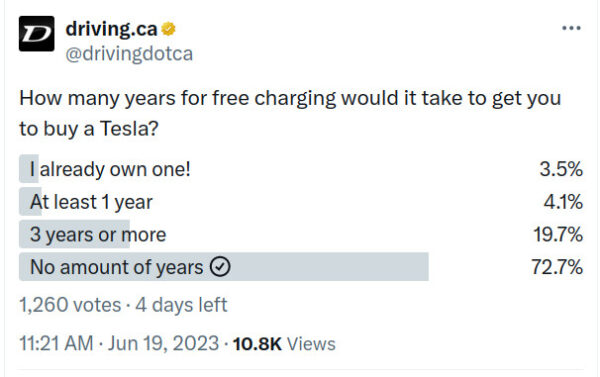
We Don’t Need No Flaming Sparky Cars

It’s not about the emissions, it was never about emissions.

The rush to subsidize and mandate EVs is animated by a fatal conceit: the assumption that they will radically reduce CO2 emissions. That assumption is embedded orthodoxy not just among green pundits and administrators of the regulatory state but also among EV critics, who take issue with a forced transition mainly on grounds of lost freedoms, costs, and market distortions.

But the truth is, because of the nature of uncertainties in global industrial ecosystems, no one really knows how much widespread adoption of EVs could reduce emissions, or whether they might even increase them. (And no, this has nothing to do with the truth / joke that Teslas are coal-fired when fueled at night in many places.) While grid realities will indeed matter more than most realize, the relevant and surprising emissions wildcard comes from the gargantuan, energy-hungry processes needed to make EV batteries. This is one of those technical issues that tends to attract slogans, simplifications, and illusions of accuracy; a better understanding requires some patience.

That’s why “whose the biggest emitter” is a losing argument. The electrification of everything is fueled by rent seeking, political donations and naked cronyism. Emissions are just the cover story.

Y2Kyoto: State Of Anorexia Envirosa

They really don’t like you, and they’re doing something about it.

In Enemies of Progress, author Austin Williams suggests that ‘the mantra of sustainability’ starts with the assumption that humanity is ‘the biggest problem of the planet’, rather than the ‘creators of a better future’. Indeed, many climate scientists and green activists see having fewer people on the planet as a key priority. Their programme calls not only for fewer people and fewer families, but also for lower consumption among the masses. They expect us to live in ever smaller dwelling units, to have less mobility, and to endure more costly home heating and air-conditioning. These priorities are reflected in a regulatory bureaucracy that, if it does not claim justification from God, acts as the right hand of Gaia and of sanctified science.

They will never admit to failure: To aspiring central planners and their enablers in the media, empirical evidence that their policies are backfiring is merely proof of the need to double down. From this, a horde of otherwise intelligent people earnestly believes that proactively destabilizing the grid is not the cause of grid instability.

Navigation