Category: Alternative Subsidy

Sparky cars for the masses!

Whoever calls this an investment with a straight face is utterly delusional. An investment implies an identifiable return related to the profitability of the company. In this case, taxpayers can kiss the money goodbye. In a race with the United States to see who can go bankrupt first, Canada is obviously not going to win, but we seem to think it shows character to die trying.

Prime Minister Justin Trudeau’s government agreed to subsidies that may top $13 billion over a decade to land an electric-vehicle battery plant by Volkswagen AG, the company’s first gigafactory outside Europe.

The money is provided through an unprecedented contract negotiated by Trudeau’s industry minister, François-Philippe Champagne. Canada will provide annual production subsidies as well as a grant toward the factory’s capital cost — effectively matching what the German automaker could have received via the Inflation Reduction Act if it had located the plant in the U.S., according to government officials.

We Don’t Need No Stinking Giant Fans

Fishermen Endangered by Offshore Wind’s Political Power

Apparently left out of this cozy relationship is one keenly affected group: more than 1 million people in the U.S. who work in the seafood industry, including 158,811 commercial fishermen. Fishermen have been shouldering longer hours and more expenses as private equity takes over their industry. Now, they are grappling with the prospect that offshore wind farms will box them out of fishing areas and further imperil their livelihoods.

For generations, East Coast fishermen have plied the same waters where turbines the height of 70-story skyscrapers will soon be spinning. The Atlantic’s Outer Continental Shelf is comparatively shallow, making it easier to anchor turbines deep in the ocean floor. Steady winds blow through the entire year. But it’s also along the shelf’s ridges that currents mix and sunlight penetrates, allowing microorganisms and fish to flourish in a complex ocean ecosystem.

Federal scientists, the commercial fishing industry and industry regulators each have sounded the alarm about potential harm to fish spawning habits and about the lack of compensation for losses suffered by fishermen who will be displaced by the offshore wind industry. The Interior Department has ignored or downplayed those warnings.

Via

Y2Kyoto: Moby Sick

Steve Milloy;

Greenpeace launched its “Save the Whales” campaign on April 27, 1975. But in the ensuing years, Greenpeace has gone full Orwell. Greenpeace is no longer interested in saving the whales. It may actually be aiding and abetting the Biden administration and the offshore wind industry in killing whales supposedly to “save the planet.”

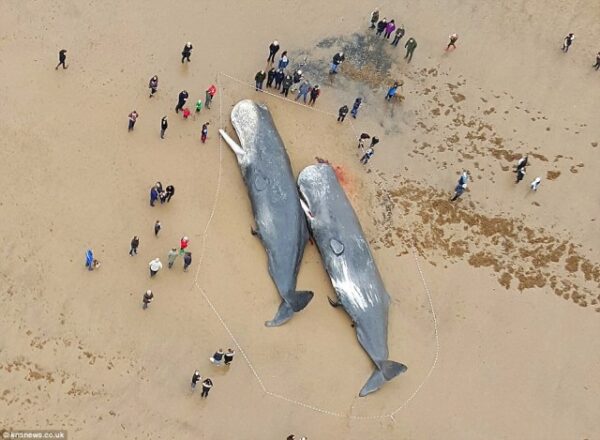
Since December, dozens of whales and dolphins have washed up dead along East Coast beaches, especially the New Jersey coast. There are no eyewitnesses to, and no video of, the deaths so no one knows for sure what is killing the animals.

The deaths are coincident, however, with an increase in activity by the offshore wind industry as it surveys locations to erect its turbines. These surveys include seismic testing that involves bouncing sounds off the bottom of the ocean. It is possible that these sounds impair sound-sensitive whales and dolphins in such a way that deaths can result.

Green activists certainly believed as much when the Natural Resources Defense Council sued the U.S. Navy over its sonar testing in a case that went all the way to the Supreme Court. The Greens also oppose seismic testing when conducted by the oil industry in its offshore activities.

The Biden administration denies that there is evidence that the whales and dolphins are being harmed by the offshore wind industry.

“At this point, there is no evidence to support speculation that noise resulting from wind development-related site characterization surveys could potentially cause mortality of whales, and no specific links between recent large whale mortalities and currently ongoing surveys,” says the U.S. Department of Commerce’s National Oceanic and Atmospheric Administration.

And not only does Greenpeace embrace the agency’s denial, but it denounces links between offshore wind seismic testing and the whale and dolphin deaths as a fossil fuel industry-funded “right-wing disinformation campaign.”

So what’s the truth?

Once again, there are no eyewitness or video. But there is some inconvenient paperwork.

As it turns out, the federal agency has actually issued permits to the offshore wind industry to kill whales, dolphins and even seals. And not just one or two members of the species.

A currently proposed permit would allow New Jersey-based offshore wind developer Atlantic Shores Offshore Wind, L.P., , a partnership of foreign-owned wind companies, to kill 42 whales, 2,678 dolphins, and 1,472 seals.

Not very green. But it gets worse.

Among the 42 whales that Atlantic Shore Offshore Wind has been licensed to kill are 13 whales that are listed as “endangered” under the Endangered Species Act. Three whales are the North Atlantic right whale, a species federal regulators are wielding to wreck the Maine lobster and groundfishing industries on behalf of the offshore wind industry.

And this is not the only such permit. There are others already issued with more on the way. Each one allows for the killing of dozens of whales and thousands of dolphins and seals. And all this permitted killing is just for the survey phase of construction. There is the actual erection of wind turbines, and their operations and maintenance still to come.

Now Is The Time At SDA When We Juxtapose!

Hydro-Quebec press release, October 25, 2022;

“We are proud to contribute to the development of this network by hosting the first charging site for heavy and medium-duty vehicles. Ideally located near the municipal garage, it will allow us to accelerate our green shift started a few years ago for the eco-responsible management of our fleet of vehicles and motorized equipment.”

CTV News, April 9, 2023:

Hydro Quebec said that roughly 300,000 residents were still without power Saturday morning following Wednesday’s ice storm.[…] Some Pontiac residents are anticipating being in the dark for upwards of a week – the longest stretch without power since the ice storm of 1998. “We haven’t even seen a truck; we haven’t seen or heard of anything,” says Thompson “[Hydro Quebec] keeps telling us to be patient because there’s several thousand people without power.”

We Don’t Need No Flaming Sparky Bricks

You don’t have to be stupid to buy into the EV claims.

America is steadily switching to electricity for its driving fuel. But the early days of EV ownership are filled with bugs and small frustrations. Even the aspects of the experience that promise to be easy aren’t always easy at first.

When J.D. Power analysts studied the experience of using public EV chargers, they found drivers frustrated with defective chargers and balky payment apps. More than 20% of public charging attempts last year ended in failure, analysts found.

But that’s OK because public charging is rare, right? The promise of electric cars includes an easy, cheap refuel at home every night while you sleep.

That’s not working out well yet, either.

But it helps.

New World Order

Terry Etam: The axis of the world is shifting.

Here in the weird West, where we set aside our vast wealth, bountiful resources, technological prowess, best-in-history medical/safety establishments, and other assorted existential victories to get into fistfights about whether more racism will eliminate racism and who can go to the bathroom where, we are used to watching ancient conflicts take place on the other side of the world, shaking our head, and wondering either “Why can’t they all just get along” or “Well that’s unacceptable, better step in.”

The weird west has long gotten involved in many of these conflicts because of, well, o-i-l. It’s been that way since the 1950s, probably longer; the west’s insatiable thirst for hydrocarbons has driven a lot of international shenanigans and weird relationships. Recall that after a gang of terrorists hijacked four planes and flew them into the US’ most fundamental landmarks on home soil, and that more than half of those terrorists were from Saudi Arabia, the US promptly and expectedly retaliated – by invading two other countries, and going for tea with Saudi Arabia. Kind of transparent, that one.

But that established hydrocarbon-based camaraderie is fading fast, and it doesn’t look like the West has a game plan in response. That’s about as far as I’ll wade into geopolitics because the whole mess is grossly complicated (who hates who again this week?), other than to point out how rapidly things are changing and how that is impacting the energy world.

More: Saudi Arabia’s Crown Prince Mohammed Bin Salman (MbS) is no longer worried about pleasing the United States as his relationships with other global superpowers including China and Russia have strengthened.

We Don’t Need No Stinking Giant Mirrors

a thread by John Lee Pettimore;

800 sq. ft. of solar panels weigh 1 ton. 2.5 lbs per sq. ft. 40-340 watt panels is what’s needed to power a typical family home. This depends on sun zone, amount of snow cover etc. Approx. cost $10,000 dollars for panels. 10K divided by 20 yrs.=$500 per yr.

There is approx. 140 million housing units in the United States. 112000000000 sq. ft. of solar panels would be needed to power just the homes excluding all industry. 4017.44 sq. miles of panels. How much mining/manufacturing do we have to do to make that amount of solar panels?

280000000000 lbs or 140000000 tons. So we know in order to make one ton (t) MG-Si (Kato, et. al) (solar wafers for solar panels) it takes 2.4 tons of quartz, 550 kg of coal, 200kg oil coke, 600kg charcoal and 300 kg of woodchips. This excludes glass, plastic, copper and aluminum.

350000000 tons of quartz, 7574000 tons of coal, 2800000 tons of oil coke, 82600000 tons charcoal, and 4060000 tons of woodchips.

So we know the industrial sector is the greatest energy end-user in the United States, reaching a consumption of some 26.9 quadrillion British thermal units in 2021.

So how much mining would we need to do for solar panels to cover the industrial sector?

We Don’t Need No Stinking Giant Fans

Via Zerohedge;

It could be argued that the basic arithmetic showing wind power is an economic and societal disaster in the making should be clear to a bright primary school child. Now the Oxford University mathematician and physicist, researcher at CERN and Fellow of Keble College, Emeritus Professor Wade Allison has done the sums. The U.K. is facing the likelihood of a failure in the electricity supply, he concludes.

“Wind power fails on every count,” he says, adding that governments are ignoring “overwhelming evidence” of the inadequacies of wind power, “and resorting to bluster rather than reasoned analysis”. […]

In his paper, Allison concentrates on working out the numbers that lie behind the natural fluctuations in the wind. The full workings out are not complicated and can be assessed from the link above. He shows that at a wind speed of 20mph, the power produced by a wind turbine is 600 watts per square metre at full efficiency. To deliver the same power as the Hinkley Point C nuclear plant – 3,200 million watts – it would require 5.5 million square metres of turbine swept area.

Money for nothing

I’m not sure who’s worse: the ones that undertake these studies, or the cheerleaders who breathlessly report only those details which promote the narrative.

For companies that rolled out the shorter work hours — whether it was one less workday a week or longer hours in parts of the year and shorter hours the rest of the time to make an average 32-hour week — revenue wasn’t affected, the findings show.

Revenue grew 1.4 per cent over the course of the trial for 23 companies that provided adequate data — weighted for the size of the business — while a separate 24 companies saw revenue climb more than 34 per cent from the same six-month period a year earlier.

Just a few questions: were these employees getting the same wage, or less? How did a shorter work week cause an uptick in revenue or is this just an unacknowledged coincidence? If revenue went up, what about expenses? Inquiring minds expect more than this drivel.

We Don’t Need No Flaming Sparky Cars

Business Insider;

Axios reporter Joann Muller said her husband took the electric car on a 1,500 mile road trip — she joined him part-way through — to see if the US is truly ready for mass EV adoption. While electric cars are becoming more prevalent, charging infrastructure isn’t quite what it should be, Muller wrote.

“We were constantly thinking about where to charge next,” Muller wrote of her experience during the trip. “It occupied our minds more than where to eat or spend the night.”

They stopped 12 times to recharge the car, which has an estimated battery range of 274 miles, over the course of the 1,500 mile, four-day journey, and that charging times were between 20 to 55 minutes.[…]

Muller said her husband drove the car alone from Detroit to Washington DC, where they met up to head to Florida. During his solo portion of the trip, he said he was so “anxious” about the drain cold temperatures would have on the battery that he didn’t use the cabin heat, choosing instead to rely on the heated steering wheel and seats.

We Don’t Need No Flaming Sparky Cars

We tried to warn them.

Here’s how much electricity prices have surged in parts of New England this winter: For some drivers of electric vehicles and hybrid cars, it’s now more expensive to charge up than to fill up.

Power rates across the region have jumped an average of 30% since last summer, while gasoline prices have receded well below their peak in June of 2022. Web engineer Matt Cain, who lives in Amherst, Massachusetts, said he ran a price comparison when his electricity bill shot up in January and found that his overall costs for utilities had climbed a whopping 50%.

“We have a Prius Prime that we normally drive around town, and we drive most of it on electricity. It’s now 50% more expensive than fueling it with gas,” he told CBS MoneyWatch.

Navigation