Author: Kate

Is There Nothing That Obama Can’t Do?

So let’s see. The president sneers at the ignorance of 15th century Spaniards when, in fact, he is the one entirely ignorant of them. A man who has enjoyed a million dollars of elite education yet has never created a dime of wealth in his life sneers at a crippled farm boy with an eighth-grade schooling who establishes a successful business and introduces electrical distribution across Michigan all the way up to Sault Ste Marie. A man sneers at one of the pioneering women in broadcasting, a lady who brought the voices of T.S. Eliot, G.K. Chesterton and others into the farthest-flung classrooms and would surely have rejected Obama’s own dismal speech as being too obviously reliant on “Half-A-Dozen Surefire Cheap Cracks For Lazy Public Speakers.” A man whose own budget officials predict the collapse of the entire U.S. economy by 2027 sneers at a solvent predecessor for being insufficiently “forward-looking.”

Related!
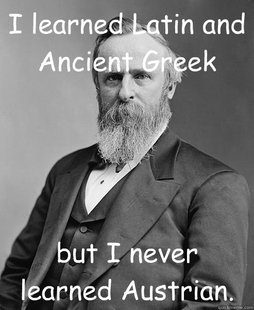
… and also related: #BarackObamasPresidentialFacts
h/t Marc

Free Ethical Oil!

Rex Murphy

Outside Fort McMurray, it is impossible to escape the furor over the Alberta oilsands. Its product is routinely described, lazily and slanderously, as the dirtiest on the planet. The Premier of Ontario, a province that owes much of its prosperity to its huge automobile industry shivers when he looks at Alberta, mutters about the dark forces of the “petro-dollar,” and implied (until he was scolded and half-recanted) that somehow Ontario’s fretful financial state is Alberta’s fault.
It’s almost a fantasy disconnect. Dalton Mcguinty can throw billions at General Motors and urge the feds to do the same, all to save the automobile industry. He ignores that four decades or more of Ontario’s prosperity wasn’t founded on windmills: It was based on gas-guzzling cars and trucks.
[…]
[H]ow easily we bite the hand that feeds us. “Environment” has become a narrow, bitterly focussed word turning exclusively on hurts or despoilations of nature, magnifying the slightest alteration or disturbance of “the natural” as an unspeakable sin.
There is another wider, larger, humane dimension to the environment — larger and more vital than any reference to landscape. That is the human and social element, the business of supplying reasonable support for workers and their families, towns and communities, and ultimately wealth for the entire nation. We owe something, it is true to the rocks and trees. We also owe something to human beings as well.

The Horror, The Horror!

OMG who would ever imagine that a government would have the audacity to provide job training for welfare recipients?!?

The B.C. government is considering a plan to help people get off welfare by flying them north to cash in on high-paying jobs in areas such as the oil and gas industry.
Minister of Social Development Stephanie Cadieux, whose ministry is involved in planning the project, said she anticipates the program will be attractive to only a “modest number of people.” She said the government will not force people into the program, or remove benefits from those who refuse to participate.
Shauna Butterwick, an associate professor at the University of B.C. and a researcher for the Canadian Centre for Policy Alternatives, has penned two reports on creating meaningful training programs for welfare recipients in B.C. She said the proposed plan appears to have a “limited view” and does not factor in the reasons why many people are on welfare in the first place. “One thing that welfare studies have found to be really crucial is that the social networks [welfare recipients] create are the one thing that helps them survive,” she said. “You would be taking them from that. Those kinds of social networks you don’t just recreate overnight. I would expect a level of isolation and alienation.”

Charles Adler & David Menzies discuss this “outrageous” idea.

In The Mail

The West Speaks – a “collection of interviews with some of the brightest minds of our time conducted between 2008 and 2012 for New English Review. These are remarkable people actively striving to defend and to define what is best in Western culture…”

The Wheels Canadians Prefer

More than half of them are not cars–will our eco-oriented do-gooders notice? And what might they do, other than try to shove a Volt, stuffed with taxpayer money, down your throat?

Canadian sales of new cars and trucks opened the year on a resoundingly positive note, Statistics Canada suggested Wednesday.
The federal agency — which collects data on monthly retail sales in dollars and in the number of new vehicles sold in Canada — found a 15.4 per cent rise in vehicles sold in January to 153,623 units from 133,146 sold in December. That’s the fastest pace in more than 15 years, economist Robert Kavcic said Wednesday in a report by BMO Economics…
Among Statistics Canada’s other findings from January; passenger car sales rose 23.9 per cent to 71,539 units on increased sales of lower-cost vehicles…

Is Niall Ferguson A True Conservative?

Not really, according to the conclusion of this review of his Civilization: The Six Ways the West Beat the Rest:


Wishing that the nations of the West retain their cultural character in historic continuity with their ancestors, reproducing their own populations, with some influx from outside, but not mass migration, is not racist (4); it is conservative. A conservative idea of Western civilization would include the Enlightenment as well as the Christian tradition, the Greco-Roman principles of natural aristocracy, and the age-old ethnic character of European peoples. Conservatives don’t accept the premises of the ‘end of history’ and the unchallenged ascendancy of a liberal global system that discredits and neutralizes local loyalties, historical communities, and family life. The Liberal enlightenment did promote a radical and universalizing side of the Western heritage. But this enlightenment was nurtured by a particular historical setting, religion and community, and without these traditions the heritage of the West amounts to nothing more than a set of killer applications.

You’ll probably be surprised at the author’s, er, provenance.

Navigation