
Ontario Is For The Birds
Where would society be without the Chimney Swift and the derelict industrial chimneys that they call home? How dare those evil contractors disturb a nesting site!!
Marble Arch and Adam Watson significantly damaged the chimney’s function as a habitat for the Chimney Swift by carrying out demolition work during the birds’ migratory season, and by leaving a large hole in the side of the chimney for the remainder of the 2020 season.
About That Canadian Doberman Who Won BIS At Westminster
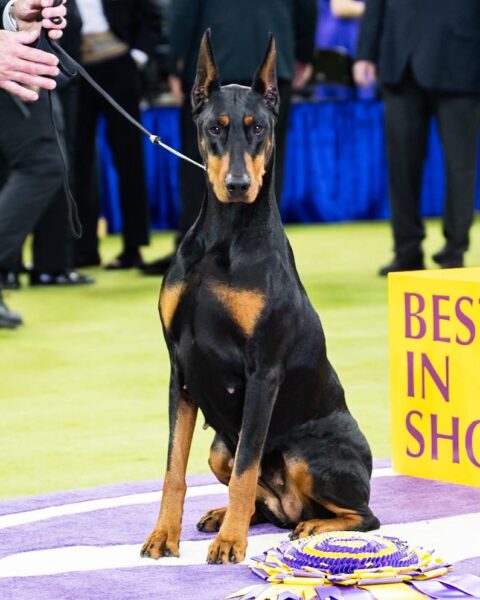 It’s unlikely to happen again.
Ontario appears set to push ahead with a ban on declawing cats and debarking and ear cropping dogs, a move animal welfare advocates say is years overdue and doesn’t go far enough.
The province is consulting on the possible ban on its regulatory registry through early February, after first pitching it as part of a sweeping omnibus bill of anti-crime measures last fall. The proposal would see the province’s animal welfare inspectors enforce a ban on medically unnecessary surgeries.
They never stop at ears- as those with short-faced and dwarf breeds are now learning. Enjoy your “weiner dog” while you still can. Goodbye, French Bulldog.
If Canadians want a domestic purebred dog community to provide quality puppies and the support structure that comes with it, they need to contact their lawmakers to ask they stop interfering in the interests of breed experts and the health care providers who serve them. We are better judges of what is and isn’t necessary to preserve and protect our breeds.
 And in some cases, we’ve been doing it for thousands of years.
Again, they never stop at ears. They never stop at tails or cat declawing or eating beef, just as they never stop at “assault rifles”. They never stop until they reach their intended goal.
If you’re in Ontario, call your MPP.
Which Came First?
The chicken or the corporate bankruptcy? As a black man. I never thought I’d say I’m completely done with chicken. But here we are.
DEI The Friendly Squirrels

“Government is simply the name we give to the things we choose to do together.”
Social media star Peanut the squirrel was taken by authorities in New York and euthanized. His owners Mark & Daniela Longo came on TMZ Live to talk about the insane raid on their home, how they found out Peanut was killed and what this means for their animal sanctuary. pic.twitter.com/PYnx5QlQYS
— TMZ Live (@TMZLive) November 1, 2024
How Many Deaths Has Walt Disney Been Responsible For Worldwide?
Denial of objective truth is one of the signs of a society’s downfall.
How Many Deaths Has Walt Disney Been Responsible For Worldwide?
It’s the most effective deterrent: HOW ABOUT IF WE SHOOT BEARS THAT COME NEAR HUMANS OR THEIR DOGS?
2023 Grand National
The world’s most famous steeplechase, live streaming from Aintree. Race in 45 minutes. (Meh, it looks like the feed will go down. Apologies!)
Related: Alleged ringleader of Animal Rising plot to ‘ruin’ Grand National and end horse racing forever is arrested
A Vancouver Humane Society Survey
Goes horribly wrong… VHS is one of the most activist Humane Societies in Canada. Consider your answers accordingly.
Playing yourself
James Cromwell must have the easiest job in Hollywood these days. His character of Ewan Roy on Succession seems to parallel his actual viewpoints so closely that it’s like he’s not even acting.
Cromwell glued his hand to the counter at a Midtown, Manhattan location to call on Starbucks to stop charging extra for vegan milk.
It turns out, in fact, that the similarities between himself and his character are no accident.
Cromwell, a longtime activist for animal rights, racial justice and environmental causes, told the Guardian his character was rewritten to reflect his politics as a condition of his participation in the HBO series. “I demanded that we have similarities,” he said.
O, Sweet Saint Of San Andreas
O, Sweet Saint Of San Andreas
Restauranteurs in California are getting very concerned that a meat staple of many dishes, especially in breakfast-centred restaurants, is going to be gutted from their menus in January. Beginning then, much of the U.S. pork production will be prohibited from sale in the state. In Iowa, for example, a major pork supplier for California, it is estimated only four per cent of the state’s hog production operations will be able to ship into California.
In 2018, voters passed a measure mandating more space where pigs, laying hens and veal calves were raised. Pig producers have been loath to spend the hundreds of millions of dollars required to overhaul production barns and systems to meet a law they didn’t believe would stand. The Commerce Clause of the U.S. Constitution prohibits one state from restraining trade among other states.
Many expected such a blatant move by California to set its own restrictive production standards and impose them on other states’ producers would be disallowed. But a lawsuit filed by the North American Meat Institute and joined by attorneys general in multiple states lost in California’s district court, lost at the very liberal Ninth Circuit Court of Appeals and the U.S. Supreme Court declined to hear the case.
How Many Deaths Is Walt Disney Responsible For Worldwide?
The root cause of coyote attacks is not shooting coyotes.
Police are searching for a coyote they believe was involved in separate attacks on 2-year-old girls in Arlington Sunday.
The first attack happened around 5:40 p.m. on Epping Street. Police said a 2-year-old girl was in her yard when she was bitten on the back and dragged by a coyote.
About 10 minutes later, a second incident was reported on Summerhill Road. A 2-year-old girl was scratched by a coyote while she was in her yard, police said.
This Is Not Your Grandma’s Humane Society
A former Royal Marine trying to evacuate 200 dogs and cats alongside his animal shelter staff out of Afghanistan has been given fresh hope by the defence secretary.
Open Carry?
Coyote attacks five-year-old child in Stanley Park
Conservation officers are urging the public to avoid Stanley Park after a boy was injured in yet another coyote attack in the popular downtown Vancouver park.
According to the B.C. Conservation Officer Service, the five-year-old boy was with his family for a walk at Prospect Point around 9:30 p.m. Tuesday and was running ahead “when a coyote lunged and bit him on the leg.”
This is the latest in a string of coyote attacks at Stanley Park in recent months, and the second one involving a young child.
Rangers will be installing more signs in the park to warn the public of the risk of coyote encounters, said spokeswoman Christine Ulmer,
Maybe they need to hire more social workers for the coyotes.
This Is Not Your Grandma’s Humane Society
Governing agriculture by popular urban opinion – what could possibly go wrong? Meet Colorado’s Initiative 16;
A recent ballot initiative being proposed in the state of Colorado is a serious concern for farmers, veterinarians, and other animal welfarists. The initiative, originally called Protect Animals from Unnecessary Suffering and Exploitation (PAUSE), has appeared before the title board after it was filed with Colorado’s Secretary of State. After a successful title board hearing, it is now called Initiative 16 in Colorado. This means that once enough signatures have been gathered, Initiative 16 will appear on the Colorado voting ballot for the general public to determine.
It includes a definition of the “natural lifespan” of livestock: “a cow lives to 20 years, a chicken lives to 8 years, a turkey lives to 10 years, a duck lives to 6 years, a pig lives to 15 years, a sheep lives to 15 years, a rabbit lives to 6 years.”
Section 3 then goes on to incorporate this change by adding in another subsection (1.9) which reads as follows: “any person who slaughters livestock in accordance with accepted agricultural animal husbandry practices does not violate the provisions of subsection (1) of this section so long as the animal has lived one quarter of their natural lifespan based on species, breed, and type of animal and the animal is slaughtered in such a way that the animal does not needlessly suffer.” This would essentially mean that the age required for legal slaughter and harvest is greatly increased – which, in the case of cattle, would be a full five years according to the language in this proposed change.
Language expanding the definition of “sexual act with an animal” would also effectively ban artificial insemination, and other veterinary and husbandry procedures unless that person is “dispensing care to an animal in the interest of improving that animal’s health”.
How “interest” might be defined will keep veterinarians up at night.
Chad Vorthmann, executive vice president of Colorado Farm Bureau, said this initiative is, in his 20 years in Colorado, the worst initiative he’s seen filed, even in the shadow of Proposition 114 which requires Colorado officials to introduce and manage wolves.
“That was bad,” he said. “This is worse.
The animal rights fueled initiative still faces a process of appeals and other requirements before it can be certified for a public ballot. The original document can be downloaded here..
This Is Not Your Grandma’s Humane Society
Rescue That Saves Dogs From Chinese Meat Trade Opening First U.S. Shelter In Jersey City
This Is Not Your Grandma’s Humane Society
The Colorado State University College of Veterinary Medicine announced, without input from doctors of veterinary medicine students, faculty or external stakeholders, the cancellation of terminal surgical teaching procedures. For large and small animal owners, this means graduates will have more limited surgical experience upon graduation.
In a letter from Dr. Melinda Frye, associate dean for Veterinary Academic and Student Affairs, professor, Biomedical Sciences, announced the change, the strong support of Dean Mark Stetter, and the implementation of a “longitudinal surgical training program based on multispecies application of foundational principles and skills, using models, cadavers, virtual reality, and authentic clinic and field experiences.”
In response, a group of CSU-trained veterinary practitioners are voicing their deep concern that the change will be detrimental to the students, the veterinary profession, and the general welfare of animal clients, large and small.
Dr. Chad Zadina, a 2009 graduate of the program, said the outcome will be quite the opposite, damaging the welfare of animals. In Zadina’s experience, practitioners, especially in rural areas currently experiencing a grave shortage of veterinarians, a wide range of surgical procedures are often expected of practitioners. Zadina said when he was faced with this wide array of procedures on several species as a new graduate, he wasn’t as prepared as he could have been but possessed adequate skills to perform general surgeries as well as more specialized procedures independently.
Insectavore pod people of the future won’t need animals, so progress.
The Children Are Our Future
How to train a child to be the future bitch of a Chinese child.