
I’m reading a new paper claiming attribution of all increased burned area in CA to climate change
Turco et al in PNAS todayAnthropogenic climate change impacts exacerbate summer forest fires in California
They start their data in 1971 even though reliable data exists much earlier, so I’m curious …
Honey, I Survived The Early Cretaceous Period
Emphasis on “known”: Crocodile found to have impregnated itself in 1st-known ‘virgin birth’ for species
The Sound Of Settled Science
The project of science calls for rigor, humility, and open discussion. The pandemic has revealed the stunning magnitude of the political and institutional capture of science. For this reason, both of us — Rav and Jay — are launching a podcast devoted to investigating the concoction of pseudo-consensus in science and its ramifications for our society. To start — and for quite some time — they will be examining the illusory consensus during COVID. However they will soon branch out into issues pertaining to transgender care, mental health, psychiatry, and nutrition — topics that have been wholly corrupted with one monolithic consensus that has proven to bear many costs on our society.
Honey, I Finished The Internet
Safe and Effective®
More cannon fodder for the great war on covid.
World Health Organization- Covid-19 vaccination can induce multiple sclerosis
Dr John Campbell dives into the new paper.
The Sound Of Settled Science
The Sound Of Settled Science
Dispatches from the war on meat;
In a new, unprecedented effort, scientists at the University of Washington’s Institute for Health Metrics and Evaluation (IHME) scrutinized decades of research on red meat consumption and its links to various health outcomes, formulating a new rating system to communicate health risks in the process. Their findings mostly dispel any concerns about eating red meat.
“We found weak evidence of association between unprocessed red meat consumption and colorectal cancer, breast cancer, type 2 diabetes and ischemic heart disease. Moreover, we found no evidence of an association between unprocessed red meat and ischemic stroke or hemorrhagic stroke,” they summarized.
The IHME scientists had been observing the shoddy nature of health science for decades. Each year, hundreds of frankly lazy studies are published that simply attempt to find an observational link between some action — eating a food for example — and a health outcome, like death or disease. In the end, owing to sloppy methods, varying subject populations, and inconsistent statistical measures, everything, especially different foods, seems to be both associated and not associated with cancer. How is the lay public supposed to interpret this mess?
What Would We Do Without Peer Review?
Fake scientific papers are alarmingly common
When neuropsychologist Bernhard Sabel put his new fake-paper detector to work, he was “shocked” by what it found. After screening some 5000 papers, he estimates up to 34% of neuroscience papers published in 2020 were likely made up or plagiarized; in medicine, the figure was 24%. Both numbers, which he and colleagues report in a medRxiv preprint posted on 8 May, are well above levels they calculated for 2010—and far larger than the 2% baseline estimated in a 2022 publishers’ group report.
“It is just too hard to believe” at first, says Sabel of Otto von Guericke University Magdeburg and editor-in-chief of Restorative Neurology and Neuroscience. It’s as if “somebody tells you 30% of what you eat is toxic.”
The Sound Of Settled Science
Via Phantom Soapbox: Speed of light violated, spooky action at a distance confirmed
Albert Einstein was famously uneasy with some of the consequences of quantum entanglement. If quantum mechanics were right, then a pair of entangled objects would behave as a single quantum system no matter how far apart the objects were. Altering the state of one of them should instantly alter the state of the second, with the change seemingly occurring faster than light could possibly travel between the two objects. This, Einstein argued, almost certainly had to be wrong.
Vitamin D
Published This Month In The Journal Of The Blindingly Obvious
A Columbia University study has found that teens who use cannabis recreationally are two to four times as likely to develop psychiatric disorders, such as depression and suicidality, than teens who don’t use cannabis at all.
The research, published in JAMA Open Network May 3, also finds that casual cannabis use puts teens at risk for problem behaviors, including poor grades, truancy, and trouble with the law, which can have long-term negative consequences that may keep youth from developing their full potential in adulthood.
“Perceptions exist among youth, parents, and educators that casual cannabis use is benign,” said Ryan Sultan, MD, assistant professor of clinical psychiatry in the Department of Psychiatry at Columbia and lead study author. “We were surprised to see that cannabis use had such strong associations to adverse mental health and life outcomes for teens who did not meet the criteria for having a substance use condition.”
Y2Kyoto: A Tip From An IPCC Insider
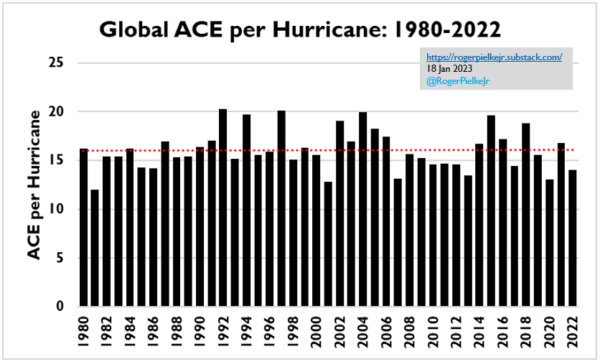
A high level participant in the IPCC (purposely vague to protect their identity) has confirmed to me that the major error on tropical cyclones that I recently identified was (a) indeed a major snafu and (b) a result of claims being inserted into the IPCC outside its review process. Neither of these things should happen in an process that the IPCC promotes as the “gold standard” of scientific assessment.
The error was to claim that a change in the proportion of Category 3-5 tropical cyclones has been detected and attributed to human-caused climate change, which is contrary to both evidence and the scientific literature. Even worse, in making the false claims the IPCC confused a study of measurements of tropical cyclones with tropical cyclones, and failed to acknowledge that paper had undergone a major correction, which altered its conclusions and rendered it irrelevant.
The false claim was not caught and was ultimately elevated by the IPCC to the summary of its recent Synthesis Report where it was promoted as one of the most significant scientific findings of the past assessment cycle. You can read all of the details on the error in this post and its follow up.
The tip that I received prompted me to go back and look carefully at the evolution of the drafting IPCC AR6, which was where the mistake made. I can confirm that the tip checks out. The IPCC failed to follow its own procedures of quality control and peer review. False information made its way into the report outside of the review process and was repeatedly elevated to the highest levels of information conveyed to policy makers.
How Can We Further Divide Canada?
Looks like the next election will be a referendum on mandatory jabs.
Liberal.ca- Mandatory Vaccination
To finish the fight against COVID-19, protect people at work, ensure businesses can get back up to speed, and, most importantly, make sure our kids can safely return to school, we need to do everything we can to keep public spaces safe.
A re-elected Liberal government will:
-Require that travellers on interprovincial trains, commercial flights, cruise ships, and other federally regulated vessels be vaccinated.
-Ensure vaccination across the federal public service. As the country’s largest employer, this will protect the health and safety of the federal public servants and their communities, across Canada.
-We will also keep working with employers in Crown corporations and federally regulated workplaces to ensure vaccination is prioritized for workers in these sectors.
h/t Scott
What Would We Do Without Experts?
Dozens of people infected with COVID-19 at CDC’s annual conference of ‘disease detectives’ … although many wore masks, says CDC spokesperson
Remain In Your Pods, Eat Your Bugs
And await further instructions.
The spread of antibiotic resistant bacteria poses a major threat to global health and food security as the use of antibiotics continue to grow. And now, a team of researchers from Quebec and France say bacteria with antibiotic-resistant genes can even spread through the clouds.
The study, published last month in the journal Science of The Total Environment, looked at samples taken from clouds at the Puy de Dôme summit, located 1,465 metres above the ground atop a dormant volcano in central France.
Analysis of the samples found anywhere between 330 to over 30,000 bacteria per millilitre of cloud water, with the average being around 8,000.
The Sound Of Settled Science
Joe Rogan & Dave Smith on the Illusion of Scientific Consensus
"It's not that there's consensus amongst the scientists. It's that any scientist that doesn't agree with the consensus gets kicked out. They all get excommunicated and silenced. And then it's just this completely… pic.twitter.com/mNblPe6MsM
— Chief Nerd (@TheChiefNerd) April 28, 2023
Related: Now it turns out Canadian health officials knew ahead of time that the COVID-19 vaccinated likely carried the same viral load as the unvaccinated.
And How Was Your Day?
One Flu Out Of The Wuhan Nest
Jordan Schachtel: I am struggling to find one good reason why there is an advanced bio lab in Khartoum, Sudan.
“The most striking technological breakthroughs often come from the most unexpected sources”.
“That is why Apple, not IBM, perfected the personal computer, why the Wright brothers, not the French army, invented powered flight, why Jonas Salk, not the British National Health Service, invented a polio vaccine, why Amazon, not the Post Office, invented one-click ordering and why a Finnish lumber-supply company, not a national telephone monopoly, became the world leader in mobile telephony.”
Another good one from Robert Graboyes.
Patient Zero
Just trust the expert.