
This Rock Just Rewrote British Prehistory
On the Origins of Peanut Allergy
The epidemiology of peanut allergy is interesting to begin with. It’s not much of a problem in most of the world. Only in America—where roughly 1% of children are thought to be affected, and maybe a dozen people die annually from it—are schoolchildren forbidden from bringing a PB&J to lunch, for fear of endangering a classmate’s life.
So what makes the USA different? […]
Regular readers will know that I’m skeptical of some modern industrial agricultural practices, e.g. killing plants with chemical herbicides and then eating them. So naturally, my first instinct was to wonder: did they approve a weird new pesticide for use on peanuts in 1980? Maybe eating peanuts laced with some chemical toxin could train the body into thinking they’re bad business.
I did a quick search along those lines—something like peanut agricultural approval 1980. I didn’t find anything like what I was expecting. Instead, I got a slew of hits in the form of old newspaper articles, all reporting on something called the “Great Peanut Crisis of 1980”.
We’re All Gonna Die!
It speaks to the credibility problem of a mainstream media like Reuters when they can regurgitate an extraordinary claim about AI without once questioning how anyone could reach such a conclusion. It’s not that someone said AI could kill a lot of people, but rather that AI could literally kill all of us. And by what means?
Public alarm about the potential danger posed by AI is growing, after Anthropic researcher Jacob Coxon said last week he had resigned, in part because the “people building AI earnestly believe that it could kill us all by the end of the decade.”
Update, from Kate — this thread by Kevin Bass is a “rest of the story” must-read.
I have conducted an audit of Anthropic’s finances.
What I have found is so shocking that I am calling for a Congressional investigation.
Anthropic is not just seeking regulatory capture.
It has built a regulatory capture machine that cannot be turned off.
Structural financial incentives make it impossible for Anthropic — I call it the Anthropic Network — to turn off its own AI doom cycle.
It starts with METR.
Dario Amodei proposes “third-party evaluators” to assess the risk of Anthropic’s models.
He proposes METR for this purpose.
But METR is financially dependent on the Anthropic’s success — specifically, on the explosive growth of more than $7 billion dollars in Anthropic stock.
Indigenous Ways Of Sciencing
All federal scientific research should be Indigenous focused, says a Department of Natural Resources report. “How can we as public servants be actors in reconciliation?” it asked: “Ideally, the decolonization of research implies full Indigenous ownership of research. However it is still hard.”
(coding glitch fixed, sorry)
Published This Month In The Journal Of The Blindingly Obvious
A Study Of EDI In Canada Research Chairs Program: Executive summary
Is diversity truly our strength? Does equity, diversity, and inclusion (EDI) improve excellence?
Since 2017, the prestigious Canada Research Chairs (CRC) program, which sets the agenda for Canadian academic research, has moved dramatically in the direction of implementing EDI ideology and quotas.
Regrettably, prioritizing EDI results in an “equity-excellence trade-off”: Canadian taxpayers are funding cultural socialist activism among elite professionals at the expense of the disinterested pursuit of truth.
And, Canadian research is paying a high cost for its unfettered embrace of EDI, both through the non-meritorious appointment of less qualified Black, Indigenous, and female chairs, and by diverting millions of dollars to left-wing scholar-activist research.
According to our analysis — the first of its kind — EDI ideology is costing approximately $36 million per year, equivalent to a 12 per cent “tax” on the CRC’s $300 million annual budget.
While previous studies have examined demographic differences and the effects of EDI on organizational and team performance, none has examined its organizational-level consequences in academic research. This study fills that gap by testing EDI’s impact on research output in the CRC holders program from 2016 to 2025. It turns out, diversity is not merely neutral — it can actually lower performance.
Because real DEI has never been tried: This is one of the 68 “world-class academics” Canada poached from the USA at a COST OF 504 million Dollars….
The Sound Of Settled Science
Until now, no randomised trial had compared Tamiflu with no antiviral in critically ill patients.
The international REMAP-CAP trial has now done that—and found no benefit. More patients died with Tamiflu than without it.
The Sound Of Settled Science
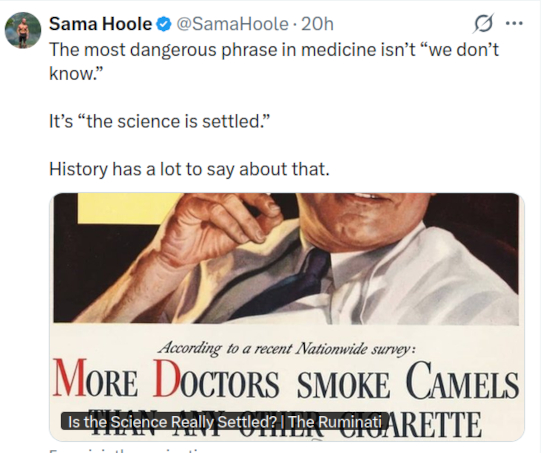
Trust the Experts
“Safe and Effective. Trust the Science.”
Dr Bonnie Henry claimed the covid vaccine was safe for unborn babies when their pregnant mothers get vaccinated.
She criminalized healthcare professionals for asking questions regarding efficacy and safety.
She changed the AEFI… pic.twitter.com/kUo86VO6O7
— Michelle Worton 🇨🇦 (@michelleworton) August 12, 2026
The Sound Of Settled Science
Here we used canopy-penetrating LiDAR data over 4,430 km of flight to define the geographical distribution and quantity of earthworks in this region better. On the basis of both existing data and our LiDAR documentation, we show that this cultural area alone contains as many earthworks as previously estimated for the whole of Amazonia. We also propose that the total human population of the area in 100–300 ad was 1.25–3 million people. If similar results are found elsewhere in Amazonia, the total precolonial population density and its effect on the current Amazonian soil and forest structure, biodiversity and even some modelling of the global climate should be re-evaluated.
Awash With Idiocy
Faced with widespread backpedaling on the most useless aspects of the climate science cult, hacks like Gwynne Dyer just double down: since we can’t jettison fossil fuels fast enough, let’s just embark on an attempt to do nothing less than geoengineer the weather as if the earth were connected to a house thermostat. What could possibly go wrong?
Cutting our carbon dioxide and methane emissions, while it is still vital, cannot act fast enough….
What can act fast enough is Solar Radiation Management (SRM for short). That includes any technique that reflects some incoming sunlight back into space and cools the planet, but the most promising one involves putting some reflective substance into the stratosphere.
We’re All Gonna Die!!!
I remember when Popular Mechanics used to be an insightful, informative publication. Not so any more. These days, they just regurgitate the same kind of claims that worked so well to gin up public hysteria during the pandemic.
Biofouling may result in a massive marine super-spreader event if preventative measures prove inadequate.
This exposure could turn into a biological apocalypse.
And on top of all that, some species notorious for biofouling can also become parasitic to native species, which can then cause outbreaks of disease that threaten many host species and (depending on the parasite) could possibly infect humans.
What Would We Do Without Peer Review?
The requirement that scholars constantly publish or face academic ruin has been considered the primary engine of scientific discovery for decades. But a growing movement of universities and researchers is trying to banish the practice to the archives, saying it has perverted the pursuit of knowledge and eroded the public’s trust in science.
Reformers at top universities in Europe and the U.S., including Cambridge, Sorbonne, and UC Berkeley, say this traditional system of advancement has led to an explosion in the growth of low-quality research, with little meaningful impact on academic fields or society. It has also sparked the spread of fraudulent research, as “paper mills” churn out fake articles for sale to academics seeking to pad their CVs.
To weaken the “publish or perish” stranglehold on universities, hundreds of research institutions are reforming the incentive system that shapes academic careers. It currently rewards scholars for frequently winning grants and publishing papers, with extra points for landing in the most esteemed, high-impact journals, even when the articles are not themselves influential.
More: Rossner is part of a network of experts that sniff out researchers who intentionally or recklessly fabricate, falsify, or plagiarize evidence. Rossner, a consultant specializing in identifying manipulated and duplicated images in journal papers – a telltale sign of deceit – has been dismayed by his findings at U.S. research centers. Scientists often have deleted the data underlying the images, making misconduct harder to prove and casting doubt on the validity of the research.
What Would We Do Without Peer Review?
The editors of the world’s most prestigious medical journals are sounding the alarm, and nobody is listening.
“We have peer reviewed, high impact editors in most of the journals that are the most high impact, saying that they don’t believe what is being published in those journals is trustworthy anymore.”
“The BMJ, The Lancet, all of those editors have come out and said, we have a huge problem. We can’t replicate this research and we actually don’t even know who did the research.”
“Everywhere we’ve looked for corruption, we’ve found it.”
Critical Shovel Theory
“Neutrality is a luxury that archaeologists are not afforded and they cannot be apolitical in the face of politics,” she wrote….
Five years of national angst and anger over the “discovery” of “graves” at the former Kamloops Indian Residential School was driven by an archeological report by a self-proclaimed activist archeologist and critical theory advocate Sarah Beaulieu. Her PhD thesis, completed in 2019, glorified her social warrior/critical theory credentials.
In her thesis, Archaeology of Internment at the Morrissey WWI Camp, insight into Beaulieu’s philosophy is revealed in chapter two under the headings “Critical Theory” and “Applications of Critical Theory within Modern Conflict Archaeology.”
Critical theory, she explained, has a dual purpose: exposing ideologies (or regimes/governments) that justify oppression and forcing a commitment from the “practitioner” (in this case Beaulieu) to act against the oppression once it has been exposed.
“Through the application of critical theory, researchers gain an understanding of how certain groups have become exploited. This understanding allows the researcher to use this knowledge and critique gained through research to strive to end such oppressive forces,” wrote Beaulieu, a professor at Fraser Valley University.
“Critical archaeologists thus take part in an emancipatory archaeology to serve marginalized societal groups and challenge the dominant class.”
I’ve linked to the archived page, but if you have a couple of bucks to spare, consider subscribing to the National Post. They’re the only ones with the cajones to take these hoax mongers on, and it costs nearly nothing.
The Sound Of Settled Science
If you’re looking for something to do and tired of social media, Roger Pielke Jr: Five of My Favorite Papers and the Stories Behind Them
Trust The Science
According to the criminal complaint, Vincent Munster, a citizen of the Netherlands, 53, is the Chief of the Virus Ecology Section, Laboratory of Virology at the Rocky Mountain Laboratory in Hamilton, Montana. Claude Kwe, a citizen of Cameroon, 38, is a research fellow in Munster’s section. The work of both men is focused on “emerging viral pathogens” and how those pathogens “cross the species barrier.” They work at a Biosafety Level 4 laboratory, which employs the highest level of biosafety precautions for scientific research of known and potential human pathogens.
On January 25, 2026, Munster and Kwe arrived at the McNamara Terminal at Detroit Metropolitan Airport with travel originating from Brazzaville, Republic of Congo, where an outbreak of monkeypox was occurring. Monkeypox is an infectious virus that can result in painful rash, enlarged lymph nodes, fevers and other ailments.
Munster and Kwe were inspected and interviewed by Customs and Border Protection (CBP) officials upon their arrival. CBP officers observed Kwe and Munster traveling with a large black plastic case. Munster and Kwe falsely told CBP officers that the black case contained diagnostics and testing equipment. But subsequent investigation by CBP and FBI agents revealed that the case actually contained 113 vials in Styrofoam coolers. As of the date of the complaint, the FBI has tested 20 of the 113 vials. Seventeen of them contained deactivated monkeypox virus, one contained the Chickenpox virus, and two contained only human DNA.
Your Moral And Intellectual Superiors
Journalists’ brains show a lower-than-average level of executive functioning, according to a new study, which means they have a below-average ability to regulate their emotions, suppress biases, solve complex problems, switch between tasks, and show creative and flexible thinking.
The Sound Of Settled Science
What Would We Do Without “Gold Standard” Researchers?
How a tiny circle of repeat offenders poisoned 100s of gold-standard medical trials for over a decade… and didn’t go to jail.
In a recent study, researchers set out to investigate how many retracted randomized clinical trials were linked to superretractors (authors with the most retractions) and to highly cited authors with multiple retractions.
They found that just 6 superretractors were co-authors on 22% of all retracted clinical trials studied, 5 were based in Japan, and 1 was from Germany. Also, a group of 18 top-cited scientists were involved in 25% of all retracted trials. The retractions were highly concentrated in specific areas like anesthesiology, endocrinology and metabolism.[…]
To become a superretractor, first, a researcher must produce large volumes of unreliable, duplicate, or fabricated work, often fueled by the publish or perish system of academia that rewards output over rigor and lacks strong oversight. Second, that misconduct has to be uncovered through investigation and exposure.
Superretractors can also act as superspreaders of contaminated research. When flawed or fabricated trials enter systematic reviews and meta-analyses, they are amplified and woven into widely used evidence summaries. By the time a study is retracted, it has often already shaped these studies referenced for developing clinical guidelines that doctors rely on. The result is a cascade of distorted evidence that can translate into incorrect, even harmful, decisions in patient care.
Splashdown!
🚨 NOW: HUNDREDS of flight controllers just surged into the flight control room to watch the Artemis II crew safely exit the capsule after splashdown
History is being made!
Furthest in space EVER 🔥 pic.twitter.com/6gE773PINP
— Eric Daugherty (@EricLDaugh) April 11, 2026
Please share any great links you have!