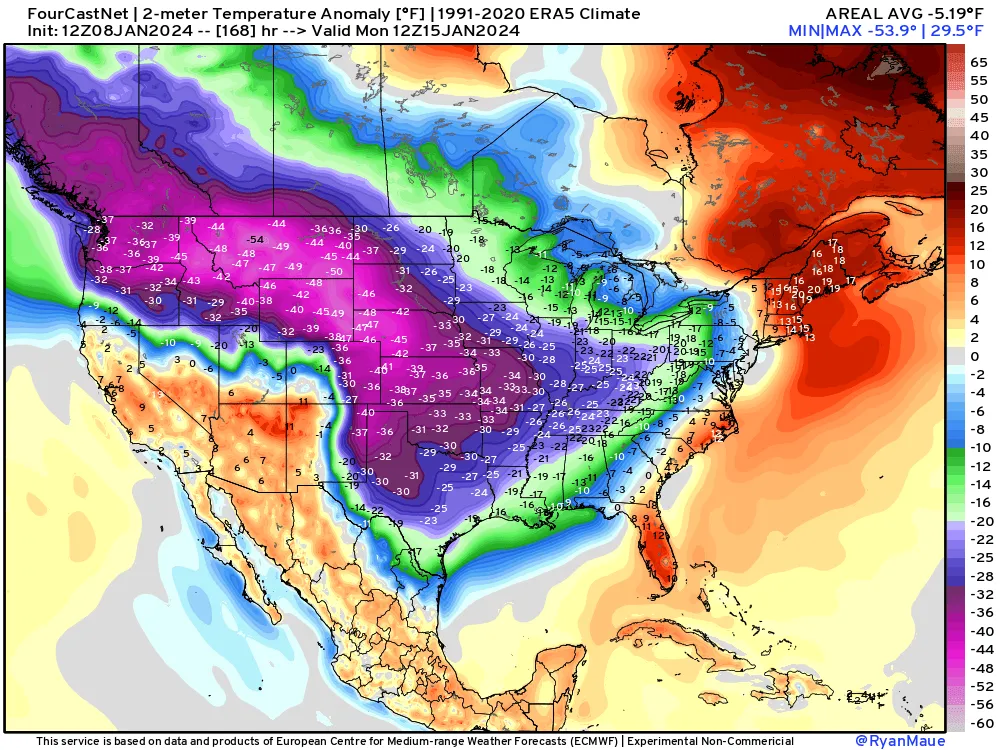
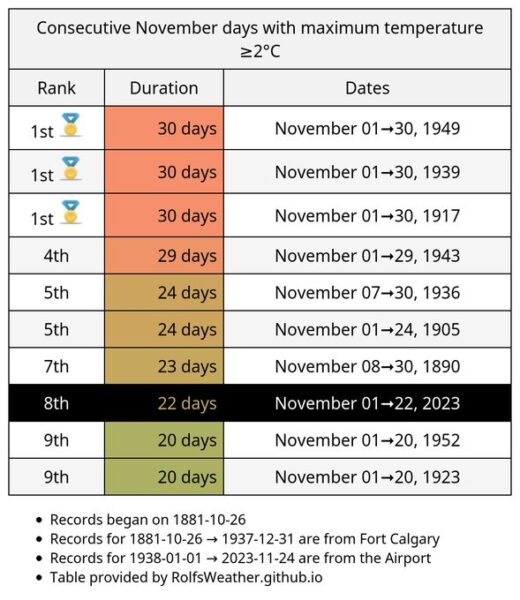
It’s -35C in Calgary right now.

WUWT: Is France Quietly Ditching Renewable Energy Targets?

Now is the time at SDA when we juxtapose!
From a thread by Bjorn Lomberg:Super-expensive but ineffective climate policies mean De-industrialization with small climate benefit […] On current trends, Germany will reach 0% fossil fuels in the year 2473, nearly half a millennium from now


In related No Business Case geopolitical developments: China regains title as world’s biggest LNG importer. And that demand growth isn’t expected to slowdown anytime soon
As this year draws to a close…
…it is worth noting that over the last 12 months — and contrary to predictions and headlines, including claims about “the warmest year ever” — polar bears have not been reported dying, starving, or eating each other in large numbers, or relentlessly attacking people. On top of that, summer sea ice coverage in the Arctic has stalled for the last 17 years, not melted out in a death spiral of rotten ice.
But take heart! All is not lost!
h/t PaulHarveyPageTwo, roaddog
Into the void;
A new study by a team of mostly San Francisco Bay Area scientists that found human-caused climate warming has increased the frequency of extremely fast-spreading California wildfires has come into question from the unlikeliest of critics—its own lead author.
Patrick T. Brown, climate team co-director at the nonprofit Breakthrough Institute in Berkeley and a visiting research professor at San Jose State University, said his Aug. 30 paper in the prestigious British journal Nature is scientifically sound and “advances our understanding of climate change’s role in day-to-day wildfire behavior.”
But Brown this week dropped a bomb on the journal—as well as his study’s co-authors who are staunchly defending the team’s work. In an online article, blog post and social media posts, Brown said he “left out the full truth to get my climate change paper published,” causing almost as much of a stir as the alarming findings themselves.
Brown wrote that the study didn’t look at poor forest management and other factors that are just as, if not more, important to fire behavior because “I knew that it would detract from the clean narrative centered on the negative impact of climate change and thus decrease the odds that the paper would pass muster with Nature’s editors and reviewers.” He added such bias in climate science “misinforms the public” and “makes practical solutions more difficult to achieve.”
Robert Lyman (Financial Post);
The International Energy Agency, in its reports on energy financing, breaks down global energy investment into investment in fossil fuels, on the one hand, and in “clean energy,” on the other. In 2023, estimated investment in “clean energy” will be close to $2.2 trillion (in C$). That is an almost unimaginable amount of money, made only slightly less daunting when portrayed as $6 billion per day. […]
What has been the result of these gargantuan expenditures? The effects of current investments in electrical energy infrastructure won’t be fully apparent for some time, but we should be able to see the effects of spending that has been rising for more than 20 years. To find out, I consulted the authoritative Statistical Review of World Energy 2023, published by the Energy Institute, the successor to British Petroleum as the producer of the Statistical Review. It works closely with KPMG to produce the report.
The share of the world’s primary energy consumption produced by renewable energy has essentially doubled since 2015, from about 3.5 to seven per cent of the world total. Yet, fossil fuels (oil, natural gas and coal), which accounted for 85 per cent of primary energy consumption in 2015, still accounted for 82 per cent in 2022. At that rate of reduction — three percentage points every seven years — we will not get to full decarbonization (i.e., zero use of fossil fuels) until well into the next century.
As usual, the news is buried in the opinion pages.
Related: Whoppers and moer whoppers in the WSJ
A major power grid operator that oversees electricity supplies across the mid-Atlantic repeated its warning that the looming shutdown of a coal-fired power plant in Baltimore will threaten the region’s grid reliability and may have devastating impacts on consumers.
In a follow-up letter obtained by FOX Business this week, PJM Interconnection warned the shutdown of the Brandon Shores coal power plant is slated to occur before replacement power sources can come online, resulting in “degraded grid reliability” for more than 1 million state consumers, including the entire city of Baltimore.
Now pay close attention, because this is where the math comes in.
PJM is preparing for significant impacts to the grid from additional demand that includes up to 7,500 MW of new data centers to be sited in Virginia and Maryland. This is combined with widespread effects from the deactivation of more than 11,000 MW of generation across the PJM footprint.
Read the whole thing.
It rained all night the day I left
The weather it was dry,
It was so warm I froze to death
Susanna don’t you cry.
The United Nations (UN) climate summit, known as COP28, featured a Tuesday discussion on sustainable yachting.
The discussion centered on finding “a variety of technical solutions developed to make the yachting experience more responsible and sustainable,” according to its official COP28 website. The event, titled “Responsible Yachting. Today & Tomorrow,” was moderated by Nico Rosberg, a yacht-owning former race car driver, and organized by Sunreef Yacht, a company that builds custom yachts and luxury vessels.
The discussion also included “a conversation about electric, hybrid and hydrogen propulsion, battery technology, plant-based composites, bottom paints, modern photovoltaics, sustainable interior finishing, water management, energy management (and) air conditioning,” according to the event’s COP28 website.
Where the foxes caper unmolested, the government packs your school lunch and the British remember what they used before candles.
People are being encouraged to make sure they have emergency supplies at home to help them cope in the event of extended power cut
People must buy battery-powered radios, torches and candles to boost their “personal resilience” in the event of a national crisis wiping out digital network or power supplies, the government has said.
Oliver Dowden, the deputy prime minister, has given the first of what will be an annual update to MPs on the government’s national risk and resilience strategy.
Guidance to be issued next year will help people to prepare for different emergencies.
He said that members of the public needed to be more “personally resilient” as he suggested they have become too reliant on devices powered by the internet.
A new “resilience website” will contain advice on how people can ensure they are prepared for being left without power for the gadgets they rely on.
Anas Alhajji: As COP28 is being held in Dubai with the oil industry participating in such events for the first time, the oil industry wasted no time making its case. We decided to repost this article for everyone to read.
EOA’S MAIN TAKEAWAYS
1. Data indicates that future demand for oil and gas is UNDERESTIMATED, while demand destruction is HYPED.
2. Global energy demand is increasing, making decarbonization more difficult to achieve, and the process of replacing fossil fuels slower.
3. Despite massive spending on renewables in the last two decades, fossil fuels remain the dominant source of energy in the world, even in Europe.
4. Coal remains the dominant source of electricity in India and China.
5. Oil is rarely used in power generation in the OECD, China, and India. Doubling or tripling solar and wind energy sources will have a very limited impact on oil demand. However, the failure of renewable energy, and consequent power shortages, will have a significant impact on oil demand.
6. As LNG prices reached a record high in 2022, oil use in power generation increased. The level of substitution among various energy sources last year was unprecedented.
Dubai or bust: Today’s Planetary Fever Update brought to you by the good folks of COP28.
(I see Robert Francisco beat me to it, but that’s ok)
Or your guns, nor your gas stoves…
The world’s most-developed nations will be told to curb their excessive appetite for meat as part of the first comprehensive plan to bring the global agrifood industry into line with the Paris climate agreement…
The guidance on meat is intended to send a clear message to governments. But politicians in richer nations typically shy away from policies aimed at influencing consumer behavior, especially where it involves cutting consumption of everyday items.
‘Livestock is politically sensitive, but we need to deal with sensitive issues to solve the problem,’ said Dhanush Dinesh, the founder of Clim-Eat, which works to accelerate climate action in food systems. ‘If we don’t tackle the livestock problem, we are not going to solve climate change. The key problem is overconsumption.’
India has by far the largest herd in the world with over 300 million head of cattle! Who is gonna tell them?
In bone-dry language, the report “Inquiry into Bulk-Power System Operations During December 2022 Winter Storm Elliott,” explains how the gas pipeline network in New York nearly failed last Christmas when temperatures plummeted during the bomb cyclone. Freeze-related production declines, combined with soaring demand from power plants, homes, and businesses, led to shortages of gas throughout the Northeast. The lack of gas, as well as mechanical and electrical issues, resulted in an “unprecedented” loss of electric generation capacity totaling some 90,000 megawatts. While the lack of electricity was dangerous, the possibility of a loss of pressure in the natural gas network should send a bone-chilling shiver through the sacroiliac of every politician and bureaucrat in Washington, D.C., New York and the Northeast.
The report explains that if the gas pipeline system had failed, the recovery process in New York City would have taken “months.” In addition, the property damage due to damaged water pipes in homes and buildings would likely have caused hundreds of millions of dollars in damage.
Left unsaid in the report is that the collapse of the gas grid during the period in which temperatures in New York City stayed below freezing would have caused a calamity unlike any other in U.S. history. The cold that lasted from December 23 to December 28 could have resulted in thousands, or even tens of thousands, of deaths. The damage from burst water pipes would have rendered untold numbers of residential and office buildings in New York City unusable.
Quelle surprise that more and more Canadians are coming to the conclusion that changing the weather 200 years into the future is not worth a life of penury. Most of us at SDA came to that conclusion the moment carbon taxes were introduced, but it’s too bad it has taken this long for enough Canadians to realize that this was never a win/win proposition to begin with.
Now, when Canadians are asked to rank their top concerns, the top spot is a duel between “economy” and “cost of living” — with climate change lucky if it can crack the top five.
Carbon pricing was broadly popular when Trudeau took office; one survey had 56 per cent of Canadians supporting a price on emissions. As support has dwindled, it’s dropped in almost perfect tandem with the rate of Canadians actually paying the carbon tax.
This was most dramatic in Atlantic Canada, where good feelings on carbon pricing screeched to a halt on July 1 when it became the country’s last region added to the federal carbon pricing scheme.
If a frog is put suddenly into freezing water, it will jump out, but if the frog is put in tepid water which is then cooled slowly, it will not perceive the danger and will be frozen to death.
In 2019, then-President Donald Trump mocked the idea of powering our society on unreliable wind and solar power by joking, “Darling? Darling? Is the wind blowing today? I’d like to watch television.”
Now, wind and solar advocacy groups are advocating for this exact policy, but instead of being honest with the public about their desire to curb your electricity use when the wind isn’t blowing or the sun isn’t shining, they use innocuous-sounding words like “demand response” and “load flexibility” to hide their true intentions from ordinary people.
For example, Fresh Energy, a wind and solar special interest group located in Minnesota, says the grid of the future will need to be balanced not by building enough reliable peaking power plants to make sure the lights stay on but by charging people more to disincentivize them from using power during times of peak demand and otherwise controlling or rationing power to keep wide scale blackouts from occurring.
Don’t expect sanity to intervene in Minnesota any time soon.
Roger Pielke Jr: We know that as climate changes, the impacts are getting worse. We’re seeing more and more flooding going on as a result.
Everybody knows this — it is conventional wisdom.
Not only is the conventional wisdom on flooding wrong, data show that flood impacts as measured by direct economic losses have actually decreased by about 90% since 1940 as a proportion of U.S. GDP. The United States is in fact more resilient to flooding than it has ever been. The reduction in flood impacts is an incredible story of success sitting out in plain sight that is completely ignored, in favor of stories that instead tell us that down is up.
The figure below shows U.S. annual flood damage as a proportion of GDP. In 1940 flood losses amounted to a 2023 equivalent of about $50 billion per year, and in 2022 they totaled about $5 billion, a reduction of over 90%.1