Category: Climate Cult

Living on borrowed time, Ring of Fire and a pipeline to where??

Coal Revival: From living on borrowed time to once again having a future: United Mine Workers of America Local 7606. This is a powerful story about coal, Estevan, Saskatchewan, SaskPower and Westmoreland.

Pipeline Online Podcast Ep. 13: Greg Rickford, Ontario Minister for the Ring of Fire. Are we Can’tada?

Danielle Smith and Doug Ford gave a press conference just before Bronwyn and I went online with Monday’s podcast, conveniently with the Ontario minister responsible for the Ring of Fire. Something came out of Ford that REALLY caught my eye.

He was talking about a deepwater port on James Bay. That’s the dangly part of Hudson Bay that happens to be really close, relatively speaking, to Ring of Fire.

No details have come out yet, but we have to remember this – there is no road, no railroad, no pipeline, NOTHING to James Bay. That area of northern Ontario might as well be the moon, which is why it has been so hard to get a GRAVEL road built to the Ring of Fire. I was shocked, yes, gravel. A multi billion dollar development to rival Fort McMurray and you’re going to have a gravel road???? And they talked about possibly a pipeline to said port, which will be conjured up from thin air. (Maybe they should build a paved road, first?)

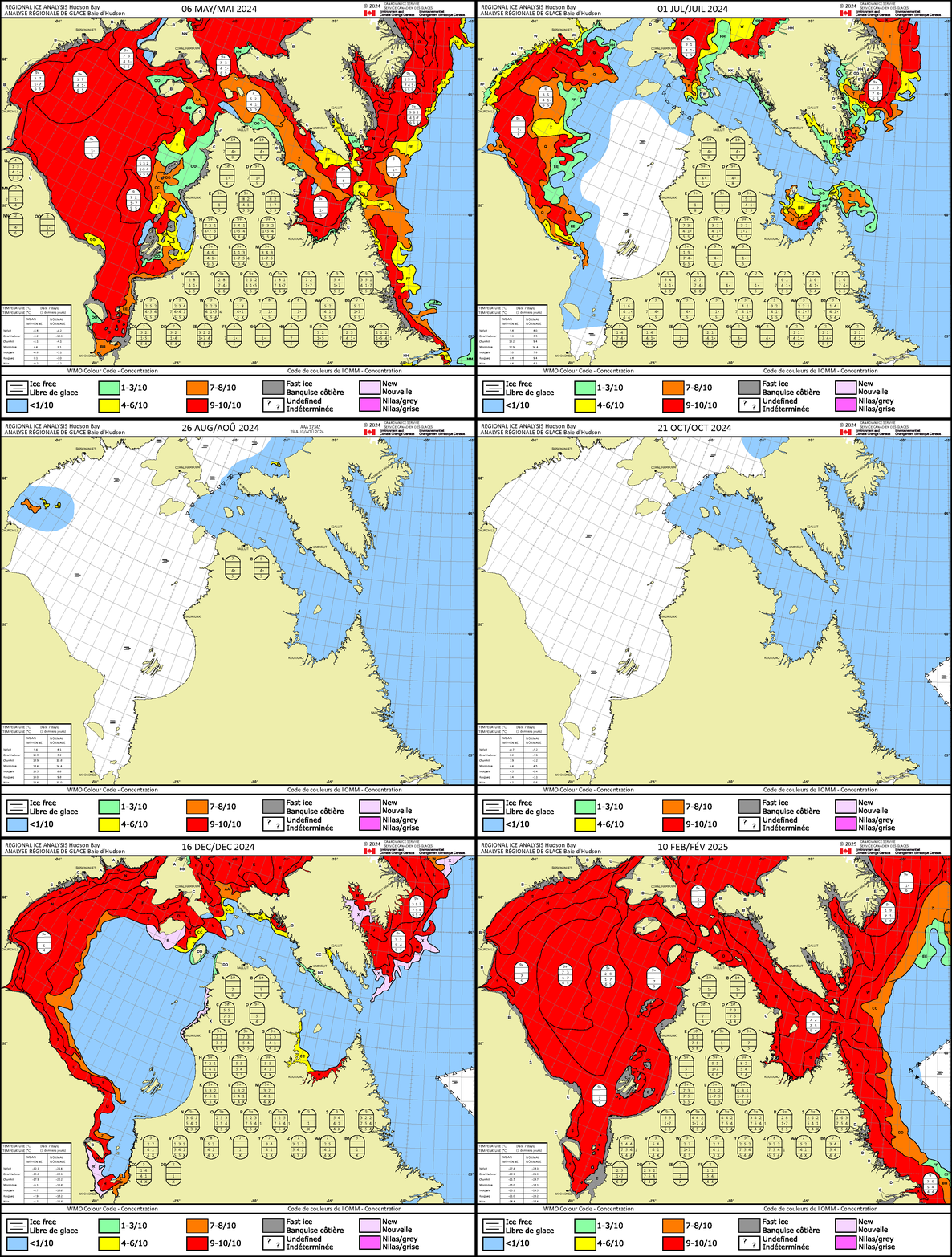
What does this mean for Saskatchewan? Now there are potentially three ports in play on Hudson/James Bay? As I wrote last week, without a fleet of icebreakers at over $3 billion a pop, any port on Hudson Bay is a fool’s errand, at least for shipping oil.

But it seems Ontario is now serious about a new oil pipeline, entirely in Canada, to replace Enbridge Line 5.

And Premier Moe spoke a while back about any pipeline through Saskatchewan being automatically approved. Not sure what he meant by that, but is that why he didn’t need to take part in this press conference, since he was present at Stampede?

I didn’t have time to dig into all of this, but maybe I’ll do a column on it later this week. Here’s the Canadian Press stories about it.

Premiers Danielle Smith and Doug Ford agree to study new energy corridors, more trade

Ontario Premier Doug Ford pitches railway to Ring of Fire, Alberta is on board – Note, this is the first major rail project I’ve heard about, well, since I was born. Is this why the Sask NDP talk about rail projects, using EVRAZ steel?

Alberta to hold nuclear power consultations as reactor companies weigh opportunities

That column about Hudson Bay I referred to: Brian Zinchuk: Let’s get serious about shipping oil from Hudson Bay

I updated it with an animation of sea ice from last year to show how serious of an issue it is. https://pipeline-online-v1750862700.websitepro-cdn.com/wp-content/uploads/2025/07/Hudson-Bay-Ice-Gif.gif

Drilling For Debt

One measure of Canadian exceptionalism might be how much capital we insist on destroying in order to shove harmless trace gases deep into the earth.

He made his announcement at the site of Bow Valley Carbon Cochrane Ltd. northwest of Calgary, where emissions from a natural gas extraction plant are to be stored four kilometres underground. Bow Valley is a partnership between Inter Pipeline Ltd. and Entropy Inc.

It is to receive $10 million to add equipment to the plant, and Hodgson says its emissions reductions will equate to taking more than 12,000 cars of the road a year.

Great Success!

ChekNews- Transport Canada change forces BC Ferries to prohibit damaged EVs

“To ensure passenger and crew safety, BC Ferries has recently updated its policy around the transport of electric vehicles due to the potential fire and environmental risks associated with damaged lithium-ion batteries. Lithium-Ion batteries are widely used, but when damaged or handled improperly, they can pose a serious fire risk,” said the corporation in a statement.

We Don’t Need No Stinking Giant Fans

The Physics Behind the Spanish Blackout

When a grid failure plunged 55 million people in Spain and Portugal into darkness at the end of April, it should have been a wake-up call on green energy. Climate activists promised that solar and wind power were the future of cheap, dependable electricity. The massive half-day blackout shows otherwise. The nature of solar and wind generation makes grids that rely on them more prone to collapse—an issue that’s particularly expensive to ameliorate. […]

Grids need to stay on a very stable frequency—generally 50 Hertz in Europe—or else you get blackouts. Fossil-fuel, hydro and nuclear generation all solve this problem naturally because they generate energy by powering massive spinning turbines. The inertia of these heavy rotating masses resists changes in speed and hence frequency, so that when sudden demand swings would otherwise drop or hike grid frequency, the turbines work as immense buffers. But wind and solar don’t power such heavy turbines to generate energy. It’s possible to make up for this with cutting-edge technology such as advanced inverters or synthetic inertia. But many solar and wind farms haven’t undergone these expensive upgrades. If a grid dominated by those two power sources gets off frequency, a blackout is more likely than in a system that relies on other energy sources.

Green energy manufacturer can’t afford the cost of energy;

A major supplier to Britain’s green energy industry is set to close after its Japanese owner failed to clinch a rescue deal for the company and its 250 workers.

Wigan-based Electric Glass Fiber UK (EGFU), which is owned by Nippon Electric Glass (NEG), makes vital components used in wind turbines and electric cars. Its closure puts net zero supply chains under threat.

Insane Predictions

So a warming climate will diminish crop yields? I guess that’s why corn yields in Manitoba are currently so much higher than corn yields in Iowa….oh, wait….

And if carbon pollution worsens, the loss of calories across the same six staples — corn, wheat, rice, soybeans, sorghum and cassava — rises to nearly a quarter by century’s end, the researchers reported in Nature.

More generally, every additional degree Celsius of warming reduces the world’s ability to produce food from these crops by 120 calories per person per day, or nearly five percent of current daily consumption, they calculated.

Navigation