Trump’s Venezuela deal underlines the urgency of building new export pipelines to reach non-US customers: But that doesn’t mean the universe will unfold like Trump thinks it will.
President Donald J. Trump speaks with members of the media alongside outgoing White House Press Secretary Karoline Leavitt, before boarding Air Force One at Joint Base Andrews, Maryland, Friday, August 21, 2026, en route to South Carolina. (Official White House Photo by Molly Riley)
The timing of this, in the midst of a major trade dispute between Canada and the US, as well as the impending Alberta independence referendum, if likely no coincidence. Trump may have just played his trump card, as it were. If our biggest customer of our most valuable product no longer needs or wants it, what are we to do?
“Again, this is only a function of a flawed policy discussion that we have had in this nation over the course of the last decade or better, where we see those very, in all too often, those very same individuals that are promoting export tariffs on a product like oil, 10 years ago, were the very same individuals standing up and saying we should not build important energy security infrastructure like the Energy East Pipeline.” – Scott Moe
Think about this: The top three contributors to Saskatchewan’s GDP is oil, potash and ag, with oil and potash vying for top spot (usually it’s oil, but potash might beat it this year). If we put an export tax on any of those, we’re shooting ourself through the foot, floor, and neighbour’s ceiling in the apartment below us.
On a day when the Minister Responsible for SaskPower was touring the work done on the coal-fired Boundary Dam Power Station Unit 4 and the nearby Estevan coal mine, the Saskatchewan NDP was quoting another number, their highest yet, as an estimated cost of the coal refurbishments. But what are those numbers based on?
Pipeline Online digs into that analysis, and finds the scenarios each to have significant flaws.
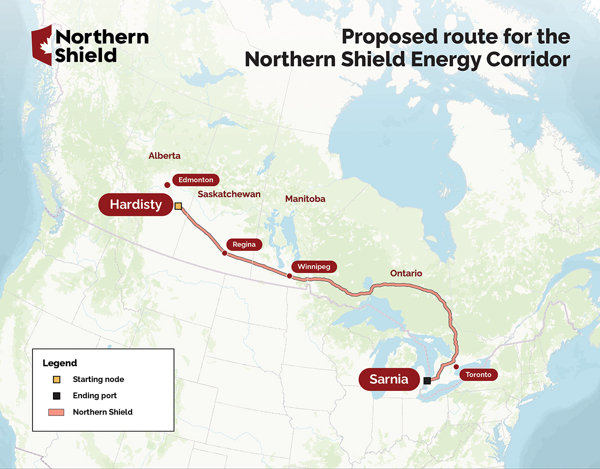
Call it Energy East 2.0, but kinda sorta, not really. There’s no Moosomin on-ramp like Energy East. It doesn’t make it past the Quebec border, yet. But it could possibly have offshoots to Churchill and maybe James Bay. This is the Saskatchewan perspective story on this pipeline
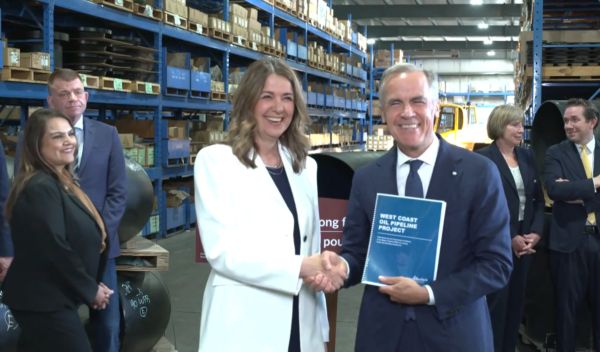
TMX 2? Trans Mountain 3? West Coast Pipeline to parallel existing Trans Mountain route, foregoing northern ports. In a case where going with the devil you know, the newly proposed West Coast Pipeline is expected to follow most of the Trans Mountain Pipeline right of way – you know, the one that saw TMX go from $7.5 billion to around $34 billion.
It turns out if the NDP wants your job to disappear, they don’t get your support. Imagine that? As in, if they want your house to lose half or more of its value, you to lose your job, and would rather spend money on gas from Alberta or wind and solar, what would you think?
Stampede Drilling, originally founded in Estevan, is sending a drilling rig to Greenland, yes, Greenland, to drill for oil. This is about as wildcat as you can possibly get, in one of the most inaccessible and hostile places on the planet.
This is NOT an April Fool’s joke, either.
(For those unfamiliar with the term, wildcatting means drilling for oil or gas in an area not previously developed. It’s a highly risky venture.) https://glossary.slb.com/terms/w/wildcat
Weekend Watch: The Iran War Expert: I Simulated The Iran War for 20 Years. Here’s What Happens Next.
While watching this, consider if the Iran War does become a forever war, what will it’s impact be on oil production, delivery through the Strait of Hormuz or lack thereof, the world economy, Canadian and Saskatchewan oil production could be profound and last years? Could this lead to a global recession, but good times for our oilpatch? Remember the $147 WTI barrel of July, 2008, led to the global financial crisis that September. Some of us are still bearing the scars of that.
Two Westinghouse AP1000 reactors at Vogtle. Cameco photo
Saskatchewan is the battleground between the AtkinsRealis (SNC-Lavalin/former AECL) CANDU reactor and the Cameco/Brookfield-owned Westinghouse AP1000 reactor. I’d digging as deep as I can to provide context for Saskatchewan decision makers who will be making this decision. In recent weeks I had two podcasts on the CANDU. This is the first on the Westinghouse. What’s really significant here is the Westinghouse ownership is now fully Canadian companies, even though the design is American. And in November or so, Trump’s administration said they’d build 10 of them.
Pipeline Online Podcast Ep. 31: Dr. Grant Isaac, Pres. & COO of Cameco on SK buying Westinghouse reactors. There were technical difficulties which shortened our time, so we’re going to take another run at it in the near future.
It turns out Pipeline Online isn’t the only one to use a Timbit as a unit of monetary measure. Maybe they got the idea from Pipeline Online? Here’s the Canadian Press story:
Should Saskatchewan buy the CANDU reactor when it comes to building large-scale nuclear in this province? Carl Marcotte Senior Vice-President, Marketing & Business Development at CANDU Energy, part of AtkinsRealis, makes the pitch. Building large reactors will only be the largest, most expensive decision made by this province for generations.
Things have been looking really bleak for southwest Saskatchewan’s oilpatch. If this were a medical drama, this would be where the doctor puts the paddles on the dying patient’s chest, yells, “Clear!” and shocks the patient.
We might have just seen a little blip on the heart monitor with this land sale.
And yes, it is that bad. Most oilfield services in that region have either shut down or are barely hanging on. I spent an hour yesterday talking to the owner of several businesses in that area.