More evidence that the marginal consumer is tapped out.
The figure represents a small percentage of Amazon’s 1.55 million total employees, but nearly 10% of its roughly 350,000 corporate employees.

More evidence that the marginal consumer is tapped out.
The figure represents a small percentage of Amazon’s 1.55 million total employees, but nearly 10% of its roughly 350,000 corporate employees.
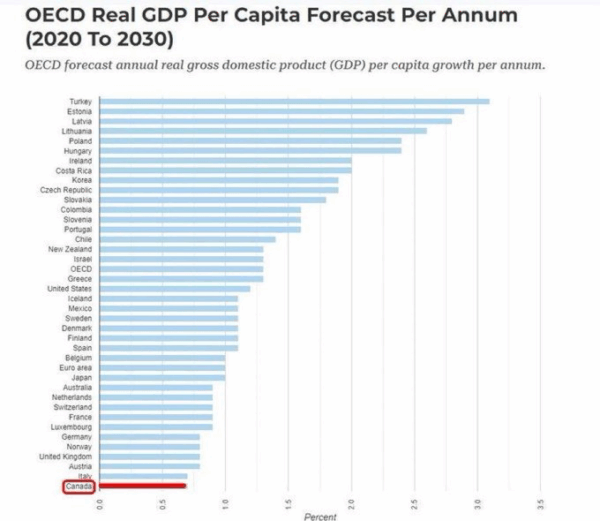
Basically, Canada needs US markets a lot more than they need our markets, or anyone else’s for that matter.
Beaudry contrasted Canada’s dependence on global trade — roughly 40 per cent of the economy — with the U.S.’s much lower reliance at about 15 per cent. That difference, he said, helps explain why Washington can afford to use tariffs as a political and fiscal tool without triggering the same level of economic disruption seen elsewhere.
Good Morning All –
In the wake of the disaster in California earlier this week, I’m going to Re-Up some previous writings on the issue of various immigrant groups into the North American trucking market.
A thread of threads + Intel
— Gord ‘Anti-Social Media Defluencer’ Magill (@GordMagill) October 25, 2025
But wait, there’s more.
Gord Magill has a book coming out…
With the Feast of All Hallows rapidly approaching I thought it would be apt to explain how the grid is haunted by a concept that doesn’t really exist. A pre-occupation with a made-up concept risks the security of our power grids. In this blog I will explain how “vars” aren’t real, and treating them as if they are is creating existential risks on our power grids.
Not being able to properly explain reactive power is common in the energy industry – ask a dozen people to explain it and you’ll get twelve different answers. Most will reach for the beer-glass analogy where real power as the liquid and reactive power is the froth, or mutter something about “energy sloshing back and forth” on the grid. More sophisticated responses will mention capacitors “injecting vars” and inductors absorbing them. These phrases are repeated so often that they’ve become folklore. Unfortunately none of them describes what actually happens in power grids.
“Vars” in particular is an accounting fictions that obscure the underlying physics. And because we’ve replaced understanding of the physics with shorthand, we now incorrectly believe that anything producing current including batteries, solar inverters, or a clever algorithm, can perform the same stabilising role as the electromagnetic machines that built our power system.This misunderstanding could one day cost us the grid.
I thought our new PM was just the guy we needed to stand up to the Americans. Oh, well…..
American truck maker Paccar Inc. is laying off 300 more factory workers in Quebec ahead of a 25 per cent import tariff to be imposed by the U.S. next month.
The factory in Sainte-Thérèse, a Montreal suburb, manufactures Kenworth and Peterbilt trucks and relies heavily on revenue from the United States.
Voters want lots of free stuff, so maybe those things will just pay for themselves, right? Unfortunately, I don’t know of a political party with currently elected members which would make a serious dent in any of that spending.
For the 2025-2026 fiscal year, Desjardins is projecting a $70-billion deficit, although the report acknowledges some estimates from other sources have been as high as $100 billion.
“There is a lot to unpack in the run-up to what will be a truly unprecedented federal budget,” said the report. “Deficits could rise to levels not seen in decades outside of a recession or pandemic, and the debt-to-GDP ratio is likely to be headed in the wrong direction.”
Apparently no one needs them anywhere else either.
General Motors is ending production of its BrightDrop electric delivery van in Ingersoll, Ont. in the latest blow to the province’s automotive sector.
The company says the decision is related to low demand for the model and it isn’t moving production elsewhere.
While monetary commodities like gold and silver continue to set new daily records in terms of their dollar price, it’s interesting to note that the dollar prices of non-monetary commodities like oil and copper continue to slide. That’s probably because economies tipping into recession don’t need as much oil and industrial metals as growing ones.
Gold prices rose by over 2% on Monday, buoyed by expectations of further U.S. interest rate cuts and sustained safe-haven demand, as investors awaited upcoming U.S.-China trade talks and inflation data out of the U.S. this week.
But zero percent interest rates ought to fix all those problems, right?
Meanwhile, traders are pricing in a 99% chance that the Federal Reserve will cut interest rates next week, with another cut in December. Gold, a non-yielding asset, tends to do well in low-interest rate environments.
At this point, I doubt that any measures are going to amount to anything other than flogging a dead horse.
Ottawa said the corporation is losing about $10 million per day, despite providing a $1-billion injection earlier this year to keep it operational. Since 2018, Canada Post has accumulated more than $5 billion in losses including more than $1 billion last year alone.
But Canada Post’s business model is meant to support communities across the country — especially those in remote locations who are hardest for private firms to reach — rather than chase profits, said Ann Armstrong, a professor at the University of Toronto’s Institute for Management and Innovation.
“There is something sacrosanct about a postal service,” she said.
“It seems to me the model is perfectly viable and needs to be preserved, if perhaps costs and so on need to be adjusted.”
…for all the Whitetail on Southern BLVD, located directly across the street from Palm Beach International Airport, in the median of a major highway… directly facing the Air Force One stairs (200yds).
For anyone who thinks that natural gas exports are going to magically replace job losses in the Canadian auto sector, think again.
Just five vessels sailed from the terminal in Kitimat, B.C. during the month of September, LNG Canada confirmed last week. It was short of the seven that had been expected, RBC Capital Markets said in note which pointed to a slower ramp-up of production at the Shell plc-led project since operations began in July.
Roughly 15 tankers per month will be required once the facility reaches full capacity, RBC noted.
It’s becoming a little clearer every day as to why gold continues to set records. Debt financing problems in the financial system don’t appear to be going away.
RealTruck’s response to its debt crisis has centered on aggressive restructuring. In a notable move, the company executed a debt-for-equity swap, converting its 0.00% 2027 Convertible Notes into 7.00% 2030 Senior Secured Convertible Notes. This maneuver reduced principal debt but came at the cost of issuing over 316 million new shares, diluting existing shareholders and sending its stock to record lows…
RealTruck’s journey through its debt crisis exemplifies the high-stakes calculus of corporate restructuring. While its debt-for-equity swap and cost-cutting measures have stabilized liquidity, the company’s reliance on volatile markets and its elevated leverage ratio remain significant hurdles.
It’s not a great sign when the mainstream financial media starts to pick up on news items concerning lending fraud. It makes you wonder how deep the rot really is.
CEO Jamie Dimon offered a mea culpa and a warning Tuesday when discussing the losses his bank experienced from the downfall of subprime auto lender Tricolor Holdings, saying, “It is not our finest moment” and “when you see one cockroach, there’s probably more.”
But the fall of Tricolor and a larger bankruptcy of auto parts supplier First Brands have captured attention on Wall Street, and investors are looking for signs that credit among commercial customers is weakening.
Rolling blackouts. A worthless currency. A once-mighty industry on life support. Doctors, engineers and students leaving in droves in search of a future. That all sounds like Venezuela, but I’m talking about Cuba.
As Venezuela’s crisis deepens, another — quieter but just as dangerous — is unfolding just 90 miles from Florida. The drama may be smaller, but the danger is real. If Venezuela is wobbling, Cuba is starting to fall.
On Sept. 10, Cuba’s entire electrical grid failed, plunging nearly 10 million people into darkness. It was the island’s fourth nationwide blackout in less than a year. Even before that, much of the country was losing power for half the day. Officials blamed machinery; Cubans blamed the system.
The country’s energy network has become a patchwork of corroded plants and emergency repairs. Over the past 14 months, it has suffered a dozen nationwide outages. Years of neglect and the burning of high-sulfur crude have crippled its power stations. As U.S. sanctions tighten on Nicolás Maduro, Venezuela’s ability to keep its ally supplied with oil has withered.
Fuel shipments from Venezuela — Havana’s economic lifeline for two decades — now fluctuate wildly, sometimes dropping below 10,000 barrels a day before rebounding. Russia and Mexico have stepped in with emergency cargoes, but neither offers stability. Without steady deliveries, plants sputter and nights become suffocating. In some towns, residents cook by candlelight, charge phones at work, and sleep on rooftops to escape the heat.
Another green fad is close to biting the dust.
Beyond Meat Inc. tumbled the most since the company went public in 2019 after the troubled plant-based protein producer said nearly all creditors had accepted a debt swap that will lead to a substantial dilution of shareholders.
The stock sank as much as 58% to 84.5 cents on Monday, its worst-ever intraday decline. The shares had already fallen 47% this year through Friday.
Good conversation.
Who’s bidding up the dollar price of monetary metals today? Central banks? Investors who lost tens of billions in Bitcoin on Friday? Whatever the case, the barbarous relic is really shining.
Spot silver climbed as much as 3.7% above $52 an ounce, exceeding last week’s peak, while gold traded near $4,100, building on a record-breaking run of eight weekly gains.
In reality, it’s a way of saying “we’re moving out” while trying not to make it look too obvious.
Linamar Corp. says it’s expanding its U.S. manufacturing footprint through a US$300 million deal to buy select North American assets of Aludyne Inc.