Category: It’s Probably Nothing

Job Shredding

As is typical of mainstream financial media reporting, you need to scroll to the bottom of an article to see a comment by David Rosenberg regarding Canada’s recent unemployment numbers. I suppose putting the comment at the top would have raised too many eyebrows.

While Statistics Canada’s Labour Force Survey is telegraphing a jobs boom, its Survey of Employment, Payrolls and Hours (SEPH) is telling a different story, said Rosenberg, founder and president of Rosenberg Research & Associates Inc. In the latter report the number of employees receiving pay and benefits dropped by 58,000 in September. For the first time in five years payroll employment was “completely flat,” he said.

“In a sign that there is more slack in the Canadian jobs market than meets the eye … if we were to superimpose the SEPH employment trend on the LFS (household) survey, the unemployment rate would be 8.2 per cent, not 6.9 per cent — and that would be the highest since May 2021,” said Rosenberg.


Dispatches from the Maple Gulag Truck Stop

Bankruptcies abound, yet the Mark Carney’s job numbers show a huge increase in transportation and warehousing?  I am starting to think the job numbers are prepared by the same people who said Mark Carney would win by a landslide in Alberta.  Trucking News reports on bankruptcies in Canada and Freightwaves reports on US bankruptcies, so any news of growth in the industry is highly suspicious.  Several months ago Gord Magill reported on the financial chinanery in the trucking industry

Sonar truck freight index shows an 11% decrease this year after several years of decreases.  Yet somehow we are supposed to believe the economy is adding jobs when trucking is failing, construction jobs are down and housing sales are flat?  Something stinks in the state of Denmark.

Trump’s New National Security Strategy

Zerohedge;

The Trump administration’s just published new National Security Strategy has generated a lot of ‘shock’ and discussion since it appeared online early Friday. One of its more ‘controversial’ elements is the stark contrast in outlook on Europe in comparison with prior years’ national security strategy documents.

It warns that some of America’s oldest allies in Europe face “the real and more stark prospect of civilizational erasure” as a result of unchecked immigration, as well as the erosion of democratic principles. Alongside calling out irresponsible unchecked EU immigration policies, it further cites the curbing of free speech – also with the support for EU censorship excesses by transnational elite institutions, describing that “should present trends continue, the continent will be unrecognizable in 20 years or less.”

Matt Gurney and Jenn Gerson discuss implications for a similarly compromised northern free rider.

Some of what the document lays out is simply true, and Canadian and other allied politicians, especially on the left, have ignored those realities at their peril. Some of it is debatable, or at least worth taking seriously. And some of it is outright nuts, pulled straight from the conspiratorial anxieties of America’s far-right social media ecosystem. But whether reasonable, arguable, or deranged, it is now official White House policy — and the rest of us are going to have to learn to live with it.

From there, the conversation turns to how Canadians are, or aren’t, learning to live with it. There is still very little evidence that anyone here grasps the scale of the threat or the urgency involved. Jen introduces a new theory: Canada as a nation is increasingly resembling the federal New Democrats — and that’s not good news for anyone.

Then they get angry that the document treats us like a bitter underachiever, before going full CBC derangement.

Money For Nothing

Yet another example of what happens when a bunch of politicians scream “emergency” and a gullible John Q. Public largely falls for it. This reminds me of a Seinfeld episode where Kramer tries to explain to Jerry what happens when a company makes a bad investment decision: “They just write it off, Jerry!”

Ontario wrote off more than one billion items of personal protective equipment at a cost of $1.4 billion since 2021 and is now burning expired products, the province’s auditor general found.

The province signed long-term contracts for PPE between October 2020 and April 2021 that locked it into buying 188 million surgical masks annually. Yet it only distributed 39 million of those masks last year, or 21 per cent.

Circling The Drain

The mainstream financial media is subtly acknowledging that a lot of the price action in Bitcoin was fueled by leverage. We seem to be in the process of finding out how leveraged bets on a rising asset price work in reverse. Hint: they don’t work very well.

Bitcoin, which was soaring around $125,000 in October, dropped below $86,000. That’s down roughly 7% from a day earlier.

Strategy, the company that used to be known as MicroStrategy and now raises money just to buy bitcoin, lost 10.3%. It said that it raised a fund of $1.44 billion in U.S. dollars, not in bitcoin, by selling stock to help pay for its dividends on preferred shares and interest on its debt.

Gradually, Then Suddenly


Ptomekin Village PM gets results.

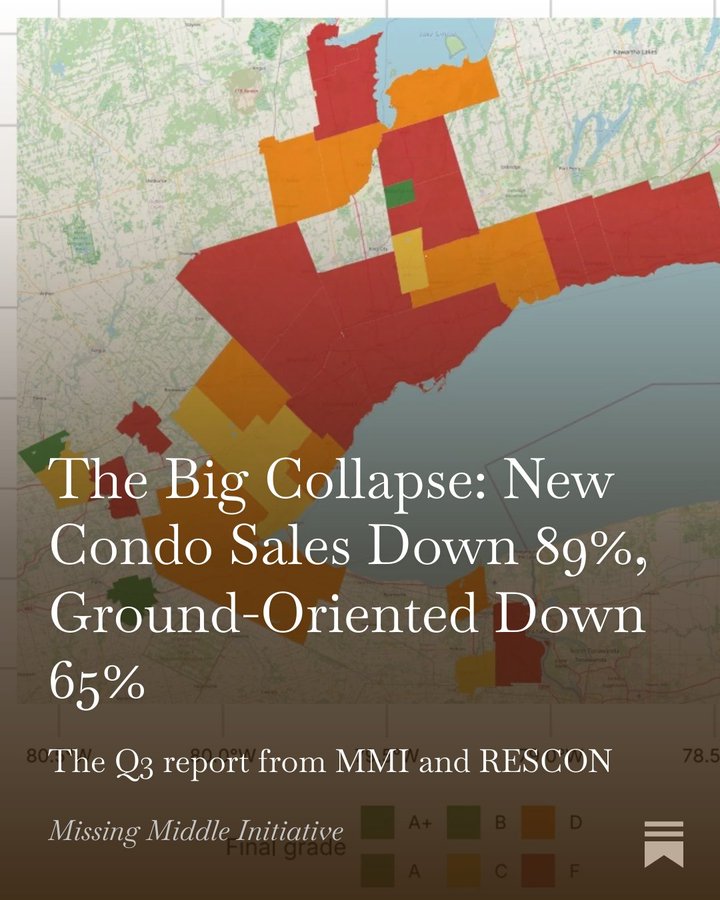
➜ Ontario’s housing engine has stalled: Starts are collapsing across the GTHA and GGH. Condo starts are down 51%, ground-oriented homes are down 43%, and overall starts are down 34%, with only rental apartments keeping the sector on life support. The weakness is not confined to condos or to Toronto.

➜ Tens of thousands of jobs are vanishing: The construction slowdown now equals 35,377 lost person-years of employment in the first 9 months of the year, and the losses are accelerating quarter after quarter.

➜ The real crash is still ahead: Pre-construction sales have fallen off a cliff, condo pre-sales down 89%, ground-oriented pre-sales down 65%, guaranteeing an even deeper downturn in 2026 and beyond.

@harrisonlowman – Only 25 new condos were sold in downtown Toronto last month. How is this possible?

Salt in wound: Housing Minister Gregor Robertson’s department spent more than $97,000 to send managers to a two-day conference on homelessness for “inspiration,”

Added Costs

It looks like someone forgot to tell John Deere that tariffs are a win/win proposition. Considering that companies like Deere are a perfect example of what most people would consider heavy industry, what’s the point of burdening them with extra costs?

Deere & Co on Wednesday flagged a bigger hit from tariffs in 2026 ​and forecast its annual profit below estimates on the back of weaker ‌margins on large tractors, sending the farm-equipment maker’s shares down 5%.

Caterpillar didn’t get the memo either.

Caterpillar now expects a tariff hit of $1.5 billion to $1.8 billion this year, up from its prior forecast of up to $1.5 billion.

Car Loan Blues

Yet more evidence that the marginal consumer, in this case the marginal car buyer, simply can’t afford that shiny metal anymore.

Scott Terrio, manager of consumer insolvency at Hoyes, Michalos & Associates, says that in his 17 years on the job, this is the first year he’s seen people contacting the firm with the intention of returning their vehicles.

“It’s very non-typical,” he said. “They’ve recognized that their car is killing them financially.”

Not to worry. I’m sure that tweaking EV mandates from 100% of new car sales to 90% will fix all of that.

“The Age of Disclosure”

NY Post;

Eric Davis, an astrophysicist who was a scientific advisor on the since-disbanded Advanced Aerospace Threat Identification Program, created by Congress in 2007 by late Sen. Harry Reid (D-NV), claimed that Bush confirmed to him in a private conversation details of contact between the military and an alien creature at Holloman Air Force Base in Otero County.

Bush told him that three spaceships were seen approaching the base and that an interstellar being emerged from one ship and had a face-to-face encounter with military and CIA officials, Davis said during an interview in “The Age of Disclosure,” a documentary by filmmaker Dan Farah that went live on Amazon Prime on Friday.

I did check it out at Amazon, but it’s kind of expensive.

Talkin’ Bout My Generation…

The more pressing question is: can most retirement funds generate sufficient capital to sustain themselves for such a long period? I’ll hazard a guess that most government plans don’t have nearly enough. Speaking from personal experience, I’d go crazy if I stopped working completely.

Not only is retirement coming faster, Canadians are also living longer. Since 2023, life expectancy in Canada has risen two years to 83, and since 2001 the number of people over 100 has doubled, said the study. Globally, the number of centenarians is expected to grow by 800 per cent by 2050.

Instead of the 20 to 30 “golden years” of earlier generations, workers today are potentially looking at retirements that span 40 years or more.


The Cheque Is In The Mail

I’m suspicious about the impact of these measures for a few reasons: voluntary departures come with severance; government retirement plans often require funding out of general revenue so early retirement just means more losses to cover; many eliminated jobs are potential positions as opposed to actual ones, and the timeline is an entire decade.

He said the company will use “attrition first” to downsize from the roughly 62,000 people it employed at the end of last year.

The company expects to shed 16,000 employees through retirement or voluntary departures by 2030, with an additional 14,000 leaving by 2035.

I, For One, Welcome Our New Self-Driving Overlords

Bubble, bubble, toil and trouble…

Hello, my friends. Have you been feeling too sane lately? Have I got something for you! It is a company called CoreWeave.

You may not have heard of it because it’s not doing the consumer-facing part of AI. It’s a data center company, the kind people talk about when they say they want to invest in the “picks and shovels” of the AI gold rush. At first glance, it looks impressive: it’s selling compute, the hottest resource in the industry; it’s landed a bunch of big-name customers such as Microsoft, OpenAI and Meta; and its revenue is huge — $1.4 billion in the third quarter this year, double what it was in the third quarter of 2024. The company has almost doubled in share price since its IPO earlier this year, which was the biggest in tech since 2021. So much money!

But as I began to look more closely at the company, I began feeling like I’d accidentally stumbled on an eldritch horror. CoreWeave is saddled with massive debt and, except in the absolute best-case scenario of fast AI adoption, has no obvious path toward profitability. There are some eyebrow-raising accounting choices. And then, naturally, there are the huge insider sales of CoreWeave stock.

Money For Nothing

That’s 600 billion, with a ‘B’. How much of the melt-up was driven by leverage, and who’s left holding the bag for those loans?

After topping $126,000 in October, Bitcoin has fallen sharply, briefly wiping out its 2025 gains before stabilizing on Monday.

With gold and stocks near all-time highs, Bitcoin is the “tip of the risk-assets iceberg and melting,” said Mike McGlone, senior commodity strategist at Bloomberg Intelligence. “I expect Bitcoin and most cryptos to keep falling.”

Nothing Burgers

When the marginal consumer can no longer afford Wendy’s, you just know things are going downhill.

There are currently about 6,000 Wendy’s locations in the U.S. Locations that are “consistently underperforming” will close in late 2025 or at some point in 2026. The number of stores affected could be up to around 350. Nation’s Restaurant News noted that Cook indicated they were “acting with urgency” to reverse the negative trend.

As CNN detailed, Wendy’s sales in the last quarter were down nearly 5 percent.

Elbows Down!

Generally speaking, the leadership cadre of large Canadian businesses tend to carry water for the Liberals no matter what. It’s refreshing to see at least one of them speaking out about the Canadian economy’s appalling lack of productivity.

“The business sector (has) grown productivity about 50 per cent since roughly 2000 (but) the non business sector — this is government and not-for-profit businesses and workers — in those areas … productivity has been absolutely flat, zero growth, not one bit of productivity,” she said at the University of Waterloo’s Tech Horizons conference.

“I find it kind of frustrating because those people were telling us in business that we’re not productive when they’re the ones who are flat like pancakes.”


Navigation