Category: Gradually Then Suddenly

Circling The Drain

The mainstream financial media is subtly acknowledging that a lot of the price action in Bitcoin was fueled by leverage. We seem to be in the process of finding out how leveraged bets on a rising asset price work in reverse. Hint: they don’t work very well.

Bitcoin, which was soaring around $125,000 in October, dropped below $86,000. That’s down roughly 7% from a day earlier.

Strategy, the company that used to be known as MicroStrategy and now raises money just to buy bitcoin, lost 10.3%. It said that it raised a fund of $1.44 billion in U.S. dollars, not in bitcoin, by selling stock to help pay for its dividends on preferred shares and interest on its debt.

Gradually, Then Suddenly


Ptomekin Village PM gets results.

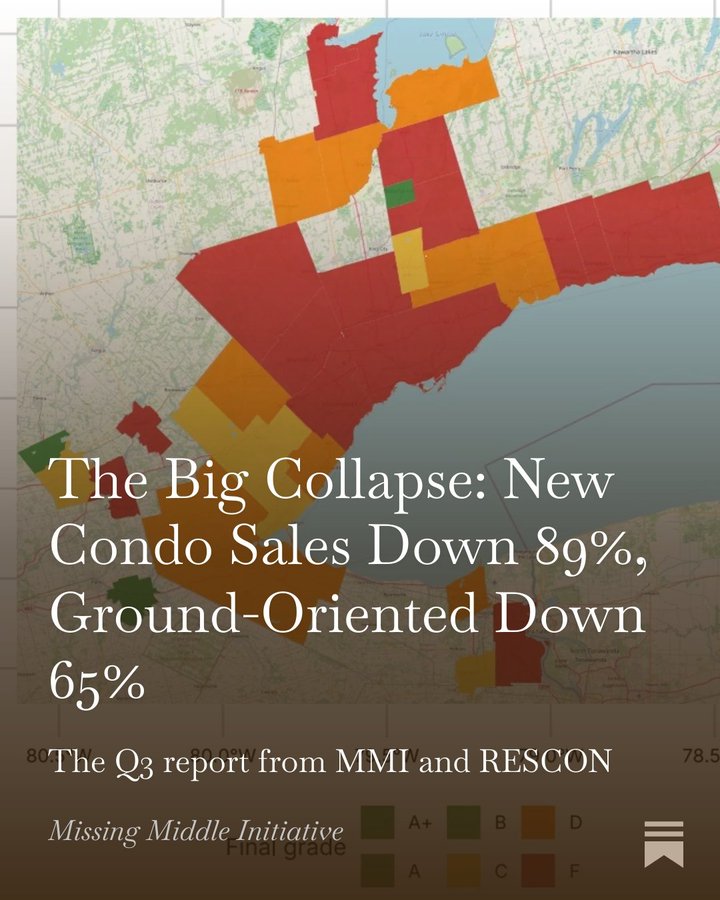
➜ Ontario’s housing engine has stalled: Starts are collapsing across the GTHA and GGH. Condo starts are down 51%, ground-oriented homes are down 43%, and overall starts are down 34%, with only rental apartments keeping the sector on life support. The weakness is not confined to condos or to Toronto.

➜ Tens of thousands of jobs are vanishing: The construction slowdown now equals 35,377 lost person-years of employment in the first 9 months of the year, and the losses are accelerating quarter after quarter.

➜ The real crash is still ahead: Pre-construction sales have fallen off a cliff, condo pre-sales down 89%, ground-oriented pre-sales down 65%, guaranteeing an even deeper downturn in 2026 and beyond.

@harrisonlowmanOnly 25 new condos were sold in downtown Toronto last month. How is this possible?

Salt in wound: Housing Minister Gregor Robertson’s department spent more than $97,000 to send managers to a two-day conference on homelessness for “inspiration,”

Added Costs

It looks like someone forgot to tell John Deere that tariffs are a win/win proposition. Considering that companies like Deere are a perfect example of what most people would consider heavy industry, what’s the point of burdening them with extra costs?

Deere & Co on Wednesday flagged a bigger hit from tariffs in 2026 ​and forecast its annual profit below estimates on the back of weaker ‌margins on large tractors, sending the farm-equipment maker’s shares down 5%.

Caterpillar didn’t get the memo either.

Caterpillar now expects a tariff hit of $1.5 billion to $1.8 billion this year, up from its prior forecast of up to $1.5 billion.

Car Loan Blues

Yet more evidence that the marginal consumer, in this case the marginal car buyer, simply can’t afford that shiny metal anymore.

Scott Terrio, manager of consumer insolvency at Hoyes, Michalos & Associates, says that in his 17 years on the job, this is the first year he’s seen people contacting the firm with the intention of returning their vehicles.

“It’s very non-typical,” he said. “They’ve recognized that their car is killing them financially.”

Not to worry. I’m sure that tweaking EV mandates from 100% of new car sales to 90% will fix all of that.

Talkin’ Bout My Generation…

The more pressing question is: can most retirement funds generate sufficient capital to sustain themselves for such a long period? I’ll hazard a guess that most government plans don’t have nearly enough. Speaking from personal experience, I’d go crazy if I stopped working completely.

Not only is retirement coming faster, Canadians are also living longer. Since 2023, life expectancy in Canada has risen two years to 83, and since 2001 the number of people over 100 has doubled, said the study. Globally, the number of centenarians is expected to grow by 800 per cent by 2050.

Instead of the 20 to 30 “golden years” of earlier generations, workers today are potentially looking at retirements that span 40 years or more.


Money For Nothing

That’s 600 billion, with a ‘B’. How much of the melt-up was driven by leverage, and who’s left holding the bag for those loans?

After topping $126,000 in October, Bitcoin has fallen sharply, briefly wiping out its 2025 gains before stabilizing on Monday.

With gold and stocks near all-time highs, Bitcoin is the “tip of the risk-assets iceberg and melting,” said Mike McGlone, senior commodity strategist at Bloomberg Intelligence. “I expect Bitcoin and most cryptos to keep falling.”

Nothing Burgers

When the marginal consumer can no longer afford Wendy’s, you just know things are going downhill.

There are currently about 6,000 Wendy’s locations in the U.S. Locations that are “consistently underperforming” will close in late 2025 or at some point in 2026. The number of stores affected could be up to around 350. Nation’s Restaurant News noted that Cook indicated they were “acting with urgency” to reverse the negative trend.

As CNN detailed, Wendy’s sales in the last quarter were down nearly 5 percent.

New Governor, Same As The Old Governor

Fitch ain’t having any of it.

Persistent Fiscal Expansion Underscores Canada Rating Pressures

Canada’s (AA+/Stable) proposed budget, announced in Parliament on Nov. 4, underscores the erosion of the federal government’s finances, says Fitch Ratings. While Canada’s rating is broadly stable, persistent fiscal expansion and a rising debt burden have weakened its credit profile and could increase rating pressure over the medium term. This may be exacerbated by persistent economic underperformance caused by tariff risks and structural challenges, including low productivity. […]

Combined with sizable non-budgetary financing needs (mainly support of enterprise crown corporations), the higher deficits will substantially increase general government gross debt (GGGD), which we forecast to reach 91.8% of GDP in 2025 from 88.6% in 2024, before accelerating to 98.5% by 2027, nearly double the forecast ‘AA’ median of 49.6%.

Another Zero Percent Interest Miracle!

The purpose of interest rates is to align the supply of capital with the demand for it. When they fall to zero, that sends a false signal that capital practically self-replicates and that no one really needs to care about where capital gets invested. These “malinvestments” are starting to show up more and more these days.

Among other things, authorities are trying to determine whether Tricolor double-pledged—using the same set of subprime loans as collateral against multiple warehouse loans. This would be akin to a homeowner with a $500K mortgage on a $600K house taking a second mortgage for $500K without notifying—in fact, intentionally withholding relevant information from—the lender about the first mortgage.

Smelter Skelter

Reuters;

Glencore is planning to close its Horne smelter, Canada’s largest copper metal-producing operation, due to environmental issues and the millions of dollars needed to upgrade the facility, two sources with knowledge of the matter said.

The London-listed miner does not disclose copper metal production figures for its Canadian operation, but industry sources estimate annual output at more than 300,000 metric tons.

Meanwhile… REGULATORY RELIEF FOR CERTAIN STATIONARY SOURCES TO PROMOTE AMERICAN MINERAL SECURITY

Oil’s Well

An economy in recession doesn’t need as much oil as one that grows. Who knew? More evidence that the marginal consumer is throwing in the towel.

Investors and analysts have spent much of the year embracing the view that the oil market, which has been in oversupply mode, is heading straight for a glut through 2026 — and that glut could reach as high as 4 million barrels per day (b/d) and depress global prices even further along the way.

Lacking Alternatives

Basically, Canada needs US markets a lot more than they need our markets, or anyone else’s for that matter.

Beaudry contrasted Canada’s dependence on global trade — roughly 40 per cent of the economy — with the U.S.’s much lower reliance at about 15 per cent. That difference, he said, helps explain why Washington can afford to use tariffs as a political and fiscal tool without triggering the same level of economic disruption seen elsewhere.

Dispatches from the Maple Gulag Truck Stop


But wait, there’s more.


Gord Magill has a book coming out…

Navigation