
Warning: The Bank of Canada is on track to lose over $5 billion in 2023.
The Bank of Canada released it’s 3rd Quarter report on Nov 17, 2023, and no one wants to talk about, not even the Conservatives, because it’s so bad. They don’t want to scare Canadians.
The Bank incurred net losses of $1,459 million ($1.46 billion) and $4,461 million ($4.4 billion) for the three- and nine-month periods ended September 30, 2023, respectively, primarily because the interest incurred on deposits was greater than the interest earned on investments. The interest expense on deposits was higher as a result of increases in the Bank’s policy interest rate, which increased from 0.25% in the first quarter of 2022 to 5.00% in the third quarter of 2023
Last year the Bank of Canada had it’s first loss in its 87-year history, and they paid themselves nearly $10 million in performance bonuses. This year the bank is on track to lose over $5 billion because of band borrowing.
Bogged Down
When even the leftist corporate media starts to question the Ukraine’s war strategy, it’s generally a pretty clear sign that the honeymoon is over.
The United States provides both Israel and Ukraine with military aid, and the breakout of a new war has raised fears about whether artillery shells and air defense missiles, once intended for Kyiv and already in short supply, would be diverted to Israel. Aid for both countries faces an uncertain path in the deeply divided Congress, and Ukraine was already facing a shortfall on what it was promised by the European Union.
The president is also facing criticism in some circles for signaling that he opposes holding next year’s scheduled presidential election amid the war, and Kyiv Mayor Vitali Klitschko said last week that the country was moving toward authoritarianism.
“At some point we will no longer be any different from Russia,” Klitschko told German news outlet Der Spiegel.
Gradually, Then Suddenly
Gradually, Then Suddenly
As a once-loyal client, I can attest to the fact that Royal Bank customer service has gone to shit, and recent interactions at TD even worse.
With many street-facing branch staff both communicatively handicapped (English as a recent language), limited in their authorities, and apparently without access to more capable supervisor support — what reason is there to believe such a system breeds competency at higher corporate levels?
Three of Canada’s biggest lenders posted quarterly earnings on Thursday, and as was the case at Scotiabank earlier in the week, they’re all putting a lot more money aside to cover loans that might go bad.
Royal Bank, TD Bank and CIBC revealed their financial results to investors before stock markets opened on Thursday, and while all three remain very profitable, they all showed a sharp uptick in the amount of money they’re setting aside to cover bad loans, a closely watched banking metric known as provisions for credit losses.
At Royal Bank, Canada’s biggest lender set aside $720 million to cover loans that either aren’t currently being paid back as planned, or the bank is worried might soon be. That figure is up by 89 per cent from $381 million a year ago.
At TD, the bank set aside $878 million in provisions, an increase of 42 per cent from $617 million this time last year.
But I’m just the customer. If you work on the front lines at a financial institution, tell me what you know.
That Sinking Feeling
Since GDP simply adds up all borrowing and spending in the economy, no matter whether undertaken by governments or the private sector and with no regard for what the money was spent on, it’s quite a feat to get a negative GDP number. Nonetheless, Canada seems to have done just that.
Statistics Canada reported on Nov. 30 that third-quarter GDP contracted 1.1 per cent, compared with expectations of 0.1 per cent growth, according to Bloomberg.
What’s truly remarkable is that the decline in GDP has occurred in an environment where borrowing and spending by all levels of government has risen exponentially in recent years. That can only mean that private sector spending must be cratering in order to have an overall decline. And if you’ve had to pay $50 for breakfast for two as I did recently, you can imagine just how tapped out the marginal consumer must be.
The Zimbabwe Solution
After nearly thirty years of rule by a party which embraced the motto of “nationalizing the mines, banks and monopoly industry” South Africa will soon be at the point where there is nothing left to nationalize anyway.
ArcelorMittal South Africa (ACLJ.J) shares tumbled nearly 14% on Tuesday after the company said it plans to close its long steel operations due to weak demand and persistent infrastructure problems, potentially affecting 3,500 workers.
The company said steel consumption in Africa’s most advanced economy has fallen 20% over the past 7 years, due to limited spending on infrastructure and project delays.
The country’s persistent rail logistics problems and an intensifying electricity crisis had also added costs to the business…
Gradually, Then Suddenly
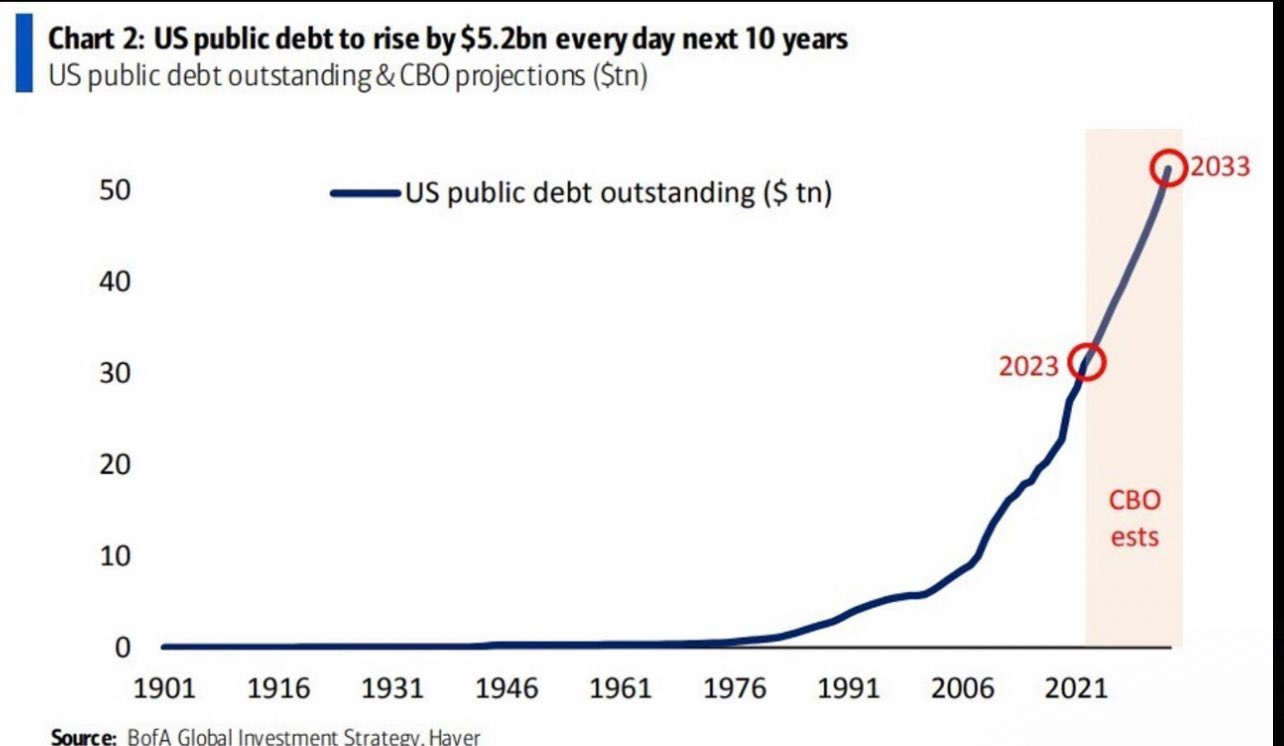
Peter St Onge, Ph.D Last Thursday saw a near-failure of a Treasury auction. Which is the global reserve asset, the biggest block in the jenga tower in our Ponzi financial system. Why? Because the debt sales are too big, and foreigners aren’t buying anymore. The Fed typically hikes until something breaks. They’ve done the hikes. Now come the breaks.