

We Don’t Need No Flaming Sparky Cars
Demand was “…not as robust as expected”.
GM CAMI Brightdrop EV van assembly plant takes another hit
"Unifor Local 88, which represents workers at the plant, says it has been informed by GM the plant will reopen mid November with just 400 people. That's down from 1,050 and significantly less than the 600 union officials… https://t.co/1mI232xZll pic.twitter.com/KGiZOXjGS2
— cbcwatcher (@cbcwatcher) September 9, 2025
We Don’t Need No Stinking Giant Fans
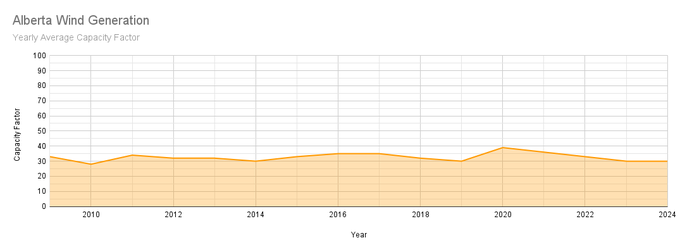
@ReliableAB — Here’s a chart showing the yearly average wind capacity factors over the past 15 years.
We Don’t Need No Flaming Sparky Cars
Think of the billions that might have been saved if they let me run the world.
Quebec’s Northvolt project is officially dead — and the government says it is cutting its losses.
Christine Fréchette, Quebec’s economy minister, announced Tuesday that the province will invest no further money in Northvolt Batteries North America.
“The company’s failure to present a satisfactory plan with regard to Quebec’s interests has led us to assert our rights in order to recover as much of our investment as possible,” Fréchette’s said in a statement. “This venture proved unsuccessful, and we are obviously disappointed.”
The announcement spells the end to Northvolt’s highly touted, but controversial, plan to build a $7-billion plant in Saint-Basile-le-Grand and McMasterville in the Montérégie region. The Quebec government had supported the proposal and changed its own rules, allowing the project to bypass an environmental review.
Quebec had invested $510 million in the project, saying it would create 3,000 jobs in the area and make Quebec a battery producing powerhouse.
The investments included a $240-million guaranteed loan and a $270-million investment in Northvolt Batteries North America’s parent company.
Quebec officially lost that $270-million investment, Fréchette said in a news release. Northvolt declared bankruptcy in Sweden in March.
We Don’t Need No Flaming Sparky Cars
General Motors Co. is slowing production of two electric SUVs at Detroit’s Factory Zero plant amid lower-than-expected U.S. interest in battery-powered vehicles.
The automaker confirmed Thursday that it will shut down one shift each for the GMC Hummer EV and Cadillac Escalade IQ from Sept. 2 to Oct. 6; the move was first reported by the Detroit Free Press. Production of the Chevrolet Silverado EV and GMC Sierra EV pickups at the Factory Zero Detroit-Hamtramck Assembly Center will be unchanged.
“Factory ZERO is making temporary adjustments to production to align to market dynamics,” spokesperson Kevin Kelly said in a statement. “General Motors updates schedules as part of our standard process of aligning production to manage vehicle inventory. Impacted employees will be placed on a temporary layoff and may be eligible for subpay and benefits in accordance with the GM-UAW national contract.”
Y2Kyoto: Sunshine Is Free

Our Chinese-Installed Governor In Ottawa
The more things stay the same, the more things stay the same.
Why Are We Trading Our Breadbasket for a Battery Pack?
In protecting a shaky electric vehicle dream, Ottawa is putting a $43-billion canola reality at risk — sacrificing a cornerstone of our agricultural economy for a battery pack that may never deliver. […]
The backdrop to all of this is Ottawa’s high-stakes bet on the EV sector. Despite nearly $50 billion in combined federal and provincial investments, Canada’s EV industry is faltering. Sales are dropping, mandates are clashing with market realities, and major projects are delayed or shelved. Without a significant acceleration in charging infrastructure, policy recalibration, and restored investor confidence, the sector risks collapse.
Ottawa’s trade stance is effectively protecting a fragile EV industry at the expense of a robust and profitable canola sector. One is speculative and policy-driven; the other is market-proven and globally competitive. The policy choice here should be obvious: Canada must either adjust its EV tariff position toward China or carve out exemptions to protect agricultural exports. Beijing has made its expectations clear.
Related: Built in 1960, the Second Narrows Bridge was not designed for the volume and weight of modern freight trains, which have grown substantially in size and frequency to meet rising global demand.
Y2Kyoto: Blunder Down Under
You can’t cheat Father Physics.
“The head of one of Australia’s biggest power retailers has warned that Australia’s energy transition is veering out of control, pointing to a major market disruption that hit New South Wales as evidence of the turmoil. During a week in which NSW agreed to extend the life of the state’s biggest coal plant, Alinta boss Jeff Dimery cited dramatic events in the market earlier in the month to argue the system was in distress.
The Australian Energy Market Operator was forced to step into the NSW market and cap wholesale prices between May 8 and 15 after a series of shocks sent costs into orbit. It’s believed to be only the second time the market operator has had to make such an intervention in NSW — the first being the energy crisis of 2022.”
[…]
“He said the energy system was getting more fragile as the addition of new clean sources of power failed to keep pace with the retirement of coal-fired generation.”
Via Doomberg.
We Don’t Need No Flaming Sparky Cars
Blacklocks: A federal regulator yesterday predicted weaker 2025 sales of zero emission vehicles just ahead of mandatory quotas. MPs on June 17 voted 194-141 to uphold the federal mandate that requires 20 percent of 2026 new vehicle sales be zero emission: “Weaker sales in 2025 are likely.”
I Want A New Country
BC & Manitoba just signed an economic trade partnership
Not to build pipelines, LNG, unlock energy corridors.Nope two NDP provinces are teaming up to build wind farms, export virtue signals, and pat each other on the back while the real economy rots
pic.twitter.com/KSn0SuumSk— Marc Nixon (@MarcNixon24) August 6, 2025
Related! Gas is $1.649 in Abbotsford, BC. Jumped 17 cents overnight!
We Don’t Need No Stinking Giant Fans
Heh.
NOW – Trump lectures Ursula von der Leyen on windmills: "It's a horrible thing… the whole thing is a con job." pic.twitter.com/rtajF0zy5q
— Disclose.tv (@disclosetv) July 27, 2025
We Don’t Need No Stinking Giant Mirrors
Sunnova’s bankruptcy saga reads like a sequel to Enron’s downfall, complete with glitzy deceptions and government-fueled illusions. Back in February, dealers gathered at a lavish summit, expecting praise and payments. Instead, they were fed assurances by then-CEO John Berger, an Enron alum, that funds were secure if they kept installing solar systems. But the truth was grim: Sunnova was already teetering, months behind on reimbursements, and hiding severe liquidity issues.
We Don’t Need No Flaming Sparky Cars
All the right people made bank and that was the objective: Biden push for $10B electric mail delivery fleet flops with just 250 trucks built in two years
We Don’t Need No Flaming Sparky Cars
EVs Are Out, Gasoline Power Is In At GM’s Orion Plant
Don’t look now, but General Motors is pulling the plug on building EVs at its Orion facility in Michigan. Confirming the news yesterday, it will instead assemble an array of light-duty pickup trucks and the Cadillac Escalade, said to be all part of a $4 billion push to meet demand for gasoline-powered vehicles in this country.Local media, specifically The Freep (Detroit Free Press) were among the first to report on the story.
Related: EV pickup truck sales in the U.S. in Q2 2025, according to new Cox Auto data
We Don’t Need No Flaming Sparky Cars
Good work by Andrew Scheer.
What do a caveman, Napoleon, and you in 2035 all have in common?
Not owning a car.
This is going to be a long one. So grab a drink and settle in because you won’t believe what Mark Carney is doing. pic.twitter.com/pAhAuYxPvh
— Andrew Scheer (@AndrewScheer) July 4, 2025
We Don’t Need No Flaming Sparky Cars
Electric vehicle (EV) sales have plummeted in Canada, dropping by a staggering 53% between Q4 of 2024 and Q1 of 2025.
This sharp decline in sales comes at the very moment governments across Canada have imposed increasingly aggressive EV sales mandates requiring consumers to switch to EVs.
An immediate course correction is required before government mandates wreak havoc on consumers and the auto industry, jeopardizing the livelihoods of the hundreds of thousands of people it employs.
We Don’t Need No Flaming Sparky Cars
Brian Kingston, President and Chief Executive Officer of the Canadian Vehicle Manufacturers' Association (CVMA) states while heading into meeting with Carney
"Well, the EV mandate itself is not sustainable. The targets that have been established cannot be met, and that will be… pic.twitter.com/4lKjp7DvPJ
— cbcwatcher (@cbcwatcher) July 2, 2025
We Don’t Need No Stinking Giant Fans
The Physics Behind the Spanish Blackout
When a grid failure plunged 55 million people in Spain and Portugal into darkness at the end of April, it should have been a wake-up call on green energy. Climate activists promised that solar and wind power were the future of cheap, dependable electricity. The massive half-day blackout shows otherwise. The nature of solar and wind generation makes grids that rely on them more prone to collapse—an issue that’s particularly expensive to ameliorate. […]
Grids need to stay on a very stable frequency—generally 50 Hertz in Europe—or else you get blackouts. Fossil-fuel, hydro and nuclear generation all solve this problem naturally because they generate energy by powering massive spinning turbines. The inertia of these heavy rotating masses resists changes in speed and hence frequency, so that when sudden demand swings would otherwise drop or hike grid frequency, the turbines work as immense buffers. But wind and solar don’t power such heavy turbines to generate energy. It’s possible to make up for this with cutting-edge technology such as advanced inverters or synthetic inertia. But many solar and wind farms haven’t undergone these expensive upgrades. If a grid dominated by those two power sources gets off frequency, a blackout is more likely than in a system that relies on other energy sources.
Green energy manufacturer can’t afford the cost of energy;
A major supplier to Britain’s green energy industry is set to close after its Japanese owner failed to clinch a rescue deal for the company and its 250 workers.
Wigan-based Electric Glass Fiber UK (EGFU), which is owned by Nippon Electric Glass (NEG), makes vital components used in wind turbines and electric cars. Its closure puts net zero supply chains under threat.
We Don’t Need No Flaming Sparky Cars
Audi has abandoned its 2033 deadline for phasing out internal combustion engines, marking a significant reversal of the German manufacturer’s previous electrification strategy.
Battery Plant Barbie
Holy crap we are doomed. Joly has no idea what she is doing or talking about. This is embarrassingly bad. This is being said in front of the automotive sector. They probably can’t believe what they are hearing. pic.twitter.com/oOKWPZg5sr
— Ryan Gerritsen🇨🇦🇳🇱 (@ryangerritsen) June 11, 2025