Pipeline Online speaks with Premier Scott Moe at conclusion of Dubai COP28 trip. (Another reporter asked questions, too, like do you believe the planet is warming…?
The problem is, except for refining, oil sands and big inch pipeline construction, unions are all but non-existent in the oilpatch. But hey, the legislation also includes five year plans, with the exact implications of what that means. Total transformation of the economy.
Pipeline Online did In depth interview with the woman at the centre of the carbon tax storm, Conservative Natural Resources Critic Shannon Stubbs. This is part 1.
Also, hope for rising oil prices to lead to an increase in activity were dashed, so one of Saskatchewan’s serial entrepreneurs relocated one of his operations, based in Regina, to North Dakota, instead. Anyone care to guess why Canada’s oilpatch didn’t see an uptick in activity, and does it rhyme with “Doh?”
This is significant news. I’ve been saying for a while that Crescent Point has lost interest in Saskatchewan, and any day now we can expect the company to sell off its assets here. Note that both Shaunavon and Weyburn have rinks called “Crescent Point Place” and the lounge at the Estevan rink is similarly named. I pointed out in the story the company for a brief time was Saskatchewan’s largest oil producer. They did over 20 acquisitions (actually closer to 30, I believe), most of them in Saskatchewan, creating many millionaires and making a lot of people rich. But these days it is readily apparent their interest is elsewhere. The only references to Saskatchewan were, at the top of the list of highlights, that this deal “Transforms company into a Montney and Kaybob Duvernay focused E&P with complementary long-cycle assets in Saskatchewan.”
Also noteworthy – with this announcement they are increasing the Alberta proportion of their capital expenditure to 80%, up from the 70% from just a few weeks ago. It wasn’t that long ago, it was more like 95% in Saskatchewan.
So if you want to know why our drilling rig count is down so much, why $80 to $90 oil doesn’t have activity shooting up in this province – here’s your answer.
If someone’s going to make billions in the lithium world, maybe we in Saskatchewan should put some of that in our pocket. One of the three active lithium explorers in Saskatchewan is moving closer to commercialization. This is a video I did showing what’s going on. Lots of cool shots of earthmovers.
I’ve been writing about the phenomenal growth of the North Dakota Bakken for the better part of 15 years. In 2008, the state produced around 90,000 barrels per day. By 2014, it was something like 1.2 million. Currently it’s around a million or so. A major player was Hess Corporation, which currently produces about 175,000 barrels of oil equivalent in North Dakota. But curiously, none of the supermajor oil companies were involved in North Dakota. Well, that changed, as Hess is being bought by Chevron.
Kruger said his comments were misinterpreted as Suncor ending its commitment to curbing its carbon footprint, when the focus is really on ensuring the company is making profits now to be able to afford the required investments in decarbonization.
Also, North American Helium opens its seventh helium processing facility in Saskatchewan. For those who might be counting, that’s the fourth in less than a year.
In Pipeline Online’s neverending quest to let the public know exactly what our federal government & Steven Guilbeault is telling us about climate change, here is a verbatim, unfiltered press release from Oct. 12 regarding the carbon tax in New Brunswick.
And our favourite minister, Steven Guilbeault, announced “Canada’s Circular Economy month in October.” Except instead of doing so on the 1st of the month, he did it on the 12. Maybe circular months have no beginning, no end. Think of Groundhog Day, with Steven Guilbeault telling us every day, forever, how we are horrible people…
There’s an election today in Manitoba, so all bets are off if the NDP forms government. But on the off chance that the Conservatives hold power, here goes. The conservative premiers of Alberta, Saskatchewan and Manitoba have been talking about building a new port at Port Nelson, Manitoba, on Hudson Bay. They would build a corridor of pipelines running oil and natural gas to said port, as well as rail, allowing potash exports. Maybe grain, too? And Power from Manitoba could run west. Anyhow, here’s an alternative way to look at it, probably for a lot cheaper than building over 1,000 km of pipeline through some of the hardest rock on the planet.
In the last week I’ve spoke to some of the most knowledgeable people I know in the Saskatchewan oilpatch, business owners all, from Weyburn, Lloydminster and several from Estevan. There’s a rising chorus of dissatisfaction amongst them. Things should be booming in this province’s oilpatch, but they aren’t. And this disquiet could threaten the governing Saskatchewan Party with the potential loss of a key portion of its base.
It turns out that carbon dioxide-enhanced oil recovery is more significant than even I thought, and I’ve been writing about if for 15 years. It accounts for a huge number of the top 100 conventional oil wells in Saskatchewan. Huge. And it proves out the significance and importance of CO2-EOR. Imagine what we could do across Saskatchewan with access to a lot more CO2? That’s going to have to be a column, methinks.
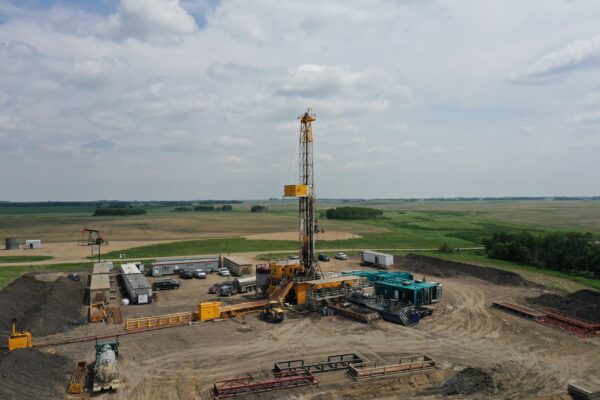
This yellow rig, originally Eagle Drilling Rig 1, was built in large part because of the activity Crescent Point was doing. It often worked for Crescent Point. Dozens of people made a lot of money over the years off of this one rig alone. Photo by Brian Zinchuk
One commenter wondered what the post about Crescent Point yesterday was all about, and seeing by the lack of comments, he was right to suggest it might be a bit of “inside baseball.” So let me lay out some context for the average Saskatchewan resident:
The “Bakken Boom” of 2008-2014, which included over a billion dollars of land sales in 2008, was largely driven by Crescent Point. Most of that billion dollars in land sales that year, the year Saskatchewan paid off a huge chunk of debt, was directly from Crescent Point. Remember when the provincial government had that huge surplus in 2008? Crescent Point was a huge factor in that.
Their prodigious activity drove thousands of high paying jobs in Estevan, Weyburn, Carlyle, Carnduff, Midale, Stoughton, Torquay, Lampman, Benson, Arcola, Redvers, Gainsborough, Oungre and more, literally spending billions per year, mostly with oilfield service companies, who in turn paid wages. See, in Saskatchewan, the oilpatch isn’t really about the oil companies, but the hundreds of oilfield services companies who employ thousands of people that work for those oil companies. And those people then bought trucks, quads, boats, RVs, houses, Riders tickets, restaurant meals and more.
Millions of people across Canada, through mutual funds or direct stock ownership, or pension plans or other institutional investors, made billions off Crescent Point.
At one point, Crescent Point accounted for roughly one out of every four barrels of oil produced in Saskatchewan. And at that time, oil royalties were paying up to 20 per cent of the provincial budget’s revenues, while health care was consuming about 39 per cent of the budget’s expenses. That meant that oil was paying for roughly every single doctor, nurse, hospital, old folks home, Xray, MRI and more south of Lumsden – including Regina – and Crescent Point was paying for roughly one quarter of that.
On health care – it was Crescent Point that got the ball over the line in leading the fundraising to get STARS air ambulance finally going in Saskatchewan. While Potash Corp eventually donated more money, Crescent Point was the leader in that endeavor. If they hadn’t done that, it might have been several more years before getting a helicopter air ambulance here. If we had STARS in 1997 when my grandfather had a stroke, maybe he wouldn’t have turned into a vegetable and died a slow death. STARS responded the night my sister died. It matters.
Before they started selling off land in 2018, Crescent Point controlled huge swaths of land across southeast and southwest Saskatchewan. Over the course of something like 30 acquisitions, almost every one of those made the sellers rich, and those sellers often went on and reinvested a large portion of that money back into Saskatchewan.
They were really hard on oilfield service providers to cut costs when the 7-year downturn hit around Christmas of 2014. But when nearly all other oil companies pulled their horns in and stopped spending money, Crescent Point did not. They kept going, even if they were paying less. That kept a huge portion of the industry afloat for several years, even if begrudgingly. For several of those years, Crescent Point employed more drilling rigs in Canada then the No. 2 and No. 3 oil companies combined. They may have been lean times, but lean was better than starvation, which is what most of the rest of the oil business was doing. In February, 2018, Crescent Point employed 29 drilling rigs, 27 of which were in Saskatchewan. They kept the industry afloat when no one else was.
Despite being based in Calgary, Crescent Point, along with Husky, were our oil industry corporate champions – Crescent Point for a decade, Husky for decades.
And now, Crescent Point’s activity and involvement in Saskatchewan is a shadow of its former self. While Whitecap Resources has in a small way picked up where Crescent Point left off, at this point it’s nowhere close. And as a result, all those towns listed above, and the province as a whole, are feeling the difference.
You may not realize it, but without Crescent Point from 2008-2018, almost everyone in Saskatchewan, and Saskatchewan itself, would have been poorer as a result.