Didn’t Biden say, “We’re not going to turn the faucet off and say we’re not drilling anymore?”
Well, on April 21, his Interior Secretary was singing from a different choirbook. But “We’re in a climate crisis, everyone,” she noted.
Didn’t Biden say, “We’re not going to turn the faucet off and say we’re not drilling anymore?”
Well, on April 21, his Interior Secretary was singing from a different choirbook. But “We’re in a climate crisis, everyone,” she noted.
The Nemeth Report Podcast: Energy transition crisis, with Irina Slav, has some real straight-forward talk about the realities of the energy industry, and keeping people scared about climate change. Expect to see more on Pipeline Online from T Nemeth, who is originally from Saskatchewan.

One of the key leading indicators of oil and gas development is Crown land sales. And the Saskatchewan April sale saw increased interest in all four oil production areas of the province.
On the opposite end of the timeline is well abandonment and cleanups. When the crap hit the fan for the industry when COVID-19 hit, there was a cry for some sort of relief program. That ended up being the Accelerated Site Closure Program, which properly abandoned inactive wells and facilities. That program just recently concluded, having been fully subscribed.
And on the other side of the country, Newfoundland’s Muskrat Falls hydro project is finally online. This project almost bankrupted Newfoundland, but the feds quietly bailed them out during COVID. That kinda got swept under the rug. Muskrat Falls was Newfoundland’s attempt at squeezing additional power out of the same river system as the massive Churchill Falls project, which produces about 50 per cent more power than the entire province of Saskatchewan on any given day. Quebec pays Newfoundland next to nothing for that power, and uses it domestically and sells it to the US and enormous margins. Muskrat Falls, at a much lower output, was basically Newfoundland’s F You to Quebec.
This stirs up serious memories for me, as I was the Canadian reporter in 2016 who asked presidential candidate Donald Trump if he would approve the Keystone XL Pipeline. He said he would, but “he wanted a piece.”
Here we are in 2023, and a Canadian Press reporter challenged President Joe Biden on cancelling the Keystone XL and delaying the Line 5 project, but approving a new oil project in Alaska. And it turns out, math is hard.
I don’t know who that reporter was, but I’d buy him a bottle of 18-year old Scotch.
Also, there’s a hell of a lot said about energy in the joint statement released by Trudeau and Biden. And some in his speech to Parliament, too.
Did you know that Lampman and the Kerrobert area are neck-and-neck when it comes to the top producing conventional oil wells in Saskatchewan? And it’s really close, despite being over 500 km apart.

Uncertainty about the regulation of downstream emissions was one of the things that ultimately killed the Energy East Pipeline project. This was one of the clearest cases of the federal Liberal government “moving the goalposts.” If legal ecowarriors Ecojustice are successful in this case, it could have profound implications for all oil production in Canada. That’s especially is we are to be “net zero” by any particular date.
Note in the story how the Bay du Nord offshore project was approved by CN-tower climber himself, Steven Guilbeault. The story notes how it was one of the hardest choices in his life. Interesting, how a Newfoundland offshore project could get approval from none other that Guilbeault, and yet the rest of the oil industry feels it has no hope with him. Would that have anything to do with Newfoundland’s consistent election results of nearly every seat going Liberal red for decades? And that this project will be enormously profitably for Newfoundland? Yet when it came to the $20 billion Teck Frontier oilsands project in Alberta, the company walked away because it didn’t feel it could get any regulatory confidence from the feds?

Year end numbers are now available for Saskatchewan oil production. Also known are the top 10 oil producers in Saskatchewan, and their total and average production for the year.
In other words, these are the people who are paying the bills for a large part of our roads, hospitals and schools.

Back in the lofty, pre-Trudeau government days of 2014, back when oil was booming, pipelines were planned to east and west coasts, and Alberta and Saskatchewan were swimming in money, around $81 billion was spent in capital expenditures (CAPEX) in the Canadian petroleum industry. On Wednesday, the Canadian Association of Petroleum Producers (CAPP) forecast CAPEX of $40 billion, which is just about double the disaster year of 2020, but half of 2014. And that’s before #justinflation. What would it be if we had a federal government supportive of the industry, instead of trying to make it disappear?
Curiously, Enbridge announced on the same day its spending a lot of money in Texas, including a port facility for Houston. Funny how it’s not talking about Northern Gateway to Kitimat, or Churchill, or even Valdez, Alaska? Wonder why?
And here’s Brian Zinchuk’s column analyzing all this.
“Dark fleet,” anyone? U of R professor Jim Warren writes about how Russia’s doing an end run around oil sanctions. Too bad we never built Energy East and were able to replace some of those barrels.
Speaking of oil – it’s expected to have a big impact on Alberta’s budget on Tuesday.

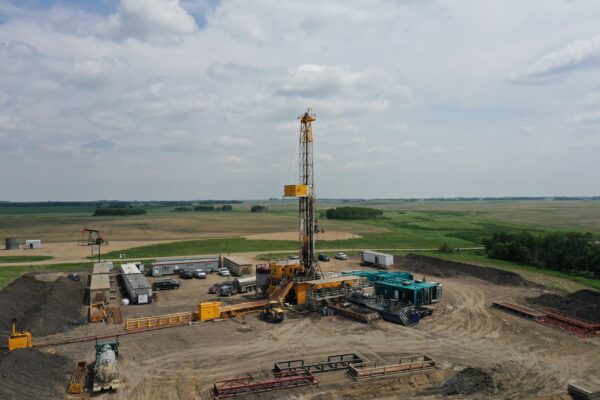
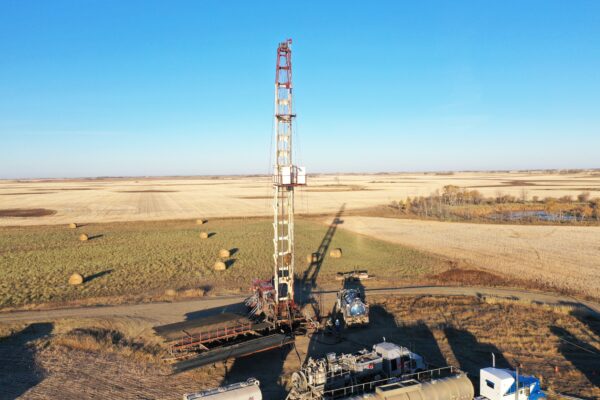
This time of year is the peak of the drilling season, and the rig count is the leading indicator for the oil business. Here’s the rig report as of Valentine’s Day. While you were giving your sweetie flowers, these guys were turning to the right.
Teck, one of Canada’s largest mining companies, has been around for over 100 years. But even with all that experience, they couldn’t handle the federal government’s Impact Assessment. They were going to spend $20 billion on their Frontier Oil Sands Project. The initial application was in 2012, but eight years later, they didn’t have an answer, so they pulled it. On Thursday, they sold off their last oil sands interests and are out of the oil sands entirely. Wonder why?
If you ever watched Battlestar Galactica (2003-2009), you’ve heard, “All of this has happened before, and will happen again.” Well, it might be happening in the Bakken north of Estevan.
Three stories on carbon capture and storage (CCUS): On Wednesday, the feds announced an intake for projects related to CCUS.
And the Petroleum Technology Research Centre announced recently they were including a CCUS summit in this spring’s Williston Basin Petroleum Conference.
And then there’s the oilsands efforts in CCUS. Bonus points for the Canadian Press story including the Canadian Centre for Policy Alternatives.
Rob Morgan, president and CEO of Strathcona Resources, grew up in Saskatoon and went to chemical engineering at the U of S. He cut his teeth in the Lloydminster oilpatch, and is now running one of the largest oil produces in Saskatchewan. Strathcona bought Serafina Energy this past year, and has substantial activity north of North Battleford. The Patchwork Podcast on Pipeline Online goes deep with Morgan, who sees a long future for oil and gas.

A huge reason behind Saskatchewan’s growth as a ‘have’ province was the advent of horizontal oil wells with multi-stage fracking, which had a substantial impact on oil production. And Crescent Point ended up with most of the fracked oil plays in Saskatchewan – the Bakken, Torquay and Shaunavon. But in what can only be considered a stunning move, Crescent Point announced on Wednesday that it’s trying to drill wells in the Bakken but not frac them.

If Saskatchewan can’t get out of a carbon tax, it looks like it’s going to try to reduce that overall carbon tax burden. The throne speech indicates that carbon offset credits from zero till farming will be available to lower other industries’ carbon tax burden.

Quick Dick McDick has a few salty words about the recent protest in London to Just Stop Oil.
“Now if you could look past the dipshittery of talking about people starving while you throw two perfectly good cans of soup against a painting….”

It’s 6 a.m. and after pulling an all-nighter I am finally finishing writing these three pieces. Huge impact on energy policy in Saskatchewan, affecting oil, coal, nukes, farming, fertilizer, even manure. Moe even mentions possibility of carbon capture on Shand. But feds want to kill off all fossil fuel power generation by 2035. On Oct. 9, 82% of Saskatchewan’s power came from coal or natural gas.
Part 1
Part 2
Part 3:
The oil price has begun 2018 strongly with Brent breaking through $70 / bbl for the first time since December 2014. OPEC+Russia+others’ discipline on production constraint remains high with ~ 1.7 Mbd production withheld from the market. The IEA reports an ~1 Mbpd stock draw in the OECD + China in 4Q 2017. IEA revisions transform the picture in the USA from one of static production to one of strong growth over the last 3 months (this undoes one of the assumptions used in my 2018 oil price forecast).
Oil Production Vital Statistics January 2018

Oil production in Venezuela has fallen 810,000 bpd since December 2014 and describes the slow motion train wreck taking place in that country.
oil production vital statistics