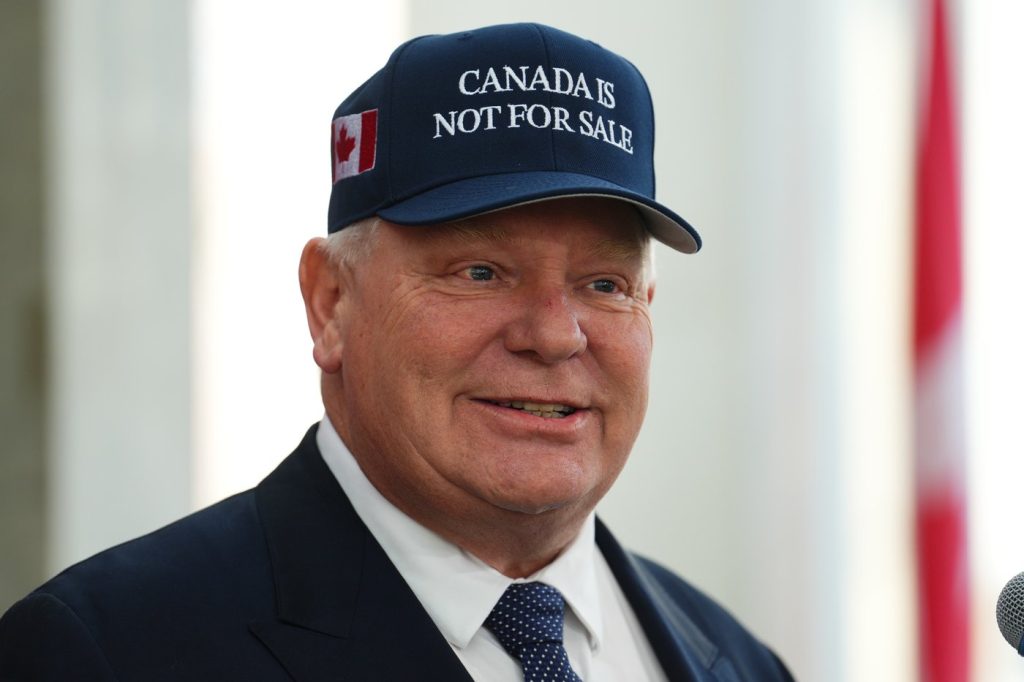
Basically, we’ll pretend to be on Team Canada if you fork over enough protection money. After all, you want to avoid “conflict”, don’t you?
First Nations also need to be partners in protecting and growing the economy in the face of Trump’s potentially devastating tariffs, the leadership council stressed.
“There can’t be a ’Team Canada’ [approach] if you don’t have a strong contingent of First Nations leadership sitting at that table with you,” Casimer said.
To avoid conflict and to craft a unified response, First Nations must have a voice at the table when decisions are being made that affect their lands and resources, she said, noting the council hasn’t been approached to be part of the tariff strategy.
While we at the Canadian Constitution Foundation are grateful for the attention our big federal and provincial cases often get, we’ve become increasingly worried in recent years about just how much local governments are stepping outside of their bounds to bully Canadians.
Not only are more and more municipalities keen on regulating things outside of what local governments are supposed to, they seem egregiously unaware that the constitution applies to them too.
One trend we’re seeing is municipal governments—both big and small—censoring Canadians using bylaws and policies to regulate speech on public property, codes of conduct used to silence council members, and other bylaws that violate freedom of speech, the freedom of assembly, and the division of powers.
Guilbeault made his remarks while endorsing the Liberal Party leadership campaign of Mark Carney, former Bank of Canada governor. The future of the carbon tax was uncertain, he said.
“I will continue to work with Mr. Carney to ensure that if we don’t go ahead with the consumer carbon price, that we have something else in place that will both help Canadians with affordability but will also help us to achieve our 2030 targets,” said Guilbeault.
SDA regular Denise sent an email with the following:
Congratulations to those American people who chose a leader vowing to “forge a society that is color-blind and merit-based.” While we may share a border, Canada is a million miles (or 1,609,344 km) away from the U.S.A. in terms of achieving this laudable goal. Consider this rejection letter sent to a highly qualified but too white Canadian man interested in working for the Canadian Border Services Agency (CBSA) at the Gordie Howe International Bridge linking Windsor, Ontario to Detroit, Michigan scheduled to (finally) open this Fall:
This from the federal department that claims it is “promoting and safeguarding a merit-based, representative and non-partisan public service that serves all Canadians” (screenshot below 01-21-25). We’re being lied to (again). President Trump is correct: under his leadership, the “rest of the world will envy us.” I already do.
After conspiring with a group of Canadian businessmen to manipulate the price of a marijuana company and then dump shares on unsuspecting U.S. investors, Dr. Avtar Singh Dhillon, a politically connected Sikh community leader, met an associate of the notorious West Vancouver lawyer Fred Sharp in a Vancouver restaurant to collect $30,000 cash, handed over in a paper bag.
The gritty exchange was just one of the covert methods Dr. Dhillon used to hide ill-gotten gains, including receiving payments to his daughter’s autism treatment provider, and stashing funds in an offshore account in Singapore.[…]
This testimony was offered during a September 2023 jury trial in Boston, in the case Securities and Exchange Commission v. Frederick L. Sharp, et al.
Dhillon, a British Columbia-educated physician turned cannabis entrepreneur, has since been convicted, mitigating his sentence as a key witness in the SEC’s fraud case against Sharp and his co-defendants.
Online retail giant Amazon is pulling out of Quebec, a spokesperson confirmed to CTV News.
The company says it will cease operations over the next two months in seven operation sites, one fulfillment centre, two sorting centres, three delivery stations and one AMXL (extra large) delivery station that is co-located with a sorting centre.
Barbara Agrait, a spokesperson with Amazon, denies that the decision was made following the unionization of 200 employees at Amazon’s DXT4 warehouse in Laval, Que.
For your bookmarks: For those interested in the daily developments in American politics from a slightly right of center and media critical viewpoint, Mark Halperin runs a pretty good podcast. You can catch it here.
If SaskPower carries through with rejuvenating coal, it will save three power plants, two mines, ~1000 jobs and two communities.
The significance of the shift on coal cannot be understated. When SaskPower’s then-CEO Mike Marsh came to Estevan in 2018 to say they would not be installing carbon capture technology on Boundary Dam Units 4 and 5, it wasn’t the obituary for the community, but it sure felt like the cancer diagnosis. And with no talk of carbon capture for Coronach’s Poplar River Power station, it seemed all but certain that town would whither away once the coal plant and related mine shut down by the federally mandated 2030 deadline. The January, 2025, announcement of SaskPower looking to rebuild both Boundary Dam and Poplar River, if carried out, would be a decades-long reprieve for both communities.
To extend the metaphor, effectively Estevan and Coronach just went into chemotherapy, and the results may be positive.
The implications of this change in direction, from the impending death of coal, to its possible rejuvenation, have local, provincial, national and international aspects, detailed in the story.
Watch for the Pipeline Online Podcast, Episode 2, to be broadcast on LinkedIn, Facebook and X at 1 p.m. on Friday, Jan. 24.. Crown Investments Corp Minister Jeremy Harrison is the guest, where we will delve even further into this new direction on coal-fired power generation.
“The example from last time was Heinz ketchup being replaced by French’s ketchup because French’s was still using Canadian tomatoes in its ketchup,” said Trudeau. “Having Canadian consumers have alternatives to having to spend tariffs on American inputs is part of how we make sure Canadians don’t bear undue costs around tariffs. At the same time there will be costs for Canadians if we move forward on tariffs to the United States.”
The burden won’t be limited to the cost of unloading the current stock of EVs to consumers who don’t want them. There will be additional losses for dealers and automakers who built production and sales infrastructure to comply with mandates that are now disappearing across the board. Maybe it’s just that Canadian politicians pride themselves in policy failure. Otherwise, why are there so many failures, so often?
“There is no pathway to 100 per cent zero-emission vehicle sales in the next 10 years with the support [currently] being provided to Canadians,” Kingston said. “Dictating what vehicles Canadians can and can’t buy, without providing them with the supports necessary to switch to electric is a made-in-Canada policy failure.”