A Lighter Shade Of Black

I have advice for my friend Andrew Coyne – “Never equate the obvious with the unlikely”.
In other words – sometimes he thinks too much;

Barack Obama’s campaign for president has barely begun, and already the questions are mounting. Is he experienced enough? Is he tough enough? And, bizarrely, is he black enough?
[…]
It’s a pointless debate, by and large: black voters, for whose benefit the arguments for and aganst Mr. Obama’s blackness are supposedly being advanced, will decide for themselves whether and on what terms they will support him. Still, it’s fascinating that the issue should have arisen, and if it is pointless, it’s useful to know why it’s pointless. One of the things Mr. Obama’s candidacy may achieve is to confirm, not the irrelevance of race as a political issue, but the incoherence of it — the maddening, irresolvable undefinability of it.

“It’s fascinating that the issue should have arisen”…. Really?
The Obama campaign is running on melanin because it can’t run on track record.
Having elevated a biomolecule to the status of “political virtue”, what other outcome is possible, than to provoke debate about whether it is present in sufficient purity and quantity?

I Concede His Opinion Lacks The Authority Of CBC Fruit Fly Guy

Hendrik Tennekes, retired Director of Research, Royal Netherlands Meteorological Institute, former Professor of Aeronautical Engineering at the Pennsylvania State University and internationally recognized expert in atmospheric boundary layer processes.

Why is it so difficult to make precipitation forecasts fifty years into the future? Most precipitation in the middle latitudes is associated with low-pressure systems, which move along storm tracks carved out by the jet stream. The ever-shifting meanders in the jet stream occur at the edge of the slab of cold air over the poles. The specialists call this slab the Polar Vortex, and have christened the meandering behavior of the jet stream in the Northern hemisphere the Arctic Oscillation. Thirty years ago I worked with Mike (John M.) Wallace and his PhD student N.C. Lau at the University of Washington in Seattle on problems concerning eddy-flux maintenance in the North Atlantic storm track. It is evident to all turbulence specialists that the dynamics of very slowly evolving states is different from the dynamics of instantaneous states. So the moment one asks what keeps the jet stream going, one encounters the kind of problem that is at the core of all turbulence research. But the mainstream of dynamic meteorology refuses to study the slow evolution of the general circulation. It has become so easy to run General Circulation Models on supercomputers that most atmospheric scientists shy away from matters like a thorough study of the interaction between the Polar Vortex and the Arctic Oscillation. Mike Wallace mailed me a year ago, saying that there is not a beginning of consensus on a theory of the Arctic Oscillation. This was one of the highlights in an advanced senior-citizens’ class on climate change I taught a year ago. It was announced as “A Storm in the Greenhouse”, referring primarily to the increasingly bitter debates of the past fifteen years.
How does this problem affect climate forecasts? If there is not even a rudimentary theory of the Polar Vortex, much less an established relation between rising greenhouse gas concentrations and systematic changes in the Arctic Oscillation, one cannot possibly make inferences about changes in precipitation patterns. We do not know, and for the time being cannot know anything about changing patterns of clouds, storms and rain. Holland’s national weather service KNMI circumvented this impasse last year by issuing climate change scenarios with and without changes in the position of the North Atlantic storm track. It did not occur to the KNMI spokesmen that they should have been forthright about their lack of knowledge. They should have said: we know nothing of possible changes in the storm track, so we cannot say anything about precipitation. But it is entirely consistent with the IPCC tradition to weasel around such issues. One of my contacts at KNMI recently explained to me that their choice was based on the increasing agreement between simulations run with different GCM’s. I had to answer that the IPCC spirit of consensus apparently was invading their supercomputers as well. It is bad enough that computer simulations cannot be checked against observations until after the fact. In the absence of a robust stochastic-dynamic theory of the general circulation, one cannot even check climate simulations against fundamental insights.
[…]
I want to lobby for decency, modesty, honesty, integrity and balance in climate research. I hope and pray we lose our obsession with climate forecasting. Climate simulations are best seen as sensitivity experiments, not as tools for policy makers.

Read the whole thing.

Glass Opposition Benches

Hansard Feb 12;

Hon. Marlene Jennings (Notre-Dame-de-Grâce—Lachine, Lib.):
Mr. Speaker, this government is allowing an increasing number of judges’ positions to remain empty. Worse yet, while the Conservatives are going over their list of defeated candidates with a fine toothed comb, they are turning their noses up at qualified candidates. Apparently, it will be a Conservative or no one.
Will the minister put an end to favouritism and appoint qualified, independent members, who are respected by the Canadian legal community?
Hon. Peter Van Loan (Leader of the Government in the House of Commons and Minister for Democratic Reform, CPC):
Mr. Speaker, as we have pointed out repeatedly, we are appointing the most qualified judges.
It is interesting that the member for Notre-Dame-de-Grâce—Lachine would speak about the quality of the appointments being made by our government when her government, in which she was a minister, appointed somebody named Luciano Del Negro to the Immigration and Refugee Board*. I believe he is the husband of the member of Notre-Dame-de-Grâce—Lachine.

(h/t reader Paul)

Off The Tracks

“Plamegate” – the case against Scooter Libby derails;

It is a common maxim that sometimes those who most loudly decry a sin are in fact the most guilty of it. The trial of Scooter Libby has become a troubling affirmation of that maxim, at least from my vantage point in the media room at the Prettyman Courthouse.
The Washington press has been giddy since the name Joe Wilson was first thrust into the limelight by the tag-team of the New York Times opinion page and NBC’s Meet the Press. This week’s court proceedings reminded us how invested Big Media has been in the prosecution of White House staff over Wilson’s now-debunked claims.
[…]
The contradictory logic evidenced in Russert’s testimony is, somewhat ironically, the keystone of the media’s case against Libby. The criticisms that his memory lapses are selective could easily be levied against both Russert and Mitchell as well. The media has attempted to convict Libby in the minds of its audience by detailing the absurdity of someone forgetting such obviously important facts and conversations. Yet the very people who have beat this drum for months are now exposed as either equally forgetful, or equally deceitful. The glaring omission of these parts of the testimony from NBC’s coverage of the trial makes deceit the increasingly more plausible of the two.

And that’s why a “Bush administration scandal” that once featured prominently in Canadian newscasts has been quietly shelved.

SES Leadership Report Card

SES Research National Survey;

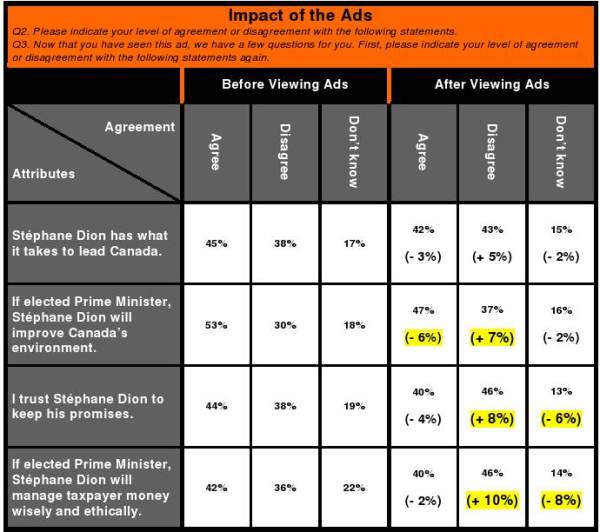
As you might remember, in the last federal election, the nightly CPAC-SES tracking included leadership measures (trust, competence and vision). One year later, SES and CPAC have completed a follow up leadership evaluation. […]
Most Trustworthy Leader
Harper – 35% (+14)
Dion – 20% (Martin – 18%)
Duceppe – 8% (-3)
Layton – 18% (-7)
May – 8% (Harris – 3%)
Most Competent Leader
Harper – 41% (+17)
Dion – 22% (Martin – 28%)
Duceppe – 8% (No change)
Layton – 13% (-4)
May – 4% (Harris – 2%)
Best Vision for Canada
Harper – 39% (+14)
Dion – 21% (Martin – 25%)
Duceppe – 5% (-1)
Layton – 16% (-2)
May – 7% (Harris – 3%)

The PDF is available on the SES Research website.

Y2Kyoto: Pushback

The “Global Warming Deniers” are beginning to speak up.
The chilling effect on free speech;

Earlier this year, when a correspondent for the American current affairs show 60 Minutes was asked why his various feature programmes on global warming did not include the views of global warming sceptics, he replied: ‘If I do an interview with Elie Wiesel, am I required as a journalist to find a Holocaust denier?’ Here, climate change deniers are explicitly painted as the bad guys. He also argued that, ‘This isn’t about politics…this is about sound science’, and went so far as to claim that it would be problematic even to air the views of climate change sceptics: ‘There comes a point in journalism where striving for balance becomes irresponsible.’

Nigel Calder, former editor of New Scientist – “An experiment that hints we are wrong on climate change”

So one awkward question you can ask, when you’re forking out those extra taxes for climate change, is “Why is east Antarctica getting colder?” It makes no sense at all if carbon dioxide is driving global warming. While you’re at it, you might inquire whether Gordon Brown will give you a refund if it’s confirmed that global warming has stopped. The best measurements of global air temperatures come from American weather satellites, and they show wobbles but no overall change since 1999.

Tom Brodbeck on “pack journalism”;

It’s not because there aren’t qualified scientists out there who are skeptical about the findings or who reject them entirely. There are plenty. I’ve heard from them before. But for some reason, reporters and editors chose not to tell that side of the story.

Is environmentalism the new religion?

“The track record of any kind of long-distance prediction is really bad, but everyone’s still really interested in it. It’s sort of a way of picturing the future. But we can’t make long-term predictions of the economy, and we can’t make long-term predictions of the climate,” Dr. Orrell said in an interview. After all, he said, scientists cannot even write the equation of a cloud, let alone make a workable model of the climate.

And public response? Watch not what they say. Watch what they drive.
That’s just a small sampling of what I’ve seen and received. Use the comments for your own on-topic links.

If It Kills One Child

The high costs of risk aversion are coming home to roost with a Helmet Generation long on self-importance and short on leadership;

Teachers who refuse to let children take risks are undermining the economy, a former director general of the Confederation of British Industry says today.
In a savage attack on the health and safety culture in schools, Sir Digby Jones says that a generation of “cotton wool kids” are applying for jobs without any leadership or entrepreneurial skills.
[…]
In the report, he says there have been numerous examples of “excessive risk aversion” in schools which must be stamped out if children are to develop properly. Head teachers have forced children to wear goggles when playing conkers and outlawed the backstroke in case pupils hit each other in the swimming pool, he says.
A survey of science teachers recently revealed that 87 per cent had not allowed students to take part in experiments in case they were injured.
Sir Digby says: “We hear of school sports days where there are no winners for fear of causing permanent damage to the self-esteem and emotional development of the ‘losers’. One of my colleagues at the CBI told me that when his eight-year-old was winning a race he was instructed to hold back to give his fellow competitors the chance to catch up.
“There have even been reports of schools banning ball games and teachers refusing to referee matches for fear of the consequences of injury.”
According to Sir Digby, the prevailing culture of risk aversion “is potentially fatal to our economics and social wellbeing”.
CBI research revealed a third of employers had to train 16-year-olds up to an acceptable standard of literacy and numeracy in their first year of employment. Two thirds said the teenagers lacked self-management skills and three quarters said they did not have a basic understanding of business and finance.
Last week, a report by the Association of Graduate Recruiters said that many vacancies were being left unfilled because even academically bright students did not have the necessary “soft skills”, such as communication and leadership.
“If we never took a risk our children would not learn to walk, climb stairs, ride a bicycle or swim; business would not develop innovative new products, move into new markets and create wealth for all; scientists would not experiment and discover; we would not have great art, literature, music and architecture,” says Sir Digby.
He adds that by attempting to remove risk, “all adults are colluding in a shameful deceit; not only are we regulating the lifeblood of enterprise out of people, we are also teaching the next generation of wealth creators that risk, failure and competition do not exist.”

Via Peaktalk.
SDA Flashback – The Risk Takers.

“At least she doesn’t write stories in her pyjamas.”

Black Rod;

Asked directly if a Dion government would nationalize oil companies, Holland said the Liberals would “work with them collaboratively,” but “of course, if they refuse to work with us … there will be consequences.”
But the day after Holland appeared on Adler’s show, no mainstream televison or newspaper carried a story about his comments.
The day after he appeared on Rutherford’s show, and after his comments were raised in the House of Commons, no coverage.
Or the day after that.
Or the day after that. On Monday, there was a brief mention in the National Post’s editorial, but nowhere in its news pages.
Late in the evening, Canadian Press carried a story about Alberta Premier Ed Stelmach responding to Holland’s comments, and saying there would be “dire economic consequences” if oil sands development was slowed to curb CO2 emissions. Holland was quoted saying Stelmach and the Conservatives were fear mongering. A Google News search shows the story was run in, count ’em, one place—CTV’s website.
On Tuesday, the National Post got around to doing a story on Holland’s threat—in its business pages.
On Wednesday, with the blogosphere afire and Adler replaying Holland’s comments for the second day in a row, CTV’s Mike Duffy broke the MSM blackout at last. His guests?

  • Holland, who attacked the Conservatives for distorting what he said.
  • Alberta’s provincial Liberal leader who said the environment trumps politics.
  • And a clip of Dion who was as unintelligible as ever.
    No mention of Rutherford or “consequences.”
    Now, imagine if Environment Minister John Baird announced that in order to meet Canada’s commitments to the Kyoto accord the Conservatives were going to take control of the auto plants in Ontario and decide how many cars would be built, what models, and in what months…
    Would that be front page news?
    How long would it take for the Globe and Mail and CBC and even CTV to plaster Baird’s threat across its news pages? A week? Or a minute?
    […]
    It’s beyond doubt that the CBC, the Globe and Mail, TVA, CTV and the rest of the mainstream media have a double standard when it comes to what’s news. When the Liberals circulated a two-year old letter by Stephen Harper on Kyoto, the MSM rushed to get the details out.
    Who leaked the letter?
    Would you believe some Liberal named Mark Holland?

  • And that’s just the warmup.

    And when we learn that the Toronto Star’s Susan Delacourt has a brother who worked for Liberal leadership candidate Joe Volpe before jumping to B.C. MP Sukh Dhaliwal, we’re supposed to say “At least she doesn’t write stories in her pyjamas.”

    The Barley Vote

    Rolf Penner sent along the following informational links on barley, barley marketing, and the CWB, starting with two recommended pro-choice links: text and 2 minute audio
    He writes;

    The next set of links is to a February 1st, 2007 talk given by independent market analyst John De Pape, author of the now infamous 2004 Sparks barley report, the talk is called “Show Me The Money” and runs about an hour in length.
    There are high and low speed internet versions of the video and an MP3 audio available. All of these are downloadable. The farmer on the go can download the MP3’s onto their i-Pod or MP3 player and listen while feeding their cattle, hauling their grain or whatever else they may be doing.

  • high speed video
  • low speed video
  • MP-3 audio
    If you look at nothing else you should look at the three comparison charts Mr. De Pape has on page 9 and 10 of the PDF of his PowerPoint presentation. They are particularly enlightening for those who are concerned about what kind of prices, returns and margins they are getting with their barley.
    Chart 1 … Chart 2 … Chart 3
    By the way, you can have the slides up on your screen at the same time you are watching the videos, and follow along by manually clicking the pages forward.

  • PDF of PowerPoint slides
    There will also be text of a Q and A interview with Mr De Pape up in the next little while so check back with the Frontier Centre website from time to time.
    And for the history buffs, there is also a fascinating audio interview that I did with Kevin Avram here on the origins of the CWB monopoly that runs around 30 minutes, and an article Kevin wrote on the subject here.
    Many people have said that this thing should not be decided by a vote and I agree with them. But we are having one and the more people that vote for choice the more likely it is that we will get it. So don’t just file your ballot in the garbage, fill it out properly and send it in.

  • You can email Rolf for more information.
    And don’t forget Marketing Choice and Designated Area for day to day updates and commentary on the CWB debate – like this;


    I find the things that protestors put on signs very interesting, the second one from the left especially; “Young farmers want a future, Save the CWB!” This is somewhat ironic, considering that none of the people in the photo appear to be under the age of fifty.

    (Special thanks to Larry Weber for the kind shout out to SDA a couple of weekends ago on This Week in Agriculture. I’m flattered, but doubt I’d make much of a deputy ag minister. Too much power in the hands of one with too short a temper, for starters!)

    Y2Kyoto – An inconvenient Czech President

    It appears Czech President Vaclav Klaus has a lukewarm view of the global warming hysteria:

    Q: IPCC has released its report and you say that the global warming is a false myth. How did you get this idea, Mr President?
    A: It’s not my idea. Global warming is a false myth and every serious person and scientist says so. It is unfair to refer to the U.N. panel. It’s not a scientific institution: it’s a political body, a kind of non-government organization of green flavor. It’s neither a forum of neutral scientists nor a balanced group of scientists. These people are politicized scientists who arrive there with a one-sided opinion and a one-sided assignment. Also, it’s an undignified slapstick that people don’t wait for the full report in May 2007 but instead respond in such a serious way to the summary for policymakers where all the “but’s” are scratched, removed, and replaced by oversimplified theses. …
    Environmentalism and green ideology is something very different from climate science. Various findings and screams of scientists are abused by this ideology.…
    Q: Don’t you believe that we’re ruining our planet?
    A: I will pretend that I haven’t heard you. Perhaps only Mr. Al Gore may be saying such a thing: a sane person can’t.

    Professor Klaus doesn’t seem to have much respect for the politically correct fashionable doomsaying sweeping the rest of Europe. The rest of the interview is well worth the read.

    Navigation