
Luckily, there were only a few oil cars this time. Between Midale and Macoun, SK.
Saskatchewan First Act
The Saskatchewan First Act passed second reading in the Legislature this evening, with the full support of both Saskatchewan Party and NDP MLAs.
— Scott Moe (@PremierScottMoe) November 29, 2022
The NDP finally steps away from the political abyss (they also voted unanimously to support legal gun owners in the latest Trudeau gun grab) – and the left are losing their junk.
But maybe not as much as they are in Alberta. Heh.
Saskatoon born and raised, cut his teeth in Lloydminster oilpatch, now CEO of significant Sask oil producer
Rob Morgan, president and CEO of Strathcona Resources, grew up in Saskatoon and went to chemical engineering at the U of S. He cut his teeth in the Lloydminster oilpatch, and is now running one of the largest oil produces in Saskatchewan. Strathcona bought Serafina Energy this past year, and has substantial activity north of North Battleford. The Patchwork Podcast on Pipeline Online goes deep with Morgan, who sees a long future for oil and gas.
Race for lithium grows, and a look at the leader, Prairie Lithium of Emerald Park

Last week’s Crown Land Sale revealed a sixth entrant in Saskatchewan’s lithium race.
Prairie Lithium is the acknowledged leader in that race. Here’s how it started.
Good Answer
Federal government employees who enter private land without the owner’s consent face fines of up to $200,000 under an amendment to Saskatchewan’s anti-trespassing law.
“This formalizes and reinforces the change to trespass regulations, made earlier this year, that requires federal employees to comply with the Act, which prohibits individuals from entering private land without the owner’s consent,” Justice Minister Bronwyn Eyre said in a news release about the Trespass to Property Amendment Act, 2022.
The legislation comes in response to a complaint the province received in August from a person claiming federal employees taking water samples near Pense, Sask., had trespassed on their land.
Previous: Good Question
The dawn of a new industry in Saskatchewan: Lithium

Pretty much anything with a rechargeable battery in it these days, from a cellphone to an electric vehicle, uses lithium (except for the lead-acid battery in your conventional car or truck). As the lightest metal, there’s no beating the periodic table.
It turns out, Saskatchewan has lithium beneath its southern soil. And now five companies are in a race to explore it, develop it, commercialize it bring it to market.
Pipeline Online just launched an in-depth series on what’s happening in Saskatchewan, a series over a year in the making. You can read Part 1, the introduction, and Part 2, recently released Saskatchewan incentives.
It’s the birth of an entirely new industry for this province, one that, if it pans out, could be worth many billions. And it’s all being done with oilfield companies and workers, as seen above.
As Alberta’s wind power generation collapsed this week, so, too did Saskatchewan’s giant stinkin’ fans

On Tuesday going into Wednesday, Wind power production in Alberta dropped to 0.1 per cent of nameplate capacity. And it stayed at 2% or less for about 24 hours. Well, now we know Saskatchewan saw a substantial drop as well.
What the minister has to say about the Sask First Act, and not freezing in the dark

Here’s a deep dive interview with the minister behind the Saskatchewan First Act.
“So let’s take let’s take the power thing first of all,” Eyre said, noting the proposed Clean Electricity Standard, if adopted in its current form, would mean no fossil fueled power generation in this province by 2035.
According to SaskPower’s Where Your Power Comes From website, on any given day, coal and natural gas combined provide 65 to 84 per cent of the power in Saskatchewan. On Nov. 6, it was 77 per cent.
Eyre said, “That’s a federal policy which we hope will never see the light of day, but which is moving along. We will freeze in the dark. And we know that. Saskatoon (is) powered by the Queen Elizabeth, a natural gas-powered power station. The entire City of Saskatoon (would be) in huge trouble.”
SaskPower is literally doubling down on wind and solar power production. Expect lots of giant stinking fans and shiny panels to come

They’re going to double wind and solar capacity. But on Oct. 3, all our wind produced just 7% of its capacity.
To hell with that

Premier Scott Moe quoted a Pipeline Online story regarding shutting down coal and natural gas for our power production, as well as possible federal limits on nitrogen fertilizer emissions. “To hell with that!” he said in his throne speech on Nov. 3. This is the energy portion of his speech.
On Halloween, 81% of SaskPower’s electricity came from coal and natural gas, a nearly even split.
We don’t need no giant stinking fans. But we’re going to build a lot of them.
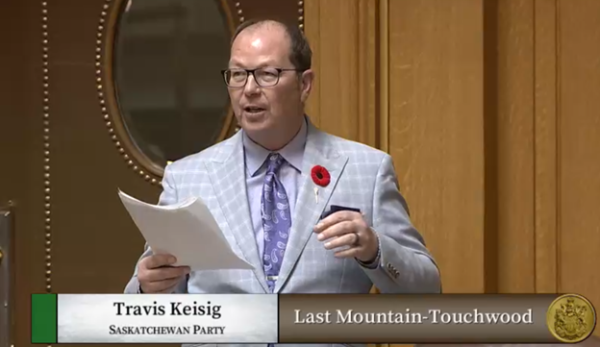
The Saskatchewan Party government sure seems to have some mixed messages when it comes to wind and solar power. We keep building more, and will build a lot more, but it turns out they don’t produce as advertised.
In two throne speeches on Nov. 2, one MLA spoke praises of SaskPower’s buildout. But another pointed out that you don’t get anywhere close to what the nameplate capacity is.
Our solar capacity is 20 and we were getting 2. You cannot run a province, you cannot run business, you cannot run industry, you cannot run people’s homes on that unreliability
Good Job, Zinchuk
“Thou shalt not use coal for power generation post-2030, the federal government hath said. And it’s moving to do the same with natural gas by 2035.
“On Nov. 1, the Province of SK said, “To hell with that,” but in a more sophisticated, legal manner.”
https://t.co/ZgNdS1AZIW— Scott Moe (@PremierScottMoe) November 4, 2022
And good job, Moe.
Saskatchewan First Act is about keeping the lights on and letting farmers keep using fertilizer
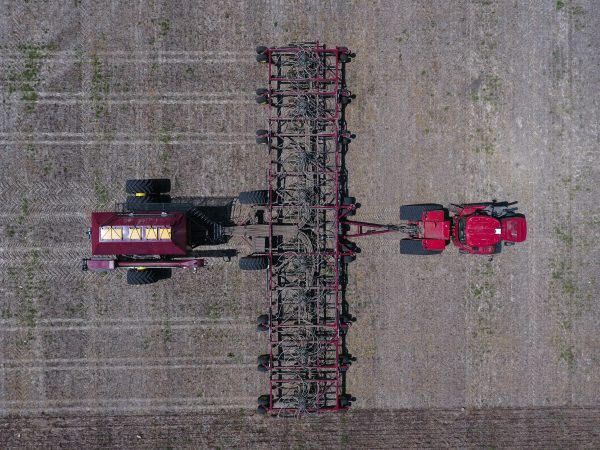
The other media simply didn’t get it, or didn’t read the full text of the Saskatchewan First Act, introduced on Nov. 1. It’s all about Saskatchewan imposing its own veto on federal initiatives that, if carried out to their fullest extent, by 2035 will literally mean cutting off up to 84 per cent of our power production on any given day. Those rules will also mean less fertilizer usage meaning less food.
This is Saskatchewan swinging for the fences, constitutionally. Here’s Pipeline Online’s take on the Saskatchewan First Act.
Thou shalt not use coal for power generation post-2030, the federal government hath said. And it’s moving to do the same with natural gas by 2035. It also wants to limit farmers’ fertilizer usage, all in the name of climate change policies.
On Nov. 1, the Province of Saskatchewan said, “To hell with that,” but in a more sophisticated, legal manner.
Saskatchewan threw down the gauntlet with the federal government on Nov. 1, introducing Bill No. 88, The Saskatchewan First Act. If implemented in its current form, the Act basically says Saskatchewan will make its own decisions and rules on environmental standards, particularly those applying to greenhouse gas emissions and power generation.
And here is Zinchuk’s column interpreting it. His daughter wonders if we’ll be reduced to kerosene lamps.
Drill, baby, drill: Saskatchewan drilling activity sees small junior producers piling on
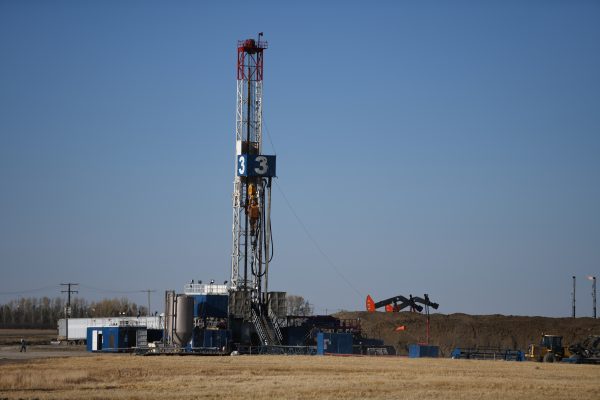
Small oil producers, known as junior producers, were a big driver of the last oil boom. Right now there’s a substantial number of juniors getting in the drilling game again. This probably close to, if not actually, the highest number of juniors with a rig in the field in years.
SaskPower’s proposed 100 megawatt solar facility at Estevan, plus a bonus up to 10 megawatt pilot project on mined land
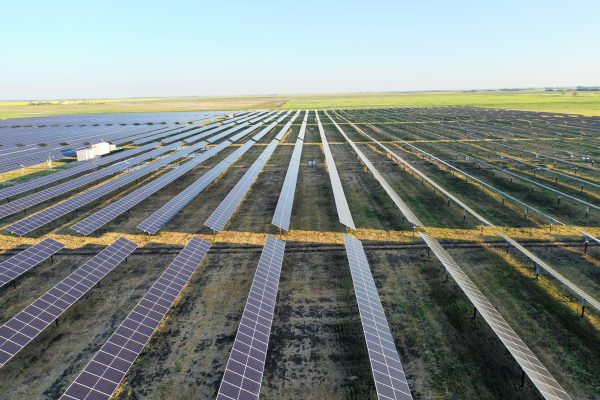
Estevan is getting not one, but two solar facilities.
ESTEVAN – SaskPower held a two day open-house regarding at proposed 100 megawatt solar facility on Oct-26-27 at the Estevan Legion Hall.
In actuality, it’s not just a single project of 100 megawatts, but two projects – a 100 megawatt solar facility and a secondary, up to 10 megawatt pilot project.
The 100 megawatt facility is to be built on seven quarters of land approximately 10 kilometres southwest of the Boundary Dam Power Station. While SaskPower has large swaths of reclaimed mine land in the area, this block of farmland was chosen because it was undisturbed. Building on disturbed land would mean the foundations would be more costly.
It’s seven quarters of land in total, 1,120 acres or 453 hectares. The land has been optioned, but has not yet been purchased. It falls within the southwest corner of the RM of Estevan, Township 1, Range 9, west of the second meridian.
And, of course
As for Estevan, when asked “What do you do when the sun goes down?” the SaskPower official said, “You don’t generate any solar power.”
Who gives a frac? That’s a really good question

A huge reason behind Saskatchewan’s growth as a ‘have’ province was the advent of horizontal oil wells with multi-stage fracking, which had a substantial impact on oil production. And Crescent Point ended up with most of the fracked oil plays in Saskatchewan – the Bakken, Torquay and Shaunavon. But in what can only be considered a stunning move, Crescent Point announced on Wednesday that it’s trying to drill wells in the Bakken but not frac them.
Throne speech includes of talk about power generation, and using farming to offset carbon burden for other industries

If Saskatchewan can’t get out of a carbon tax, it looks like it’s going to try to reduce that overall carbon tax burden. The throne speech indicates that carbon offset credits from zero till farming will be available to lower other industries’ carbon tax burden.
Believe it or not, those giant stinkin’ fans actually did run near full capacity, for a day, in Saskatchewan
What do you know? Some days the wind does actually blow in Saskatchewan. And not from politicians talking, either.
This is an exceptionally rare occurrence where the 617 megawatts of wind power generation in Saskatchewan actually put out somewhere close to nameplate capacity. Who’d thunk it?
Beck says Moe doesn’t have a plan for when commodity prices fall

The Saskatchewan NDP had their first in-person convention this weekend, with new leader Carla Beck at the helm.
The province is also experiencing a resource windfall in potash, uranium and oil brought on by the Russian invasion of Ukraine and global supply issues. But Beck criticized Moe’s government for having no plan for when prices fall.
If everyone’s going to need batteries, the lithium might as well come from Saskatchewan

Saskatchewan is in the very early stages of lithium exploration and development. Say what you want about electric vehicles, everything from your iPhone to your laptop to yes, your EV, is going to require massive amounts of lithium. And Prairie Lithium of Emerald Park is the leader in this field.