Category: youmightbeinsaskatchewan

ZINCHUK: SaskPower just signed a massive carbon leakage interchange agreement with the States

… and Estevan (and SaskPower consumers) will suffer the consequences.

SaskPower is going to beef up its power transmission interconnect with the U.S. Southwest Power Pool (SPP), from the existing 150 megawatts to 650 megawatts. It’s a connection to 106 utilities across 14 states from North Dakota right down to include the Texas panhandle.

The idea is when they need power, and we have power to offer, we sell power into the SPP. And when we need power, we can buy it from the SPP. And for that privilege, we will pay a tariff of $52 million per year. More on that later.

This sort of interconnected grid is really important when it comes to intermittent power sources like wind and solar. Especially wind and solar. When I was typing up the initial story this morning, I checked on how Alberta’s power grid is doing. And at that moment, at 10:46 a.m., Alberta’s power grid was producing 188 megawatts out of a theoretical 2,389 megawatts of wind power connected to their grid, a measly 7.9 per cent. And this has happened numerous times this summer. I’m losing track, really. […]

Let me be clear on this – Alberta is one of the most energy-rich jurisdictions on the entire planet. It’s got more oil, natural gas and coal then almost every energy producer on the third rock from the sun, never mind wind and solar. And it is routinely, almost every single day, drawing on power production from its neighbours to keep its lights on.

And this is what I anticipate will happen in Saskatchewan. Sure, we could send power to North Dakota. But it’s more likely that we will be drawing power from the SPP, nearly all the time.

[..]

But what really got me thinking were these comments: “Over 50% of North Dakota’s power is coal fired. Carbon tax free,” said one. And that’s true. According to the U.S. Energy Information Administration, “In 2021, coal-fired power plants provided 57 per cent of North Dakota’s electricity generation, and wind energy accounted for 34 per cent, which was the sixth-highest share from wind power for any state.”

And this comment hit home, as most of my neighbours are either coal miners or work for SaskPower.

“And no jobs here in coal. Goodbye Estevan, you’re ruined.”

[…]

And that $52 million annual fee – which I must compliment the Leader Post on finding that out. I missed that. That’s a lot of bucks. Indeed, it’s much more than what SaskPower pays the provincial government in coal royalties via its coal purchases.

Wait, what?

You got that right. We pay next to nothing for coal – at least the coal on crown land, which is most of it.

Read it all and subscribe. Then, call your SaskParty MLA and remind them what happened to the Alberta PC’s.

Related: Judge revives Obama-era ban on coal sales from US lands
I Want A New Country

Just get on with it.

Saskatchewan Premier Scott Moe has asked a former Saskatchewan Party MLA and former MP who recently was a part of the Wexit movement to co-host “in-house” meetings about increasing Saskatchewan autonomy.

Allan Kerpan — who served in opposition with the Saskatchewan Party and was also a Reform MP — and veteran SP MLA Lyle Stewart (Thunder Creek) have been chosen by Moe to lead the closed-door meetings across the province this month.

“The premier has been speaking about some sort of independence from Ottawa for quite a while in terms of the economy,” Kerpan told the CBC’s Morning Edition host Ted Deller on Monday.

From Crisis To Opportunity

Don’t just curse the darkness — shine the headlights.

Saskatchewan could resolve our own shortage of truck drivers by becoming an Emergencies Act sanctuary province.

Simply offer to any truck driver currently parked in Ottawa, who has not been convicted of a violent act but loses their license or insurance due to civil disobedience on Parliament Hill, the opportunity  to relocate and be reinstated to drive by the Province of Saskatchewan and Saskatchewan Government Insurance.

Because mischief has never been more important than it is right now.

There Goes The Narrative

“Weeks and months”.

Ontario needs to “reassess the value” of the COVID-19 vaccine passport system in the coming weeks to decide if it should be ended, the province’s top doctor says.

Chief Medical Officer of Health Dr. Kieran Moore made the comment on Thursday, saying while the COVID-19 vaccine offers significant protection against severe disease, two doses doesn’t do much to limit the spread of transmission.

“The vaccine isn’t providing significant benefit at two doses against the risk of transmission, as compared to someone unvaccinated,” Moore said. “We have to reassess the value of the passports in the coming weeks and months.”

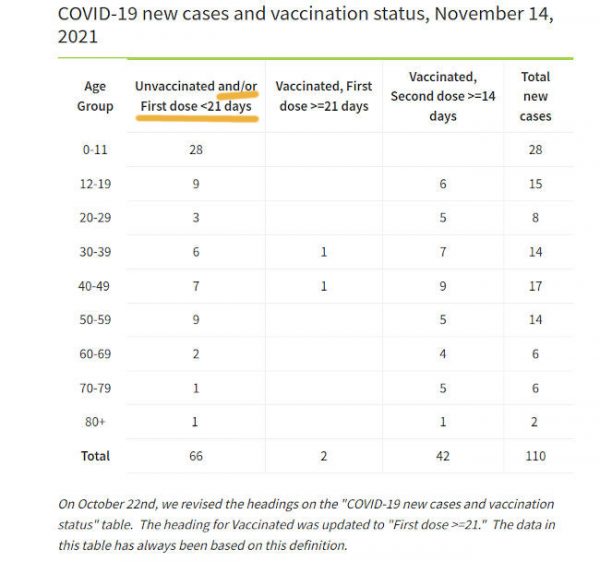
I took a final screencap from the SaskHealth dashboard on February 1st. It’s why the desk doctors at SaskHealth were deep-sixing the “new case by vaccination status” breakdowns all through January.

Scott Moe knows this and is finally saying so (to his credit) — and Ryan Meile knows this. Which is why Meile never cites the data when he states Moe is “lying about the data”. The media doesn’t cite the data when they trot out their favourite NDP mouthpieces knowing they’ll parrot Meile’s accusations. What a pathetic clown world we live in.

The passports should be the first to go. First the lockdowns, and now the passport policy has punished the same small businesses again and again and again, and it’s simply untenable.

Temporarily Unexpected

Bloomberg;

Canada’s labor market suffered a larger-than-expected setback last month after the nation was hit with fresh lockdowns meant to contain the omicron variant of Covid-19.

The country shed 200,100 jobs in January, Statistics Canada reported Friday from Ottawa, ending a seven-month streak of gains. Economists in a Bloomberg survey were expecting a drop of 110,000. The unemployment rate rose to 6.5 per cent, from 6 per cent at the end of last year.

Meanwhile, down in Hillbilly Covidland…

In Saskatchewan, the gain of 3,900 jobs (+0.7%) include increases in employment in business, building and other support services, and construction. Regina found its employment on par with January 2020, while Saskatoon was up 7.1% compared with that month.

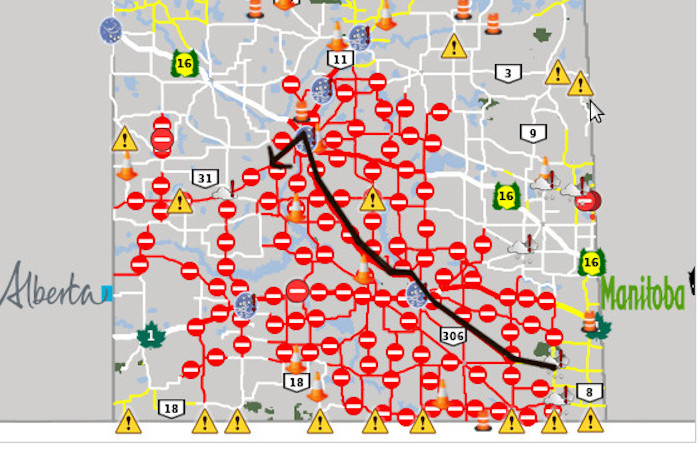
So, That Was Quite The Drive Today

I managed to stay ahead of the road closures (I’m not completely stupid).

That said, there’s something to be said for having completed several seasons of winter driving training in a 289 ’65 Mustang. It never completely wears off.

#SKStorm photos and video.

Smart And Effective (Bumped)

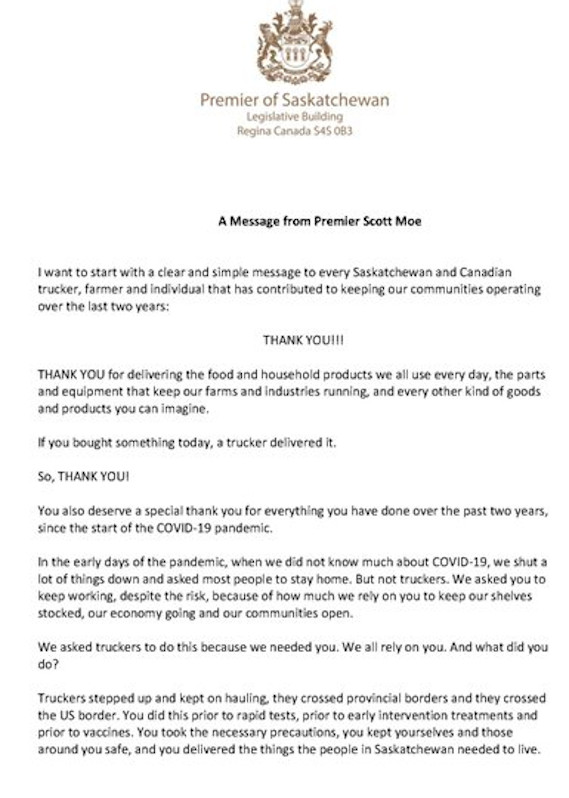
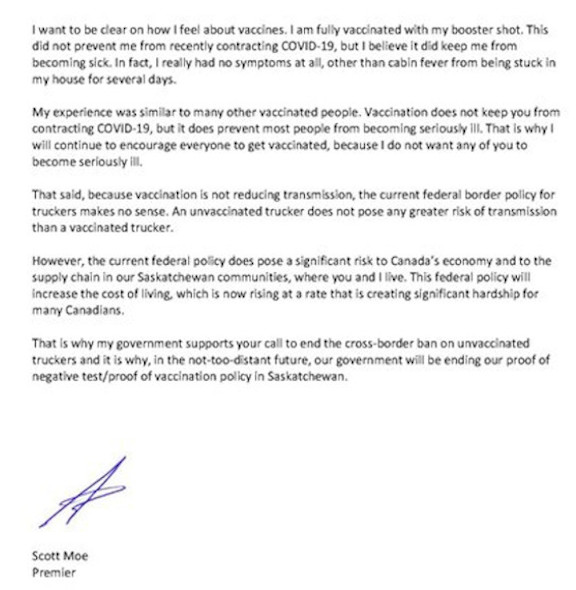
Scott Moe’s message to Saskatchewan and Canadian truckers.

(Pg 2)

Update: Jason Kenney just stuck his toe in the water.

Troll Level: New Party Leader

Zerohedge has a good roundup. (h/t Dana)

Safe And Effective ®

Let’s return once again to the manner in which SaskHealth is doing public reporting of new cases of Covid-19, (which thankfully seem to be in steady decline).

The problem here should be self-evident: the unvaccinated and newly-vaccinated do not have the same immune status — that’s just a statistical and immunological fact. It’s inexplicable that they’ve been grouped as one. They are not the same, and data from the two groups should not be combined. Why not? Because, if a recent vaccination promotes a behavioral or immune response that makes newly vaccinated more susceptible to infection, (as discussed here), that data is being suppressed.

Here’s Dr Clare Craig, in the British Medical Journal, to explain:

Thinking beyond behavioural change as an explanation for increased COVID post vaccination.

Dear Editor,

As well as the papers cited by the authors, other studies have shown a similar effect. A Danish study showed a 40% increase in infections in the first two weeks after Pfizer-BioNTech vaccination, despite not vaccinating in homes with recent outbreaks.[1] Indeed, the original Pfizer trial demonstrated a statistically significant 40% increase in ‘suspected COVID’, with 409 cases in the vaccination arm in the first week of the trial, compared with 287 in the placebo arm.[2] Other publications have omitted mention of the period immediately after vaccination.[3] [4] There is substantial anecdotal evidence of people who had tested negative prior to vaccination, becoming infected shortly afterwards, invariably attributed to exposure just before vaccination.[5] Others have raised concerns about this.[6]

The REACT study of prevalence in January showed that the odds ratio of having a positive swab was 1.48 in healthcare and care home workers and 1.38 in other key workers (when compared to all workers).[7] It seems highly unlikely that behavioural change alone (in the over 80s) could account for an increase in the risk of infection of a similar magnitude to that assumed by being in high-risk employment. […]

The Pfizer vaccination causes a transient fall in lymphocytes for the first three days after vaccination.[12], The phase 2 trials of AstraZeneca similarly showed a fall in neutrophils.[13] Post vaccination neutrophil depletion[14] and lymphocyte depletion[15] has been shown for other vaccines and the latter has been known about since 1981.[16] There is conflicting literature on whether this effect results in susceptibility to viral infections but there is certainly evidence suggesting that is the case in children.[17] Given the evidence of white cell depletion after COVID vaccination and the evidence of increased COVID infection rates shortly after vaccination, the possibility that the two are causally related needs urgent investigation.

This response is only referring to susceptibility to COVID in the first two weeks of vaccination; it is not commenting on the efficacy of vaccines after this period.

And yes, the double-vaxxed have surpassed the (so-called) “unvaccinated” as a percentage of new cases for the first time.

Navigation