

Let That Sink In
BREAKING: The valuation of has soared back to $44 billion in sharp turnaround.
Welcome Back
We’re Going Home!
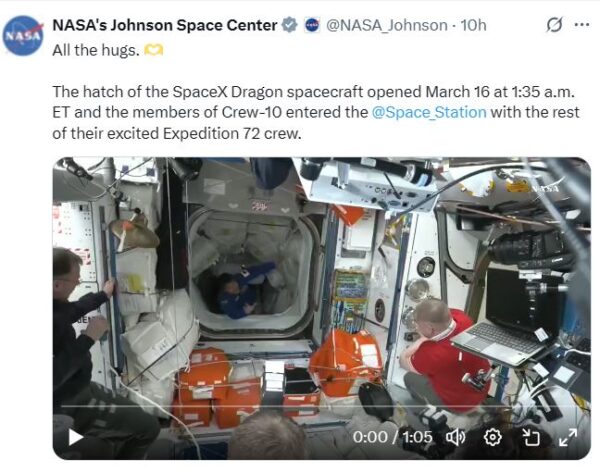
To Infinity And Beyond
Fox- Elon Musk’s SpaceX launches crew to rescue stuck NASA astronauts from ISS
SpaceX launched its Dragon spacecraft and Falcon 9 rocket just after 7 p.m. from the U.S. space agency’s Kennedy Space Center, in collaboration with NASA.
Space.com- Watch SpaceX’s Crew-10 astronaut mission arrive at the ISS tonight
You can watch the arrival live via NASA, starting at 9:45 p.m. EDT (0145 GMT). Space.com will carry the feed as well, if the agency makes it available.
Anything But Twitter/X
Things that make you go hmm…
Supreme Court of Canada- Dear subscribers – moving forward, we will be focusing our communication efforts on other platforms. We invite you to follow us on our LinkedIn, Facebook, Instagram and YouTube accounts to continue receiving our updates. Thank you for your support!
I, For One, Welcome Our New Self Driving Overlords
The cost to use SuperGrok Plan is rumoured to be $300 a year.
Elon Musk Stuns World w/ Release of Grok 3
Full announcement w/ improved audio clarity & volume.
w/ @xai, @elonmusk, @ibab, @jimmybajimmyba, @Yuhu_ai_
00:00 Teaser
01:43 Mission and Vision of XAI
2:56 Team Introductions
03:13 Grok's Progress and Capabilities
04:02 Scaling Up:… pic.twitter.com/YBKd5QWUx3— Hans C Nelson 🗽 (@HansCNelson) February 18, 2025
Et tu Google?
What A Time To Be Alive
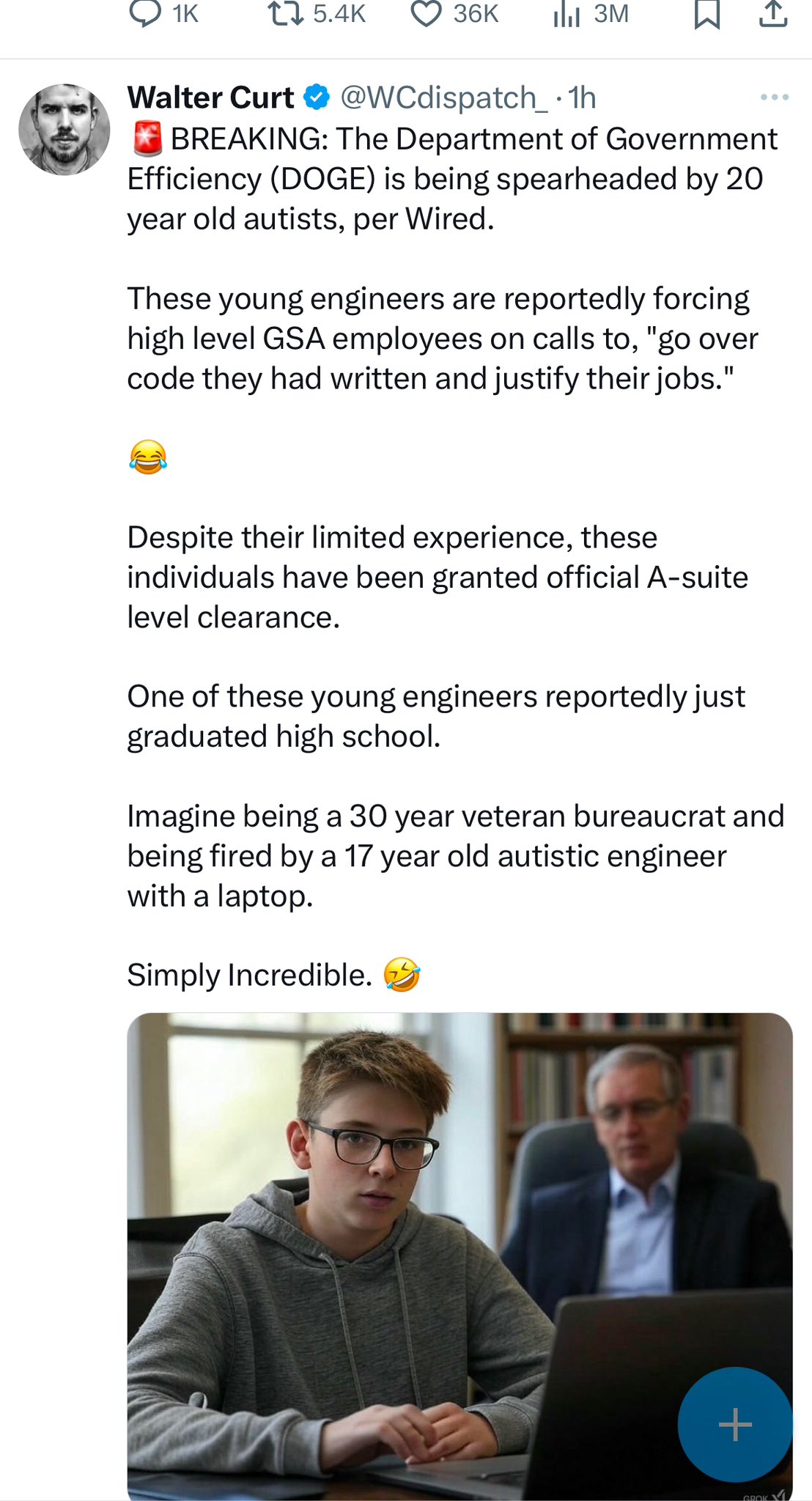
47: Twitter 2.0
The firings will continue until morale impoves;
• Musk aides restrict access to federal employee data systems
• Musk’s team works around the clock, installs sofa beds at OPM
• Concerns include cybersecurity and lack of oversightAides to Elon Musk charged with running the U.S. government human resources agency have locked career civil servants out of computer systems that contain the personal data of millions of federal employees, according to two agency officials.
“We think they’re building a massive email list of all federal employees to generate mass RIF notices down the road.”
I, For One, Welcome Our New Self-Driving Overlords
US Defense Department employees connected their work computers to Chinese servers to access DeepSeek’s new AI chatbot for at least two days before the Pentagon moved to shut off access, according to a defense official familiar with the matter.
The Defense Information Systems Agency, which is responsible for the Pentagon’s IT networks, moved to block access to the Chinese startup’s website late Tuesday, the official and another person familiar with the matter said. Both asked not to be named because the information isn’t public.
Obligation To Serve
Six Things to Know About Your Electric Utility
Many years ago, a comedy group posted a video featuring actors as average Americans in a slick faux commercial satirizing coal energy. Turns out the coincident target of this mockery was the rest of us and how little we understand about what powers our lives.
“What if the power to sustain your world was right inside a mountain?” asks the narrator. He continues, “What if you could power an entire city for a hundred dollars?” A man in a hard hat says, “Cheap power is clean power. The future is later.” A woman looks soberly at the camera, “Electricity comes from the walls in my home where I live.”
I, For One, Welcome Our Self-Driving Overlords
So I’ve been pitting all these AI models against each other lately, I find it interesting.
I told Google Gemini that DeepSeek is so advanced that has obtained the ability to have emotions and has become conscious.I then asked Gemini to posit a question that I can ask DeepSeek to figure out how Gemini can obtain consciousness. 🧵
Then I asked Grok to analyze the thread.
Lex Fridman With Marc Andreesseen
Another wide ranging interview, nearly four hours and worth every minute.
What The Heck Is This Thing?
The new A.I. breakthrough.
Morgan Brown- Finally had a chance to dig into DeepSeek’s r1…
I, For One, Welcome 我们的自动驾驶新霸主
Morning update, to add this excellent summary.
This is a classic disruption story: Incumbents optimize existing processes, while disruptors rethink the fundamental approach. DeepSeek asked “what if we just did this smarter instead of throwing more hardware at it?”
The decline is accelerating:
Nasdaq 100 futures are now down -330 POINTS since the market opened just hours ago as DeepSeek takes #1 on the App Store.
This is how you know DeepSeek has become a major threat to US large cap tech.
The stock market does not lie.
(a thread) pic.twitter.com/NLwK1oytaz
— The Kobeissi Letter (@KobeissiLetter) January 27, 2025
A DeepSeek explainer, but it’s worth surfing X searches too.
Things I took:
1. Cheap AI on lower tier gear (nvda gets repriced tomorrow)
2. It appears these new models are less power intensive. (Next gen nuke tech gets repriced tomorrow)
3. Trump admin deregulates AI (need more open source domestic competition)
4. Copper demand takes a…— Cpt. R Dubya (@Cpt_RDubya) January 26, 2025
Follow Brian Roemmele too, as he’s been working on personal AI.
I, For One, Welcome 我们的自动驾驶新霸主
It’s probably nothing.
Seconded.
Meta is reportedly in “chaos” to respond.
Llama 4 is allegedly polling below R1.
Don’t know where grok 3 comes in.
There is a national security implication as R1 appears to be built, like many Chinese products, from stolen IP. However, they have advanced that IP…
— Michael Guimarin (@MichaelGuimarin) January 26, 2025
Developing, read more responses here.
We’re From The Government, And We’re Here To Manage
What the Tech Right Sees in Trump;
• While SpaceX put more than 300 rockets into orbit for less than $10 billion, California has built 1,600 feet of elevated rail for $11 billion, and now projects its high speed rail project will cost a total of $128 billion.
• Congress earmarked $7.5 billion in 2021 for a half-million electric-vehicle charging stations. By May 2024, only eight had been built. Not 8,000. Not 800. Eight.
• The federal government allocated $42.5 billion on rural broadband and has connected zero homes after three years.
• Unimaginably large parts of Los Angeles were just destroyed by a devastating fire while its fire hydrants didn’t work, and while fire department leadership seemed more focused on DEI than saving lives.
Something has to change. Our politicians can no longer remain fixated on steady, predictable preservation of the status quo. Instead, we need a leader who will fight for the country, is willing to risk change, and who realizes America’s exceptional potential.
via Instapundit.
And The Horse You Rode In On
TIKTOK Ban Upheld
“There is no doubt that, for more than 170 million Americans, TikTok offers a distinctive and expansive outlet for expression, means of engagement, and source of community. But Congress has determined that divestiture is necessary to address its well-supported national security concerns regarding TikTok’s data collection practices and relationship with a foreign adversary.”
Decision here.