Category: It’s Probably Nothing

Socialized Credit

If anyone believes that you are “sticking it to the man” by withdrawing all the funds from your bank account in “cash”, think again. Our fiat currency system has got you coming and going. It’s not a bug; it was designed that way.

In fiat, your only real choice is this: if you wish to access credit at all, you must participate in a system where the coercive extension of credit creates an exponentially rising debt doom loop that all must shoulder the burden of.

The final collapse of fiat will occur when the burden of debt exceeds the ability of any debtor, no matter how large their balance sheet, to service it. When lost capital can no longer be replaced with fresh capital from a more creditworthy institution, one can arrive at a situation where bank notes are literally backed by nothing. A bank note backed by nothing can purchase nothing. It will not matter how many are released into the economy at that point. They will be worthless. It will be the Zimbabwe solution in spades.

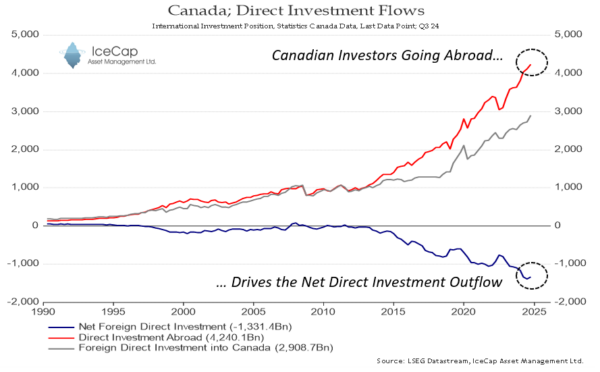
That Sinking Feeling

Maybe a “buy Canadian” program will turn things around. Probably too late, by the looks of it.

Hudson’s Bay is still waiting to see if it will be granted approval to liquidate stores as the retailer requests more time to work out some of its differences with its myriad of landlords, lenders and other partners.

Despite requesting permission from the court to move forward with the liquidation, the company is holding out hopes it can avoid the merchandise sell-off by finding enough financing to keep it alive in some form.

The $23 million it has garnered so far is not enough and necessitates a full liquidation of the business, putting 9,364 jobs at risk…

Broken Record

With all the ongoing talk about how Canada needs to bolster the security of the Arctic, maybe we could just try completing the last project that was supposed to do that.

The Nanisivik Naval Facility, Harper’s deep-sea port meant to support the AOPS, is still not finished. It has become the white elephant in Canada’s north.

Now a part-time, summer-only maritime gas station, the significantly stripped-back Nanisivik port project is mired in construction delays, cost overruns and serious questions about its long-term viability.

And now, Global News can reveal the construction company building the facility went into receivership a year ago — leaving the Department of National Defence to backtrack on its earlier plans for a long-awaited 2025 opening date.


It’s Probably Nothing

The Bureau- Brookfield’s Deep Ties to Chinese Land, Loans, and Green Deals

A review of corporate documents reveals that Brookfield—the influential $900 billion Canadian investment fund from which Liberal Prime Minister-to-be Mark Carney stepped away from in order to replace Justin Trudeau as Canada’s leader—maintains over $3 billion in politically sensitive investments with Chinese state-linked real estate and energy companies, along with a substantial offshore banking presence. One of its major real estate ventures, a $750 million entry into high-end Shanghai commercial property in 2013, involved a Hong Kong tycoon affiliated with the Chinese People’s Political Consultative Conference (CPPCC)—which the CIA labels a central “united front” entity of Beijing.

Great Success!

Blacklock’s- $42M Relief For Pot Dealers

“The cannabis industry is facing economic difficulties which threaten a key objective of the Cannabis Act which is to provide for the legal production of cannabis to displace the illegal cannabis market.

The Competition Bureau in 2023 estimated two-thirds of licensed marijuana dealers were tax delinquents. “The total amount of unpaid cannabis excise duties has continuously been rising since legalization,” said a report Planting The Seeds For Competition.

Blacklock’s- SOS For Tax-Funded EV Plant

“There is an existential crisis,” said Champagne. “I hope the project continues. I can assure you we are working hard on finding new partnerships.”

The Backfiring Sparky Car

Many more such incidents resulting in “lost value” and there will be no economy left capable of generating any value at all.

The Legault government has poured $270 million in Swedish parent company Northvolt AB, and Fréchette confirmed this sum “has lost its value.” The Caisse de dépôt et placement du Québec has also invested $200 million in the company.

Quebec granted Northvolt a further $240 million for the purchase of land in the Montérégie region. This sum is secured by collateral on the land and assets of Northvolt’s North America subsidiary, Fréchette said.

Boondoggle Opportunities

I’m surprised that there was no mention of high speed rail as a domestic “investment” gambit for Canadian pension funds.

The policy statement was issued following a request by former Bank of Canada governor Stephen Poloz, who was given a broad mandate by the government last year to find ways to persuade Canada’s large pension funds to deploy more of their billions in investment dollars in Canada.

That Sinking Feeling

More evidence that the marginal consumer has thrown in the towel.

Hudson’s Bay, Canada’s oldest retailer, is planning to file for bankruptcy, according to people with knowledge of the matter. The department chain has been unable to secure financing to shore up its cash reserves, said some of the people, who asked not to be identified discussing a private matter. Hudson’s Bay has also been delaying payments to suppliers, they added.

Three Chinese-American Soldiers Indicted

The Bureau;

In a case underscoring the growing infiltration of U.S. military ranks by China’s intelligence networks and troubling trends involving the recruitment of first-generation Chinese Americans, federal prosecutors announced indictments Thursday against three soldiers—two active-duty and one former—for allegedly selling highly classified U.S. military secrets to buyers in China.

The Justice Department unsealed indictments alleging that Jian Zhao, a supply sergeant with oversight of $55 million in Army materials in Washington state, led an espionage scheme involving the sale of top-secret U.S. military intelligence to individuals in China, including explosive information on U.S. military readiness to fight a war against China. Much of the case appears to center on Beijing’s plans to take Taiwan by force—a concern of growing urgency for leaders in Washington, Taipei, and Tokyo—and how U.S.-led forces would respond, including what weapons systems and joint-command structures could be brought to bear against China’s strategy to surround Taiwan with naval vessels, bombard the island with rockets, and deploy amphibious landing forces.

Zhao is charged with conspiracy to obtain and transmit national defense information, bribery of a public official, and theft of government property. He allegedly sold data on High Mobility Artillery Rocket Systems (HIMARS) and detailed documents concerning U.S. military readiness and exercises with an unidentified partner nation, which most likely refers to potential conflict scenarios involving Taiwan.

The Ship Is Sinking

A 60% jump in debt is probably an underestimate, but every province is likely in the same boat. With voters currently in the mood for a pandemic style spending spree and with few mainstream politicians willing to say no, any election is now a matter of choosing which party will get us to bankruptcy the fastest.

British Columbia, Canada’s third most populous province, expects debts to surge by nearly 60% over the next three years…

The fiscal plan sees provincial debt rising to C$209 billion by March 2028 — about 57% higher than today and nearly double the level of a year ago. Ministers argue that the spending is to play catch up on core services like health — more than a third of expenses — neglected after a previous center-right government focused on balancing the books.

Turn Off The Lights When You Leave

The ongoing cascade of jingoistic pseudo-patriotism keeps pushing the narrative that Canada is incredibly rich thanks to its natural resources. Apparently, the companies that produce those resources aren’t getting that memo.

Three small firms shut their Canadian headquarters in the past nine months to relocate to other countries: Lithium Argentina AG, Solaris Resources Inc. and Falcon Energy Materials Plc. At least two others — Cornish Metals Inc. and Almonty Industries Inc. — are embarking on similar plans. It’s not just small companies: Toronto-based Barrick Gold Corp., the world’s No. 2 miner, has mused about redomiciling to the US.

Money Woes

Only three years of deficits?  I somehow doubt this will end that quickly since the recession is just starting. I can’t imagine what red ink the other provinces will soon be drowning in.

The budget predicts three years of deficits, largely due to a $4.4 billion decrease in oil and gas revenue from what was forecasted in the current year’s budget. Non-renewable resources make up 23 per cent of the province’s current revenue.

The price of a barrel of West Texas Intermediate oil, the benchmark Alberta uses for budgeting, is estimated at $68 US in 2025-26. That’s a drop of $6 from the previous year’s budget.

This is the first deficit budget for an Alberta government since the 2020-21 fiscal year, presented during the early days of the pandemic.

Navigation