Grab a beverage.
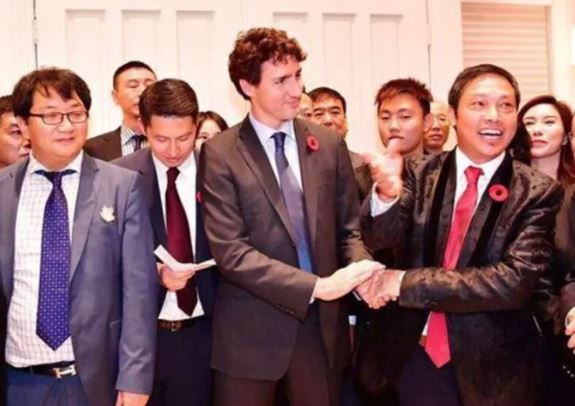
‘That famous picture of Trudeau at a Vancouver dinner with all those Chinese guys—They’re all in there’: Source on United Front money laundering suspects surveilled by US Agency

Grab a beverage.
‘That famous picture of Trudeau at a Vancouver dinner with all those Chinese guys—They’re all in there’: Source on United Front money laundering suspects surveilled by US Agency
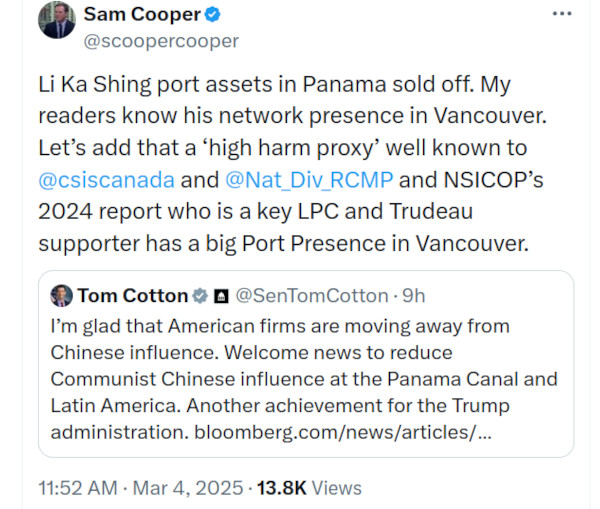
If you’re currently in the process of having an airline complaint resolved by the Canadian Transportation Agency (CTA), you’d best keep the final result to yourself.
Proposed changes to the Canada Transportation Act would make sharing it publicly a violation punishable by a fine.
Mark Carney’s top donors:
Oliver Desmarais: Chair of the Canada China Business Council
Scott Brison: Vice-chair of the Canada China Business Council pic.twitter.com/zAEk8aCjlL
— Andy Lee (@RealAndyLeeShow) March 1, 2025
This piece by Julius Ruechel is so good I’m republishing in its entirety, but do go give him a repost.
The “Canada First” response to decoupling with the 🇺🇸 is totally ridiculous once you dig beneath the surface.
Around 20% of Canada’s GDP comes from trade with the USA. So, here’s the problem with “decoupling”
1. Even if the regulatory hurdles could be cleared, it would take many years to build pipelines to BC coast to ship to China. In the meantime, you’re looking at DEPRESSION levels of economic contraction as we decouple from the US.
2. And do you think the militant environmental groups would play nice if Canada starts building pipelines to the coast? Net result. Social unrest.
3. And now you’re just replacing dependency on America with dependency on China. Nice. Who would you rather be entangled with? You think China wouldn’t demand concessions once Canada’s economy becomes dependent on them? Talk about jumping from the frying pan into the fire…
In this scenario China can buy from anyone, but Canada would collapse if China stops buying from us once we turn them into our new biggest customer. But there’s one difference… China won’t be inviting us to statehood inside their Empire as equals.
Continue reading
A closer examination of Carney’s elite network—guided by the principle that long-standing relationships of trust and shared financial interests will shape governance—reveals a constellation of global influencers deeply tied to the World Economic Forum and China’s trade and finance arms, particularly the Asian Infrastructure Investment Bank (AIIB). At its core, this network of remarkable figures—whose stated goals center on consolidating financial power across borders to coordinate carbon-reduction policies and progressive social outcomes—includes not just Carney and Trudeau but also former Canadian ambassador to China Dominic Barton, Trudeau campaign backers Mark Wiseman and Gerald Butts, and AIIB’s Jin Liqun, reportedly a senior Chinese Communist Party operative.
The Bureau- Beijing Leveraged Favoured Leader Trudeau and Business Allies in 2019 Election Interference: CSIS
China’s Ministry of State Security planned influence operations unprecedented in scale and sophistication in the run-up to Canada’s 2019 federal election, an explosive CSIS document reveals, seeking to protect Beijing’s interests by pressuring China’s favored Canadian leader, Prime Minister Justin Trudeau.
LOOK at who @MarkJCarney has as his “advisory” for the APAC region of his and Michael Bloomberg’s GFANZ organization.
Now you don’t.
Sam Cooper- Ottawa Warned On PRC Blueprint Targeting MPs and Senators Decade Before NSICOP ’24 Revelations
A leaked 2014 intelligence document from Canadian Security Intelligence Service warned that China was orchestrating a broad strategy to cultivate Canadian politicians at every level ahead of various elections, relying on community leaders as intermediaries. The classified CSIS report—marked “SECRET/CanadianEyesOnly”—details how Chinese Embassy officials in Ottawa tasked diaspora figures to target specific Canadian politicians, including a sitting Senator and a Member of Parliament, inviting them to a high-profile Chinese New Year banquet in 2015.
Investigative reporter Sam Cooper has uncovered the connection from the Trudeau government through the Liberal Party, Chinese fentanyl, and how this all ties, together with the Liberal Party in Canada profiting off of the fentanyl crisis.
On Tuesday, Prime Minister Justin Trudeau’s government moved to address growing U.S. alarm by appointing former RCMP deputy commissioner Kevin Brosseau as Canada’s new “fentanyl czar.” Announced as part of an agreement to forestall potential American tariffs in a tense trade dispute, the position mandates “accelerating Canada’s ongoing work to detect, disrupt, and dismantle the fentanyl trade,” according to the Prime Minister’s Office. Brosseau, who most recently served as deputy national security and intelligence adviser to Trudeau, will work closely with U.S. agencies to tackle a crisis that has claimed tens of thousands of lives across North America. Still, questions remain about whether he has the standing in Washington—and the authority in Ottawa—to enact meaningful reforms.
West, reflecting on his encounter with Blinken, doubts that incremental measures will suffice. He argues that only bold legislative change, coupled with a willingness to challenge entrenched legal barriers, can dispel the U.S. government’s unease over Canada’s approach. “Secretary Blinken specifically noted the lack of a RICO-style law in Canada,” West said. “He talked about how, in the United States, that law had been used to take down large portions of the mafia. Then he looked at us—one of America’s closest allies—and saw a very concerning weak link.”[…]
Blinken also conveyed to West that U.S. agencies have grown hesitant to share certain intelligence with their Canadian counterparts.
“He told me that U.S. intelligence and law enforcement are withholding some evidence because they don’t believe we’ll act on it,” West explained. “They’ve lost confidence.”
West added that in ongoing communications, he has learned American officials are shocked that major figures in Asian organized crime “seem to have so much access to our political class. They’re basically saying, ‘What’s going on in Canada?’”
Throw a few bucks his way by subscribing, if you’re able to.
In Kelowna today, Mark Carney promises to abuse the emergency powers of the federal government to build green energy projects and "take on the Americans."
Enjoy your tariff lockdowns, everyone. pic.twitter.com/GxaRKUsxbP
— Sheila Gunn Reid (@SheilaGunnReid) February 12, 2025
@JustBins – A Sask man was removed from Mark Carney’s event in Regina. Moments after he entered, a lawyer approached and questioned him about a Facebook post where he criticized Carney. The lawyer then revoked his Liberal party membership and had police remove him for trespassing.
David Asher of the Hudson Institute spits fentanyl fact at the CBC, and Rosie has nothing.
Watch this whole interview segment with as he schools Rosie
“Well, several months ago, you had the biggest lab in the history of the world taken over by (RCMP) in Vancouver… It made Breaking Bad look like minor league”
“The most of the drugs are going from Mexico to Canada and then being brought south into the northwest United States on ships. You have almost no port enforcement with police.
“How can we run an undercover police operation with your country? Which is why we don’t run them, which is why the seizure statistics are so low, because we don’t even try to work with Canada because your laws are abbreviated and distorted.”
“We need to focus on their money… And of course, you’ve got a sort of tragic situation where TD bank was laundering billions of dollars for Mexican cartels, and now it’s being hit with one of the largest fines literally, in the history of laundering.
This is a very fascinating article:
Veteran law enforcement officials—both active and retired—from the United States and Canada have come forward with explosive allegations suggesting that Canada’s federal government may have systematically obstructed investigations into the highest levels of Asian organized crime. According to these sources, American agencies, including the U.S. Department of Homeland Security, have grown so alarmed by suspected corruption and legal loopholes in Canada that they have effectively sidelined Canadian law enforcement from sensitive investigations and intelligence-sharing.
Several veterans of Canadian law enforcement argue that while U.S. President Donald Trump’s critiques of Canada’s handling of fentanyl trafficking and border security are politically charged and often harsh, they underscore an uncomfortable reality: Canada is increasingly perceived as compromised—either incapable or unwilling to confront entrenched transnational criminal networks. American and Canadian sources alike describe a nation whose law enforcement agencies are in disarray, inhibited by suspected infiltration at the highest levels, obstructing investigations into billion-dollar drug networks and money laundering operations.
A Bureau Exclusive: How the RCMP, CBSA, and Trudeau Government Lost U.S. Trust in the Fentanyl Fight
Veteran law enforcement officials—both active and retired—from the United States and Canada have come forward with explosive allegations suggesting that Canada’s federal government may have systematically obstructed investigations into the highest levels of Asian organized crime. According to these sources, American agencies, including the U.S. Department of Homeland Security, have grown so alarmed by suspected corruption and legal loopholes in Canada that they have effectively sidelined Canadian law enforcement from sensitive investigations and intelligence-sharing.
Several veterans of Canadian law enforcement argue that while U.S. President Donald Trump’s critiques of Canada’s handling of fentanyl trafficking and border security are politically charged and often harsh, they underscore an uncomfortable reality: Canada is increasingly perceived as compromised—either incapable or unwilling to confront entrenched transnational criminal networks. American and Canadian sources alike describe a nation whose law enforcement agencies are in disarray, inhibited by suspected infiltration at the highest levels, obstructing investigations into billion-dollar drug networks and money laundering operations.[…]
“It was mind-boggling. The Americans would say, we have good reason to suspect that this particular CBSA officer is corrupt,” a Canadian policing expert said. “This information would be provided to higher-ups in CBSA with the understanding that this particular CBSA officer is not to show up at any future joint meetings. So eventually there would be a meeting, and the CBSA officer in question would show up at the meeting. The lead American investigator would end the meeting before it started. The Americans would shake their heads in disgust and disbelief.”
Chrystia Freeland’s Liberal leadership campaign has been targeted by “co-ordinated and malicious activity” traced back to a WeChat account accused of having ties to the Chinese government, according to the task force set up to monitor foreign election interference.
According to the Security and Intelligence Threats to Elections Task Force (SITE), which is made up of senior intelligence and security officials, the activity was traced to WeChat’s “most popular news account — an anonymous blog that has been previously linked by experts at the China Digital Times to the People’s Republic of China.”
The rest is here, with more from Sam Cooper.
People are asking who the man is shadowing Trudeau at his Taste of Asia dance party. It’s the head of the Federation of Chinese Canadians in Markham (FCCM) Ken Ng, acquaintance of United Front director Qiu Yuanping and Consul General Han Tao.
Always keep an eye on your assets.
Federation of Chinese Canadians in Markham (FCCM) Pro-Beijing & Liberal voter machine for Markham-Unionville & Markham-Thornhill has received over $730,633 in taxpayer grants since 2015
Friends of Hong Kong, a non-partisan diaspora group that withdrew from Ottawa’s Foreign Interference Commission a year ago over concerns it would whitewash Chinese interference and endanger diaspora groups, has issued a blistering rebuke of Commissioner Marie-Josée Hogue’s final report.
The group argues the 16-month inquiry fails to show the federal government can counter foreign interference.
In a statement detailing their misgivings, the human rights group says the final report “only serves to deepen our serious reservations regarding our government’s willingness and ability to tackle foreign interference.”
The group criticizes Commissioner Hogue for what they deem to be a pattern of “wilful blindness” in assessing the significance of alleged meddling in Canada’s democratic processes. They also take issue with Hogue’s characterization of foreign interference as “isolated cases,” emphasizing that “even one such case is too many for a democracy like ours.” […]
Meanwhile, Duff Conacher, a longtime transparency advocate with Democracy Watch, also took aim at Hogue’s final report, calling it “mostly a cover-up of foreign interference, because it ignores a dozen loopholes in federal laws that allow for secret, undemocratic and unethical spending, fundraising, donations, loans, lobbying and disinformation campaigns by foreign proxies.”


