Category: It’s Probably Nothing

It’s Probably Nothing

India bans wheat exports;

“The export policy of wheat against the above mentioned HS codes is ‘Prohibited’ with immediate effect except for shipments fulfilling the conditions mentioned in [paragraph 2 above which will be allowed as per the procedure outlined in Para 1.05 (b) of the Foreign Trade Policy, 2015-2020,” the director wrote.

Even though it is the world’s second-largest producer of wheat, India consumes most of the wheat it produces.

The nation had set a goal of exporting 10 million tons from 2022 to 2023, much of which would have gone to other developing countries like Indonesia, the Philippines and Thailand.

It’s Probably Nothing

We get mail…

Kate, I am a Canadian living in Europe and I wanted to flag for your readers that we cannot get vegetable oils used for cooking at the grocery store. Olive oil is in supply for now at least but not canola, rapeseed, or sunflower oils. I have been to several grocery stores, my husband has been to different ones, and my sister-in-law has been to grocery stores in another part of the country. They currently cannot be found. Apparently Ukraine is a major exporter of these products.

Sign seen today at the grocery store: Due to shortages, we ask our esteemed clientele to take only one bag of flour per purchase.

Bags of flour in France are generally sold in packs of 1kg.

Thanks JA, keep us posted.

Blast from the past

Who can forget the heady days of November, 2021? It all seems so long ago…

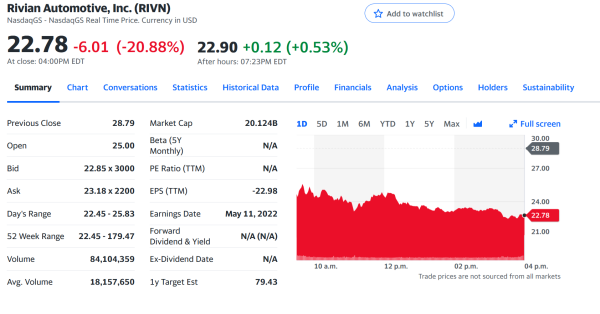
Rivian went public on Wednesday, marking the largest IPO in the United States since 2014. The electric pickup and SUV manufacturer priced its stock at $78 a share and raised about $12 billion, which the company plans to spend on boosting production and designing more vehicle models. While that price set Rivian’s valuation at around $70 billion, the carmaker’s market capitalization surged above $90 billion, after the stock started trading at nearly $107 a share on its first day.

I’m guessing there are more than a few investors out there wishing they had never heard of Rivian in the first place. After all, the price didn’t get to $179 unless someone ponied up that much money.


Calibrating the housing market

I doubt that a mortgage holder facing foreclosure is going to get much comfort out of viewing his situation as a “recalibration”. Because it takes time for rising interest rates to have an impact, in the interim we will continue to see the mainstream financial media parrot the notion of a “soft landing”. None of these pundits will recognize the train wreck until the moment it actually occurs.

Higher rates may cause a strain for highly indebted borrowers in the short run, but over time they may also help recalibrate housing budgets for borrowers based on real life monthly payments. This may also help stabilize the housing market, hopefully leading to a soft landing instead of a housing crash.

It’s Probably Nothing

Grab a beverage

The Daily Sceptic- Vaccinated Hospitalised for Non-Covid Reasons at FIVE Times the Rate of the Unvaccinated, U.K. Government Data Show

The UKHSA has at long last published raw data on hospitalisation rates by vaccine status, for those infected with Covid as well as those that aren’t. The results are very concerning, showing significantly higher A&E admission rates in the vaccinated for reasons other than Covid, and much less difference in admission rates for symptomatic Covid in the vaccinated vs unvaccinated than suggested by the estimates of vaccine effectiveness published by the UKHSA.

Collateral damage

It’s always a shock when even the CBC publishes a piece where no attempt is made to sugarcoat bad news about the effects of the lockdowns and supply chain snarls. More people are waking up to the reality that the economy is not a VCR which can be seamlessly paused and restarted at will.

Over the years, the business occasionally struggled with slim profit margins, but it started seeing success when it started serving the hospitality industry a decade ago.

That work evaporated once the pandemic hit. While business started to rebound, DeFehr Furniture was hit by supply chain disruptions. There were shortages of the raw materials the company required, and the competition for those products was fierce.

In the last month, DeFehr shut down its plant for four days because it did not have handles.

Who cut the elevator cables?

Given an economy that was supposed to be rebounding strongly from the pandemic, this probably comes as a surprise to mainstream politicians and their media lapdogs. For SDA readers, not so much.

According to preliminary data, the S&P 500 lost 148.70 points, or 3.51 per cent, to end at 4,149.31 points, while the Nasdaq Composite lost 635.21 points, or 4.90 per cent, to 12,329.65. The Dow Jones Industrial Average fell 1,033.07 points, or 3.03 per cent, to 33,027.99.

Only a small number of the S&P 500’s constituents were in positive territory, one of which was Twitter Inc.


The crash begins?

Central bankers intent on raising interest rates are hoping that it only impacts one facet of the economy: consumer demand. Their reasoning is that unemployed people have no means to bid up the price of cars, TVs or food.

But an economy is not a series of disconnected linear relationships. It’s more like a matrix, with impacts going off in all directions that are very hard to predict, much less control. It looks like the housing market is starting to feel that impact. How long until the damage spreads to the lenders and the banking system itself?

Buyers slammed on the brakes last month. The number of houses sold in Toronto declined 26% in April compared with March, according to the board’s seasonally-adjusted data. Vancouver home sales also dropped sharply.


Sparky cars: burning investment capital

Given the torrid pace of online retail sales the last two years, I was a bit skeptical when I saw this headline. But once I got a few sentences into the piece I saw the reason for Amazon’s stock slide.

EVs are just one industry whose lifeblood is zero percent interest. Now that we are moving in the opposite direction, investors can look forward to even more losses.

The company attributed the loss largely to a $7.6 billion loss from its investment in electric automaker Rivian Automotive. Rivian, into which Amazon led a $700 million investment in 2019, has seen its stock plummet more than 75% since its blockbuster November 2021 IPO.

The Amazon loss came the day after Ford, another early investor in Rivian, took a $5.4 billion pre-tax charge related to that investment, resulting in Ford reporting a $3.1 billion net loss for the first quarter.


Mother’s Little Helper

Armstrong Economics- Antidepressant Prescription Sales Spike

In addition to the billions Big Pharma made on COVID-related drugs and vaccines, they have also profited from COVID restrictions deteriorating the public’s mental health. In mid-June 2020, when many restrictions began to ease, SingleCare reported a 50% increase in antidepressant medication. The same increase was reported during the third week of March when lockdowns began. “Between the concern over job loss, isolation, and general anxiety, this growing trend in antidepressants over the past few months may well be due to the pandemic’s impact on mental health,” Ramzi Yacoub, Pharm.D., the chief pharmacy officer at SingleCare stated. Insurance and pharmaceutical companies believe the need for prescription drugs will only continue. Thanks to COVID, antidepressants are now the most prescribed medication in the US and the second-most prescribed medication in Canada.

Not me. I get high on blogging.

Is it Canada’s turn for a housing bust?

If the Canadian left-wing corporate media were half-awake, they’d be busy exploring the parallels between the U.S. housing market in 2008 and Canada’s today. One supposes that drawing attention to the freight train bearing down on mortgage holders would be too unwoke.

For Johnny Chen, a promotion and a substantial salary increase was not enough to help him find a home in Vancouver’s white-hot housing market, he told Fortune.

Chen, who sits at the top income bracket, told the publication he’s been scrolling through listings in the city every day for six months to no avail. Even single-family homes priced at $3 million need “substantial renovation work,” he said, making him “trigger shy.”

“It’s hard to wrap my head around prices right now. Vancouver’s real estate market is a bit crazy,” he said.

“This summer, the trucking market could have one of its steepest declines in recent years”

FreightWaves;

While Americans watch in horror as innocent Chinese citizens are caught up in an ill-conceived, reckless, or nefarious – take your pick – act by the Chinese Communist Party, there is little Americans can do about it. But like most geopolitical events these days, the lockdowns in Shanghai and other Chinese cities are also a supply chain story that will have a dramatic effect on domestic freight markets.

The recent slowdown in U.S. truckload markets is likely a precursor to a steeper decline in the coming weeks. The lockdowns in China were not a factor in slowing U.S. truckload volumes in February and March, as evidenced by record container imports at nearly all major U.S. ports.

But that shouldn’t give anyone comfort because the slowdown is about to hit U.S. ports – and the trucking companies that service them – in a dramatic way. FreightWaves estimates that container imports from China represent approximately 16% of U.S. truckload volumes and an even larger percentage of U.S. dry van truckloads. After all, nearly half of the containers that come into the United States originate in China. […]

The three largest cities in China are going to be removed from the world market. According to analysts, at least 40% of China’s GDP has been taken offline and this was before lockdowns began in Beijing. The vast majority of this GDP is directly related to global manufacturing. Removing it means removing the flow of containers from the world economy.

via Instapundit

Fasten your seatbelts

A soft landing? Not bloody likely. If you insist on engineering a recession, don’t think that the carnage will magically stop with the withdrawal of help wanted ads. It’s not just “virtual” jobs that will disappear, but real ones as well: the real jobs of real homeowners who will no longer be able to make their real mortgage payments on a real house.

For Macklem’s part, he suggested skeptics might be discounting the unusually high number of unfilled positions. He doesn’t deny that there will be demand destruction from higher interest rates, but he thinks companies could respond by taking down job postings rather than throwing people out of work. In other words, a soft landing is possible because any nosedive will be aimed straight at a cushion of aspirational hiring, not existing employment.

Navigation