Category: It’s Probably Nothing

Batten down the hatches

We’re not even seeing much of an uptick in foreclosures at this point, but the fact that the mainstream media is picking up on the need for shoring up loan-loss provisions shows that someone, somewhere, is a little worried about the state of the housing market.

On top of burgeoning household debt and international exposure, another issue that could force the banks to build up these provisions is that the same supports that kept Canadians paying their loans at the height of the pandemic are no longer in play.

“The train has left the station, but it’s not off the rails yet,” Hoyes said. “People are depleting the rest of their savings, they’re using whatever deferrals they can get… But with each passing month, as interest rates go higher, as more mortgages roll over, car loans roll over, everything else rolls over, then the pressure builds and builds and builds.

Put a fork in us…

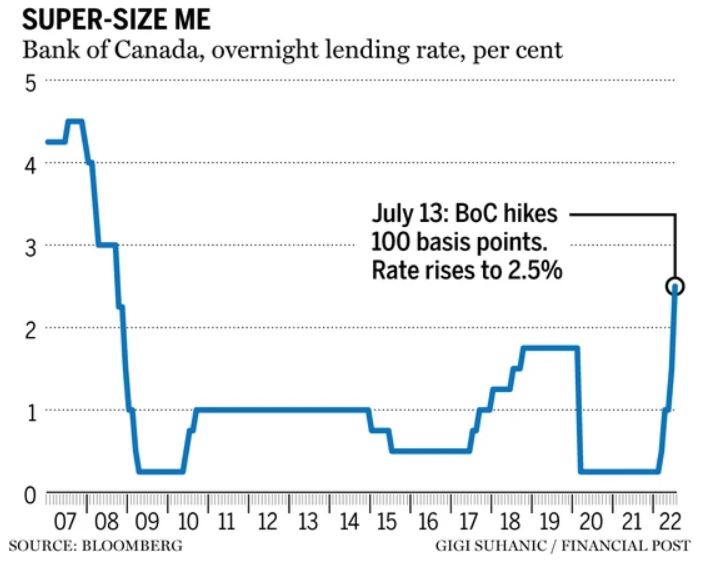
To add some fuel to the fire, the Fed chimed in yesterday with a 75 basis point hike.

…moments ago the Bureau of Economic Analysis confirmed what everyone has long known and that is that the Biden economy is now in a technical recession: the first estimate of Q2 GDP came in at -0.9%, far below the 0.5% consensus forecast (but right on top of the Atlanta Fed -1.2% tracker), and while an improvement from Q1’s -1.6%, this was still the second consecutive quarter of declining GDP which as far as the markets are concerned at least, is the definition of a recession.

The canary is dead….

There’s a notion that if you want to gauge the future of the economy, just look at default rates for auto loans. When times are good, autos are one item that people typically load up on. As the video points out, the pandemic “stimulus” packages had a whole lot to do with stoking unusually brisk demand for autos that people happily overpaid for. Now they are handing those autos back to the creditors in alarming numbers.


Bankrupt allies

When World War One began, the common perception was that it would be over in a matter of weeks. The reality turned out to be very different. Similarly, the West got involved in the conflict in the Ukraine because they believed that after a brief application of sanctions Russia would be cowed into withdrawal. Five months in, we are now finding out just how misguided that hope was. And now we find out that our ally is well on its way to becoming a long term financial ward of Western taxpayers.

Ukraine’s state-owned gas company Naftogaz has asked its international creditors to defer payments on its debt for two years, fanning expectations that the government may soon do the same.

Naftogaz which has a $335 million bond maturing as well as two interest payments due on July 19, said Russia’s invasion had left it short of cash as many of its customers were now unable to pay their bills.

Vanishing capital

Wonders never cease. A mainstream financial news outlet finally gets on the right track. My main criticism of the op-ed is that it doesn’t identify the root causes of the lack of capital creation: the collapsing fiat monetary system and the exponential rise in unpayable debt. While residential real estate has been booming, the real drivers of economic growth, such as business investment in plant and equipment, have been declining for years.

Such a multi-year decline in the tools available to the average member of Canada’s workforce is very likely unprecedented. The only historical period where consistent data (if it existed) might show something similar is the depression of the 1930s. From the perspective of Canadian workers, our economy is decapitalizing.

Going out on a limb

Who knew that the roadblocks erected over the years that made housing progressively more expensive would now be trumpeted as the savior of the housing market? In the topsy-turvy world of the left-wing corporate media, this hash is what passes for analysis these days.

Canada’s housing agency has cut its national home price forecast for this year and next, saying that interest rates were rising faster than it anticipated – but the agency is not predicting a sharp correction because it said a housing shortage will support prices.

“I have trouble believing in a very big price correction,” Mr. Dugan said. “I don’t want to say that it can’t happen. It is possible for a 10-per-cent price correction like some people are saying. But I’m just leery of that because of the supply shortage,” he said.

I’m pretty certain that various American government agencies made similar predictions in or around 2008.

Winning the foreclosure sweepstakes

Given the current state of the monetary system, buying a house on these terms is like walking into a minefield.

Canadians flocked to variable-rate mortgages in the months before the Bank of Canada began rapidly hiking interest rates this year, driving their share of the market above 50 per cent, a report by the Canada Mortgage and Housing Corporation showed on Wednesday.

“These households will see the largest rate increase because they took out a mortgage when rates were at or near record lows. This is particularly true of the historically large number of households that opted for variable-rate mortgages,” it said.

Infrastructure collapse

At the beginning of the pandemic, Jordan Peterson wrote about the dangers of monkeying with complex systems that are a critical linchpin in the economy. Thanks to the prevalence of the idiotic notion that the economy can be paused just like a DVD player, we are now faced with a serious breakdown in our economic infrastructure.

Oksana Klausmann had booked a trip from Toronto to New York City for late June and says…she and her daughter went through customs only to discover that they were not on the flight manifest, despite having their boarding passes.

From there, she says they were taken to a small room packed with other families….

She described the room as not having enough seats for everyone, forcing some to sit on the floor, and one small washroom with no soap, toilet paper or paper towels.

Several hours later, they received an email saying their flight was cancelled. An agent then arrived with a pair of police officers confirming the situation.

“What happened next should never happen to my daughter and me. Riot, angry people, screaming, yelling, pushing, and a lot more,” she said. “It was unsafe, scary, violent, and hostile. I took my daughter and we tried to leave the room filled with more than 200 or 300 angry people.”

Layoffs aplenty!

As the slide towards recession accelerates, one silver lining may be that a whole lot of fact-checkers are about to become unemployed.

According to Reuters, Facebook-owner Meta Platforms (which will likely be undoing its name change just as bitcoin bottoms) has cut plans to hire engineers by at least 30% this year, CEO Mark Zuckerberg told employees on Thursday, as he warned them to brace for a deep economic downturn.

“If I had to bet, I’d say that this might be one of the worst downturns that we’ve seen in recent history,” Zuckerberg told workers in a weekly employee Q&A session, audio of which was heard by Reuters.

Zuck belatedly acknowledges something that most of us at SDA have known for years:

“Realistically, there are probably a bunch of people at the company who shouldn’t be here,” Zuckerberg said, …. I think some of you might decide that this place isn’t for you, and that self-selection is OK with me.

Where’s The Kaboom?

They’re not saying it was aliens…

NASA has discovered the crash site of a “mystery rocket body” that collided with the Moon’s surface earlier this year. The impact left behind a widespread “double crater,” meaning it wasn’t the average rocket.

However, since its crash landing, none of Earth’s space-exploring nations have claimed responsibility for the mysterious projectile, leaving NASA scientists baffled as to who was behind its launch. New images shared on June 24 by NASA’s Lunar Reconnaissance Orbiter show the unusual impact site.

More at NASA.

Any Good Deals Out There?

Armstrong Economics- Oversaturated Retail

Samsung is not the only company suffering from supply now outweighing demand. Walmart, Gap, Target, and American Eagle all reported in their last earnings calls that they have more products than they can sell. The warehousing costs for idle inventory are leading some companies to consider reversing their return policy – here’s your money, keep the item.

“For every dollar in sales, a retailer’s net profit is between a cent to five cents. With returns, for every dollar in returned merchandise, it costs a retailer between 15 cents to 30 cents to handle it,” retail expert Burt Flickinger told CNN. This puts retailers at risk since many will abuse the policy. Sales and clearances on seasonal items are expected as the retail market is oversaturated with supplies that arrived too late.

A mountain of losses

Predictably, the federal government’s nationalization of the Trans Mountain pipeline has created a money losing boondoggle. Perhaps it should be renamed the Springfield Monorail.

The latest analysis by the Parliamentary Budget Officer (PBO) released Wednesday shows the net present value of the pipeline is negative $600 million. 

The financial analysis takes into account new developments, such as budget overruns that peg the current cost of the expansion at $21.4 billion: a 70 per cent increase from an earlier estimate of $12.6 billion.

The new PBO report also reflects the fact that the pipeline’s projected completion date has been pushed back to the third quarter of 2023.

“Once we take into consideration the purchase price, the cost of expansion and the stream of revenues over a 40 year period,” PBO Yves Giroux told CTV News, “the pipeline will not be generating, overall, a profit.”

The forever vaccine

It’s becoming increasingly clear that the mainstream pandemic narrative is collapsing into a heap of naked contradictions and frantic back-pedalling.

Canada now needs to decide whether the goal of its strategy with current generation vaccines is to protect against severe COVID or to try to prevent transmission altogether, Gommerman says, until a new vaccine or variant changes the game.

“If your goal is to prevent infection, we’re just gonna have to keep boosting forever,” Gommeman said.

“Omicron has evolved and it’s so much different than our vaccines and infections prior to Omicron — the type of immunity that you got is just a different beast,” said Sarah Otto, an expert in modelling and evolutionary biology at the University of British Columbia.

“And so what we’re seeing with vaccine protection is that it’s not so much the number of doses as it is how recent your last dose has been, and I think that’s because the neutralizing antibodies in our bloodstream, they’re not recognizing the virus as well.”

Intriguing to note that not one of these experts recalls Geert Vanden Bossche predicting exactly this….two years ago.

Navigation