Category: It’s Probably Nothing

Turn Off The Lights When You Leave

The ongoing cascade of jingoistic pseudo-patriotism keeps pushing the narrative that Canada is incredibly rich thanks to its natural resources. Apparently, the companies that produce those resources aren’t getting that memo.

Three small firms shut their Canadian headquarters in the past nine months to relocate to other countries: Lithium Argentina AG, Solaris Resources Inc. and Falcon Energy Materials Plc. At least two others — Cornish Metals Inc. and Almonty Industries Inc. — are embarking on similar plans. It’s not just small companies: Toronto-based Barrick Gold Corp., the world’s No. 2 miner, has mused about redomiciling to the US.
Money Woes

Only three years of deficits?  I somehow doubt this will end that quickly since the recession is just starting. I can’t imagine what red ink the other provinces will soon be drowning in.

The budget predicts three years of deficits, largely due to a $4.4 billion decrease in oil and gas revenue from what was forecasted in the current year’s budget. Non-renewable resources make up 23 per cent of the province’s current revenue.

The price of a barrel of West Texas Intermediate oil, the benchmark Alberta uses for budgeting, is estimated at $68 US in 2025-26. That’s a drop of $6 from the previous year’s budget.

This is the first deficit budget for an Alberta government since the 2020-21 fiscal year, presented during the early days of the pandemic.

Stick A Lobster Fork In It…

More evidence that the marginal consumer is tapped out and expensive food choices are off the menu.

Halifax-based Clearwater Seafoods announced Thursday plans to change its lobster operations, which will result in permanent and temporary job losses in Nova Scotia.

Lockeport Mayor Derek Amalfa said about half of the 145 people employed at the Pierce Fisheries plant in the town will lose their jobs…

The other question I have is how several Mi’kmaq communities raised their half of the $1 billion to buy this outfit. I somehow doubt that they just floated a bond in the equity markets.

In January 2021, Premium Brands Holdings Inc. partnered with seven Mi’kmaq communities — led by the Membertou First Nation in Cape Breton and Miawpukek First Nation in Newfoundland and Labrador — to finalize the purchase of Clearwater for a total investment of $1 billion.

Jeffrey Epstein Didn’t Kill Himself

From the replies: At least 2 of those numbers are for Carney’s wife Diana.

What’s The Problem With Decoupling?

This piece by Julius Ruechel is so good I’m republishing in its entirety, but do go give him a repost.

The “Canada First” response to decoupling with the 🇺🇸 is totally ridiculous once you dig beneath the surface.

Around 20% of Canada’s GDP comes from trade with the USA. So, here’s the problem with “decoupling”

1. Even if the regulatory hurdles could be cleared, it would take many years to build pipelines to BC coast to ship to China. In the meantime, you’re looking at DEPRESSION levels of economic contraction as we decouple from the US.

2. And do you think the militant environmental groups would play nice if Canada starts building pipelines to the coast? Net result. Social unrest.

3. And now you’re just replacing dependency on America with dependency on China. Nice. Who would you rather be entangled with? You think China wouldn’t demand concessions once Canada’s economy becomes dependent on them? Talk about jumping from the frying pan into the fire…

In this scenario China can buy from anyone, but Canada would collapse if China stops buying from us once we turn them into our new biggest customer. But there’s one difference… China won’t be inviting us to statehood inside their Empire as equals.
Continue reading →

Nothing To See Here

Housing prices just aren’t skyrocketing like they used to. More like falling into the center of the earth, in fact.

Mortgage delinquencies in Ontario have skyrocketed 50 per cent higher than pre-pandemic levels, and more than 11,000 mortgages in the province missed at least one payment in the fourth quarter of 2024, nearly three times the number seen in 2022, Equifax Canada said in its quarterly credit report.

Funny Money

Years of interest rates at near zero levels will do strange things, like incentivizing investors to throw highly leveraged capital at all manner of “sure things”.

In one stark example, two levered ETFs tied to Michael Saylor’s Bitcoin-hoarding company Strategy, which were together worth more than $5 billion at one point, are down about 40% in three days. Leveraged funds, promising two times the daily performance of Nvidia Corp., Tesla Inc., Amazon.com Inc. have tumbled. Triple-leveraged bets on innovation and semiconductor stocks have slid 20%.

Suicide Nation

Not surprisingly, the Canadian Labour Congress is proposing national bankruptcy as a way to deal with Trump. That should only take about a week to play out.

Cutting off U.S. access to critical Canadian resources—including electricity, lumber, critical minerals, oil, and gas—until the tariffs are lifted.

Naturally, it includes a plea for another pandemic style spending spree:

The federal government has taken a first step by considering income supports for affected workers—an approach that helped stabilize our economy during the pandemic.

Car Crash Carney

The French language debate between the Liberal leadership candidates last night served to make clear two things: Mark Carney is a drowning accident in progress, and his opponents aren’t there to challenge him in any substantive way but rather to act as sock puppets providing cover for his blunders. Good luck with that.

Carney was asked in English if his command of French is not strong enough to be the Liberal leader.

Carney started answering in French before switching to English.

“You asked me in English, I’ll answer in English. I said that we all were in agreement against Hamas — at least the intention. Ah, no, je suis, I look forward, if I am selected as Liberal leader, I look forward to having a debate avec Yves Françcois Blanchet et Pierre Poilievre,” Carney said, switching to French, before continuing, “I’m sorry, I’ll answer in English. I look forward to having a debate with them, in French.”

Losses Galore

A seldom mentioned phenomenon in these days of monetary madness is the ongoing spectacle of central banks actually losing money. Not a small amount of money either. More like $11 billion per month for the US Federal Reserve alone. But I’m sure that’s nothing to worry about.

Before 2022, the Fed remitted $5 billion to $10 billion per month to the US Treasury; between 2011 and 2021, the Fed’s remittances totaled over $920 billion. Since then, the Fed has run a monthly operating loss between $5 billion and $11 billion per month, and is thus unable to remit any funds to the Treasury. These accumulating Fed losses are classified as a “deferred asset,” a negative liability whose value is the cumulative amount of the earnings shortfall.

Sure You Will…

Are you willing to pay $5 more for every purchase, $5 more every month, or $5 more every year? As is typical with such surveys, to probe for those critical details would disturb the narrative of pseudo-patriotism. No matter which option you pick, your credit card statement will inevitably say otherwise. Consumers eking out a living in a stagnant economy don’t have the luxury of making such choices.

But the survey found even though some items may cost more, most Canadians are willing to spend more money to keep that buy Canadian with 53 per cent willing to pay $5 more to buy a local product.

Another 33 per cent said they were willing to spend $10 extra.

Thanks For The Mammaries

Yet another sign that the marginal consumer is clearly tapped out and no longer able to spend freely to sustain gimmicky marketing.

Hooters — which has about 300 locations nationwide — has faced increasing financial strain as traffic declines at its kitschy restaurants, leading to the closure of several outposts.

The Atlanta-based company has been working alongside turnaround consultants from Accordion Partners to address its financial difficulties, particularly its debt burden.

We Don’t Need No Flaming Sparky Batteries!

Leftists like to rant about the alleged “negative externalities” of the free market, but never seem to be concerned when central planning results in the same thing.

EV batteries are larger and heavier than those in regular cars and are made up of several hundred individual lithium-ion cells, all of which need dismantling. They contain hazardous materials, and have an inconvenient tendency to explode if disassembled incorrectly.

“Currently, globally, it’s very hard to get detailed figures for what percentage of lithium-ion batteries are recycled, but the value everyone quotes is about 5%,” says Dr Anderson. “In some parts of the world it’s considerably less.”


Heading For The Exits

I’m pretty sure that berating a company for leaving Canada not only confirms their belief that it was the right decision, but likely encourages others to consider doing the same.

Montreal-based TFI said it has decided to change its legal domicile to the U.S. because about 70 per cent of its operations are based there. The announcement annoyed the Caisse de Depot et Placement du Quebec, a public pension manager that has long fought to prevent companies from leaving the French-speaking province.

“The company has not informed us of its intentions, and we will express our dissatisfaction,” CDPQ spokesperson Kate Monfette in an emailed statement.

Gradually, Then Suddenly

Real Estate Magazine;

Something has shifted in Canada’s housing market. This shouldn’t come as a surprise, given something has certainly shifted at a global geopolitically level. You might even call it a “tarrifying” headwind for Canada’s real estate market.

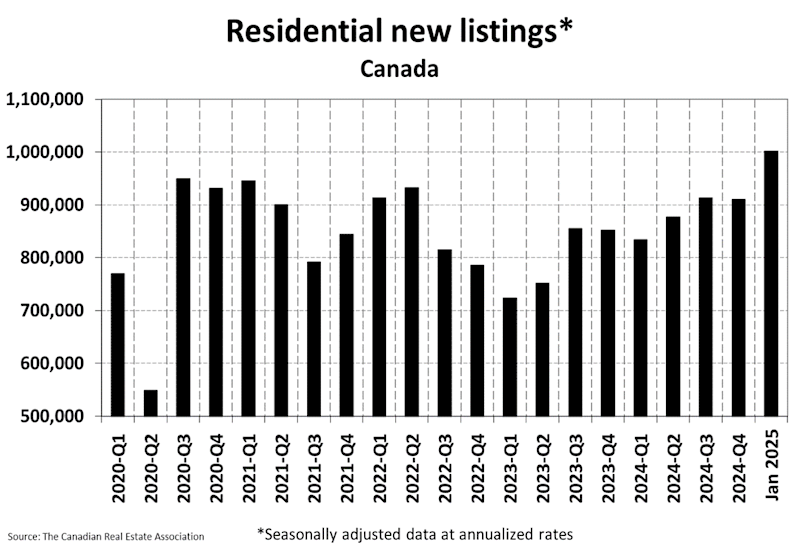
For years, supply was tight, and homebuyers outnumbered sellers in Canada’s real estate market. But as 2025 begins, the landscape looks strikingly different. New listings are pouring into the market at an extraordinary pace, while sales are faltering under the weight of mounting economic uncertainty.

As is tradition, when facing an unknown future, Canada’s real estate market has decided to hit the “pause button.” It is not uncommon to see the market take a breath when we’re facing a historic election, a pandemic or a changing economy. Today’s trade war is no different.

Heading For The Exits

When even the CBC admits it, things must be even worse that anyone could imagine.

… business investment dropped off in 2015 when oil prices plunged and have remained stubbornly low ever since.

Economists warn that has weakened the Canadian economy and gives Canada less cushion to weather a trade war.

“GDP per capita has declined for eight of the past nine quarters, and business investment has been stagnant. Both cyclically and structurally, Canada’s economy is not well positioned to absorb a shock of this scale,” wrote Royal Bank’s chief economist Frances Donald and deputy chief economist Nathan Janzen.

Buy Local…Until You Can’t

Despite the ongoing displays of jingoistic pseudo-patriotism, the brittleness of the Canadian economy becomes more and more apparent every day. In reality, much of what these stores sold was not even made in Canada anyway.

Several Canadian fashion retailers will be closing their doors after ownership company Comark Holdings announced it has filed for creditor protection.

Comark is the Vancouver-based parent company of retail brands Bootlegger, Ricki’s and cleo.

The company currently has 221 stores across eight Canadian provinces.

Navigation