Paul Vieira- According to World Bank data on Canada, net outflows of foreign direct investment, at 4% of GDP, outstrip net inflows of FDI, at 2.2% of GDP.
World Bank- Foreign Direct Investment, Net Outflows (% of GDP) Canada

Paul Vieira- According to World Bank data on Canada, net outflows of foreign direct investment, at 4% of GDP, outstrip net inflows of FDI, at 2.2% of GDP.
World Bank- Foreign Direct Investment, Net Outflows (% of GDP) Canada
I personally know some people who would choose to be a care-giver to their XBox if the math of Universal Basic Income worked out for them. In all likelihood, it would do so in many cases. At least enough to send us over the cliff into default and an inflationary currency collapse.
Sen. Kim Pate and NDP MP Leah Gazan introduced bills S-233 and C-223, respectively, in a bid to create the first national framework to provide all people over age 17 across Canada, including temporary workers, permanent residents and refugee claimants, a guaranteed livable basic income.
Based on Ontario’s basic income pilot project, the Parliamentary Budget Officer estimated that the basic gross cost of guaranteed basic income(opens in a new tab) nationally would range between $30.5 billion and $71.4 billion from November 2020 to March 2021…
It’s probably nothing … $56 billion of net-equity security sales over an 18-month stretch speaks volumes without the Oracle of Omaha having to say a word.

Wall Street was rattled by economic figures that showed exactly what stock traders did not want to hear: a significant slowdown in the world’s largest economy and persistent inflation pressures.[…]
Gross domestic product increased at a 1.6 per cent annualized rate, trailing forecasts. A closely watched measure of underlying inflation advanced at a greater-than-expected 3.7 per cent clip.
“This report was the worst of both worlds: economic growth is slowing and inflationary pressures are persisting,” said Chris Zaccarelli at Independent Advisor Alliance. “The Fed wants to see inflation start coming down in a persistent manner, but the market wants to see economic growth and corporate profits increasing.”
If neither are headed in the right direction, he said, then that’s going to be “bad news” for markets.
Unless the Federal CPC caucus thinks that capital gains are equivalent to wage income, one has to wonder why they are avoiding the question as to whether they will roll back the tax hike or not. If the CPC has any grasp of basic economics, cutting capital gains taxes ought to be a no-brainer. This doesn’t need to wait until election time.
But when specifically asked by CTV’s Question Period host Vassy Kapelos — during a panel interview with NDP finance critic Don Davies that airs Sunday — whether the Conservatives would reverse the capital gains tax changes, Lantsman wouldn’t say.
And when pressed on the party’s position on the specific measure to increase the capital gains inclusion rate, Lantsman again said the Conservatives will state their plans come election time.
Moe, Smith — exactly what are we waiting for?
Unwilling to live within the tax revenues produced by the national economy, this government has borrowed more money in 8 years than all other Canadian governments combined since the nation was founded in 1867. This recklessness has doubled the national debt and created interest payments that are breaking all records – last year over $46 billion dollars and this coming year over $54 billion dollars. That is more than the federal government spends on the military, or healthcare. All of it taken from taxpayers to pay bondholders instead of being spent on public services.
Now, the centrepiece of their new budget is a capital gains tax targeting the few Canadian individuals and firms who invest in Canadian ventures or assets. This investment is what creates the new businesses and jobs and productivity the nation so badly needs.
It is bizarre to watch a morbidly obese and fiscally incompetent government propose – in the name of ‘fairness’ – to justify taking productive capital away from Canada’s small but critical investor class and hand it to the same bureaucracy that has for almost a decade shown they will only waste it.
Ten years of Harper’s fiscal restoration was laid waste by the Trudeau Liberals in the span of months. God Bless Poilievre, but he’s going to inherit a toxic stew of public debt and social entitlement that no amount of “common sense” can resolve. Extricating the economies of Saskatchewan and Alberta from this mess would be painful (of that there is no doubt) – but not doing so will be fatal.
Perhaps the most drastic change in the recent federal budget is the hiking of the capital gains inclusion rate. This supporter of the change works out the math and finds that effectively treating a capital gain as wage income is just fine with him. The fact that an investor risks the loss of assets if the business fails is, to him, equivalent to the risk borne by the wage earner who gets paid every two weeks and never has to deal with the loss of a dime of capital to sustain the business.
Here’s the text of his X post:
$1 in wages. Top marginal tax rate = 53%.
Keep $0.47. $1 in corporate profit –> 26% corporate tax rate = $0.74 distributed as capital gains –> 50% inclusion rate = $0.37 taxed at 53% personal. All in, roughly 46% tax rate overall. Keep $0.54. Better than wages (and better than interest or dividends).
At 67% inclusion: roughly 52% tax overall for capital gains. So keep $0.48. Close to treatment of wages!
WHEE! The Liberal Govt announces a $40B deficit with $50B in debt servicing costs, or $95K a second!
@RealAndyLeeShow is following the shitshow so I don’t have to.
Budget 2024 includes $411 million to support healthcare for asylum claimants and refugees, along with $79 million improve immigration holding centres and $141 million for lodging for asylum seekers.
Meanwhile, $8 million is dedicated towards preventing migrant smuggling.
CBC gets an additional $42 million taxpayer-funded bump in the budget.
It’s painful to listen to @cafreeland speak, but a necessary evil. Major capital gains tax increase pretends to be a wealth tax but actually will be imposed on any Cdns who have retirement savings & other investments. So most of us
“There are very few measures that are designed to increase capital investment and enhance labour productivity.” #cdnpoli #Budget2024 ~ Fred O’Riordan, economist
Hit me harder, daddy: … new controls and taxes on real estate to take effect in 2025. Measures to be detailed in “consultation” documents this summer include a tax on undeveloped property…
Tax and Spend. And spend and spend and spend.
I want a new country.
“I think this is likely to be the worst budget since the [then-finance minister Allan] MacEachen budget of 1982, in the sense of pointing us in the wrong direction as to how we go about raising the incomes of Canadians and actually making Canadians feel better over the medium term,” Dodge said in an interview on CTV News Channel’s Power Play with Vassy Kapelos.
In a time of high interest rates and inflation, the 1982-83 federal budget, under then-prime minister Pierre Elliott Trudeau, became the object of political fury over spending, taxation, and wage restraint measures within it.
Dodge, who was governor from 2001 to 2008, was referencing the strong indications that in order to help finance the nearly $40 billion in pre-announced new spending without raising the deficit, the federal government may impose some form of individual wealth tax or excess profit tax on wealthy corporations.
Freeland will present the budget in the House of Commons on Tuesday afternoon, vowing a plan centred on “generational fairness.”
Seen somewhere: Why do they tax cigarettes? “To disincentivize smoking.” So why do they tax income?
Updated to add the source link! My apologies.
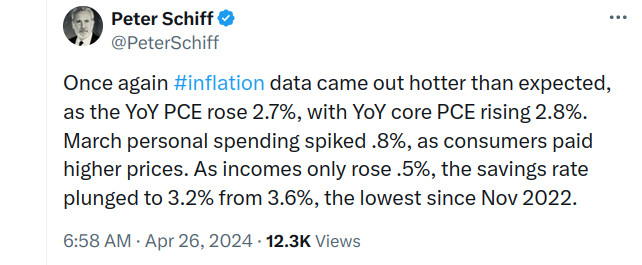
For months and even years, the mainstream news has sought to spin terrible inflation news. It’s not so bad, it’s just transitional, it’s getting better, it’s not really a problem, and all your gloom about the value of the dollar is in your head. Truly, in the past fortnight, we have been inundated with articles suggesting that the public is dumb as rocks for thinking that inflation is still a problem.
Yesterday morning: boom! The upward trend for the entire first quarter was solidly confirmed. We could be entering a second wave. It was so bad that not even the two most influential venues could deny it. The New York Times reported, “Inflation Stronger Than Expected.” The Wall Street Journal reported, “Hot Inflation Report Weakens Case for Fed’s June Rate Cut.” The accompanying editorial is even better: “The Inflation Thief Rises Again.”
Truly, I’m stunned by the highly unusual and rather brazen truthfulness of these headlines. I don’t think we’ve seen that in three years. Which makes me wonder: Maybe the problem is even worse! […]
In the 1970s, the devastation occurred in three distinct waves. Each time the trend improved, elites declared victory and the Federal Reserve moved in with rate cuts, thereby causing yet another round. Absolutely no one in charge anticipated the next wave. It came anyway.
After two years of reporting on the collapse in San Francisco’s commercial real estate market, it looks like the contagion might finally have spread to the residential market, too.
According to a report in today’s Daily Mail, “nearly one in five homes sold in San Francisco have sold at a loss in recent months.”
In the continuing saga of The Workers’ State of South Africa, there’s finally some good news. Well, sort of. It seems that there have been fewer power outages lately. Mind you, that’s not because supply is growing. Rather, shuttered factories have no need for electricity and the marginal consumer is simply going off-grid.
The weak South African economy, and the resulting generally flat overall demand for electricity.
Rapidly rising price of Eskom and municipal electricity of two to three times the inflation rate for many years, is dampening demand for Eskom generated electricity.
Load shedding and low reliability of Eskom and municipal grid electricity, particularly for the last four years, have been negatively impacting electricity supply.
Electricity customers are responding by moving to self-generation and alternative energy sources, including rooftop solar PV, battery energy storage, gas for cooking, solar hot water geysers, energy efficiency, and a general reduction in demand for grid electricity.
Maybe central planning didn’t work at this time, but trust us, it will work at some point in the future. The question remains, why do we even have such a bank in the first place?
The head of the Canada Infrastructure Bank defended $900,000 spent on a now-cancelled power line project, arguing the project will ultimately get built and the due diligence the bank did was entirely reasonable.
The bank agreed in 2021 to offer a $655-million loan to the project and spent $900,000 on due diligence involving lawyers and outside experts. The project has since been suspended and the original owner sold its interest to another company. The loan did not go through, but the $900,000 had already been spent.
Boston is certainly not the first city to hit the wall of declining commercial property values, and it won’t be the last. The cheering was widespread when everyone worked from home during the pandemic, but now that many of those jobs have disappeared and downtowns are filling up with the homeless, there’s simply not enough commercial tenants left to fill the gap.
A recent report by the Boston Policy Institute found the city may lose $1.4 billion in tax revenue over the next five years due to empty office spaces. Boston could also face a recurring shortfall of about $500 million each year after that first half-decade, the report found.
In a sane world, the solution would be to cut spending and align it with revenue. But in the insane Keynesian universe, the “solution” is to tax the remaining commercial property owners even harder than they already are. I can’t imagine any negative consequences arising from that, can you?
The measure would give the city the flexibility to temporarily shift more of the property tax levy onto commercial and industrial property owners. If approved, new tax rates would only go into effect if commercial valuations come in low as expected, Wu said.
It’s about time that Zimbabwe switched off the broken record and admitted that decades of scientific socialism have only yielded abject failure, but Maximum Leader seems intent on forcing the citizens to bang their heads against the wall yet again.
On Friday, Mushayakarara is expected to announce the introduction of a gold-backed currency to replace the worthless local dollar, which is currently trading at around 30,000 to one U.S. dollar and, unlike the South African rand, does not circulate in neighboring countries.
Zimbabwe has introduced and abandoned at least five currencies since independence in 1980, all of which lost value to become almost worthless.
The emergence of another casualty of California’s decision to hike the minimum wage to $20 per hour comes as no surprise to anyone who understands basic economics: the real minimum wage is actually zero.
When making their way to work Monday morning, Navarro and her team learned upon arrival that the restaurant owner had made the decision to close its doors for good. The owner, Loren Wright, told local Fox affiliate KMPH that this was the “last thing” they wanted to do, but knew by Friday night the business likely wouldn’t be able to absorb the wage hike…
“And those who are still working in the areas around us that went up to $20 an hour, they got their hours severely cut.”
The Food Professor- Food Sales Are Telling Us Canada Is Getting Poorer At An Alarming Rate
The gap in GDP per capita between Canada and the United States has widened by 106% since 2015, and this trend shows no signs of reversing. In other words, despite our growing population, Canada is becoming poorer, not richer.