
Put the women in the bleeding hut for 5 days It’s Hereditary Chief approved.
— Zelda (@zeldacanuck) March 1, 2020
I, For One, Welcome Our New Self-Driving Overlords
The National Transportation Safety Board has discovered that the man who was killed in a crash involving a Tesla SUV was playing a game on his phone at the time of the crash.
The man was identified as Apple engineer Walter Huang.
The NTSB said Huang was on his phone playing a game while the vehicle’s autopilot system was engaged. The SUV swerved and hit a concrete barrier on the freeway in Mountain View, California, in March 2018.
March 1, 2020: Reader Tips
Your thread’s open.
Energy advocacy in a world of energy ignorance – countering the fear narrative one step at a time
The hydrocarbon industry is under siege, outfoxed by clever tacticians that Trojan-horsed the environmental movement and made it into the formidable political climate-change beast that today envelops us like a fog. No harm at all in fighting for the environment, that should be encouraged, but it’s a totally different game as a political chess match. And the first piece to be sacrificed is the petroleum sector, a lumbering easy target that never got the hang of the PR wars. Read on…
Say It Isn’t So, Joe!
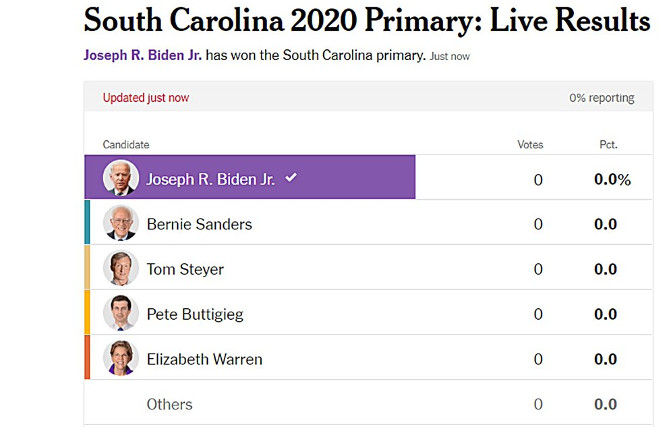
It’s Probably Nothing
It’s challenging to verify information coming out of authoritarian regimes like Iran.
But Ali’s account dates to 2009, he seems like a real engineer, and he links to a number of sources.
His account is sobering and worth investigating. If even partially true, it’s concerning. https://t.co/T2UGlfFgAs
— Balaji S. Srinivasan (@balajis) February 29, 2020
Related: #China’s factories activity plunges, worse than global financial crisis in 2008/9.
Australia has banned travel from Iran.
How Australia defied global health authority on coronavirus
Why were the Australians ahead of the world? For a very simple reason. They don’t trust the WHO. The information from multiple international sources is that the WHO is under intense pressure from the Chinese government, and succumbing to it.
The Australian Commonwealth Chief Medical Officer, Brendan Murphy, told the NSC that it was medically inexplicable that the WHO hadn’t already declared a global pandemic. It’s politics, in other words.
That’s why Australia had earlier forged ahead of the WHO in declaring the China travel ban, on February 1. It was, again, on the unanimous advice of the AHPPC.
Social Disease
The cure: Republican mega-donor buys stake in Twitter and seeks to oust Jack Dorsey – report
Pleasing Your Enemies Does Not Turn Them Into Friends
I thought he knew better.
I'm suing Progress Alberta staff for deplatforming me. They got my book launch cancelled.
But when they were deplatformed by Alberta's budget lock-up I let them use my lawyers. I even gave them free legal research.
Now they're mad we're let in too.https://t.co/UbMvQF60LH. https://t.co/AD2hltGBqO
— Ezra Levant 🍁 (@ezralevant) February 28, 2020
O, Sweet Saint Of San Andreas
Getting the government they deserve, good and hard: Lake Tahoe Music Festival calling it a “wrap” after this summer; blames AB-5
Say It Isn’t So, Joe!
Ukraine launches criminal proceedings against former US Vice-President Joe Biden on allegations he pressured authorities into forcing the resignation of Ukrainian Prosecutor-General Viktor Shokin, Interfax-Ukraine news agency reports, quoting Shokin's lawyer.
— BBC Monitoring (@BBCMonitoring) February 27, 2020
Related: Hunter Biden Seeks to Delay Paternity Deposition Until After Key Primary Votes
Oddly enough, when I searched Twitter for “Hunter Biden” it produced pro-Joe results instead. The same happened with “Hunter Biden support”. It didn’t bring up the Freebeacon link until I searched for “Hunter Biden paternity”.
This Is CNN

Leaning Tower Of Dallas
“That’s what we’re supposed to do, is build strong buildings. Nobody ever told me to make it easy to demolish.”
I, Napoleon
Nope. Not crazy. Not crazy at all.

Blunder Down Under
An Aussie “Puppetry of the Penis” performer severely injured his testicles in a freak corkscrew accident…
February 29, 2020: Reader Tips
A test of the Adams Rule of Slow Moving Disasters.
Your weekend begins now!
Honey, I Finished The Internet
Another recommendation from Colonista: How to build a warship out of ice and woodpulp.
You’re crazy if you support hydrocarbons, and you’re crazier if you don’t – welcome to the world’s largest nest of Catch-22s
The list of logical inconsistencies is as long as your arm. Opponents of hydrocarbons choose to ram through a too-fast energy transition that does not work because it is not planned out, in an effort to save the world’s population from a potential shift in weather patterns that we have decades to plan for and that might not materialize at all in any meaningful way. In other words, we need to change the entire world’s infrastructure in an unbelievably huge way within a decade, based on the assumption that we won’t be able to change the world enough over the next 50 years to deal with creeping-higher oceans or modified weather patterns. And that’s just the tip of the iceberg. Read on…
RIP Freeman Dyson
What Would We Do Without Peer Review?
Online sleuths have discovered what they suspect is a paper mill that has produced more than 400 scientific papers with potentially fabricated images. Some journals are now investigating the papers.
Elisabeth Bik, a microbiologist–turned–research integrity expert based in San Francisco, along with other “forensic detectives,” identified the potentially problematic papers, which they think came from a single source. They say the papers contain western blot images—used in molecular biology to visualize the presence of proteins—that contain remarkably similar background patterns and unusually neat bands lacking smears, stains, or dots, which often appear in such images.
“We think that these western blots are not real,” says Bik, who wrote about the case on her blog on 21 February. “Most of them have a very similar layout so we realized these are all coming from the same stable.”
More detail on this thread.