
Everyone’s got a Grinch story at this time of year. This is how the Grinch tried to steal the oilpatch.
Some big policy issues at play with lithium development

In its continuing series on lithium development in Saskatchewan, there’s some significant issues. The first is commercializing a process known as Direct Lithium Extraction, without which the whole idea is going nowhere. The next issue is primacy of rights when it comes to mineral development – whose rights trump whom? And then there’s the government response to the rights issue. But if we can work these things out, there’s serious potential for a multi-billion dollar industry here on the bald prairie.
Those giant stinking fans failed Saskatchewan, again, on Tuesday

SaskPower delays its reporting of power output by two days. But it turns out that on Tuesday, Dec. 13, wind power production in Saskatchewan all but collapsed. Again. You’d think in winter, having reliable power might be a thing? But we are intent on building more, a lot more, wind and solar.
Recently retired SaskEnergy CEO has a thing or two to say about energy transition
Recently retired CEO of SaskEnergy Ken From is a new columnist with Pipeline Online, and he’s got a thing or two to say about this supposed energy transition.
Did you know the war in Ukraine is over?
That’s how oil markets are acting. All geopolitical risk is gone, as oil prices are at their lowest point since last December for WTI, and February, 2021, for WCS.
Spend your Moe Money wisely, because you won’t likely see that again.
Drilling is down a bit in SK
Drilling activity is down a bit in Saskatchewan, as the only rig working in the southwest is actually drilling for helium, not oil.
Subsidies for oil and gas? Really?
Some people think the oilpatch is blessed with all sorts of federal subsidies. Here’s Pipeline Online’s brief to the House of Commons Natural Resources Committee on the topic, which the committee is working on right now.
Alarm bells, not sleigh bells, should be ringing in Alberta. Saskatchewan, too.
Pipeline Online column on Alberta’s two electrical grid alerts this past week. And it’s not even really cold there yet.
As evidenced twice this past week, the electrical grid can barely handle the demand we have, now, before we switch most of our transportation system to electric vehicles. What happens when half our cars and trucks are EVs? Then three-quarters? What happens when the wind doesn’t blow then? No one goes to work?
When will the other media take notice? When will they start to question this mad rush to wind and solar, and total adoption of electric vehicles? When will someone else in the Saskatchewan media declare “The emperor has no clothes?”
Are we blind?

Alberta issues second grid alert in three days, as wind power generation collapses utterly, yet again, at suppertime.
Net zero or absolute zero?
Energy analyst Tammy Nemeth and a co-writer take on Catherine McKenna’s COP27 ideas regarding net zero. McKenna wants to shut it all down.
Saskatoon born and raised, cut his teeth in Lloydminster oilpatch, now CEO of significant Sask oil producer
Rob Morgan, president and CEO of Strathcona Resources, grew up in Saskatoon and went to chemical engineering at the U of S. He cut his teeth in the Lloydminster oilpatch, and is now running one of the largest oil produces in Saskatchewan. Strathcona bought Serafina Energy this past year, and has substantial activity north of North Battleford. The Patchwork Podcast on Pipeline Online goes deep with Morgan, who sees a long future for oil and gas.
Race for lithium grows, and a look at the leader, Prairie Lithium of Emerald Park

Last week’s Crown Land Sale revealed a sixth entrant in Saskatchewan’s lithium race.
Prairie Lithium is the acknowledged leader in that race. Here’s how it started.
From ice we came, to ice we shall return
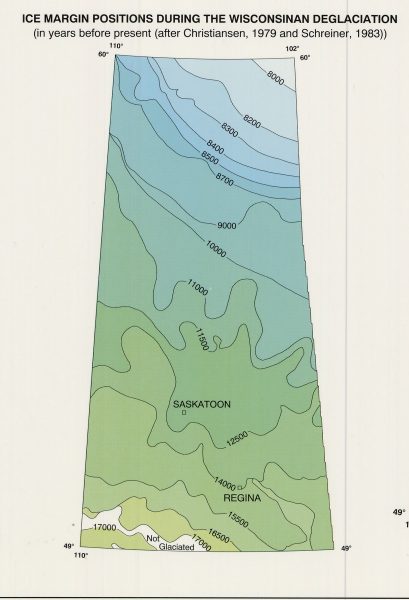
Ask a farmer about rocks. He’ll tell you all about them. Then ask him where he came from.
The answer is the retreating glacial ice sheet that once covered nearly all of Saskatchewan. The ice melted, the rocks in it got dumped in glacial till (the top layer of our land in nearly all of Saskatchewan). And that’s why your combine just chewed a rock. The climate changed, the ice left rocks, and your combine ate it.
Letter to the editor: 25,000 years from now, most of Canada will likely be covered by ice sheets, again. As it was 25,000 years ago
The dawn of a new industry in Saskatchewan: Lithium

Pretty much anything with a rechargeable battery in it these days, from a cellphone to an electric vehicle, uses lithium (except for the lead-acid battery in your conventional car or truck). As the lightest metal, there’s no beating the periodic table.
It turns out, Saskatchewan has lithium beneath its southern soil. And now five companies are in a race to explore it, develop it, commercialize it bring it to market.
Pipeline Online just launched an in-depth series on what’s happening in Saskatchewan, a series over a year in the making. You can read Part 1, the introduction, and Part 2, recently released Saskatchewan incentives.
It’s the birth of an entirely new industry for this province, one that, if it pans out, could be worth many billions. And it’s all being done with oilfield companies and workers, as seen above.
What the other side is thinking: no more fossil fuels, period

In the interest of publishing what the true believers of climate change think, Pipeline Online published this op-ed from two university professors, one from Concordia, the other from McGill. They want to shut down all fossil fuels – coal, oil, natural gas, now. Period. The article came from The Canadian Press.
If we don’t end the use of fossil fuels, all of the rest adds up to little more than branches piled on the tracks in front of a runaway train. They might slow the train temporarily, but until we get inside the engine and shut off the throttle, the train will keep accelerating.
– Eric Galbraith, H. Damon Matthews
And, in a related note: the assault on art continues, this time in Vienna, in the name of saving the planet from fossil fuels.
Do you want to buy one of the 400 business jets that showed up for the COP27 climate conference?

As Alberta’s wind power generation collapsed this week, so, too did Saskatchewan’s giant stinkin’ fans

On Tuesday going into Wednesday, Wind power production in Alberta dropped to 0.1 per cent of nameplate capacity. And it stayed at 2% or less for about 24 hours. Well, now we know Saskatchewan saw a substantial drop as well.
NDP take on Sask First Act
Is it window dressing? Is it constitutional? Aleana Young wants to know.
At 12:30 a.m. this morning, Alberta got just 3 megawatts out of its 3,076 megawatts of wind. Again
Again and again and again, Alberta’s wind power totally collapses to effectively zero. It got really low at supper on Tuesday, dropping to around 15 megawatts, which is pretty much nothing since their nameplate capacity has grown, again, now to 3,076 megawatts.
But by 12:30 a.m., it dropped to just 3 megawatts. That’s out of hundreds of turbines costing many billions of dollars.
Oh, and you have to look at how much the $100 million or so worth of batteries have contributed in the last month. Take a guess.
But hey, Microsoft just signed on to buy a whole schwack of wind power. Does your Azure server rely on Alberta wind?
What the minister has to say about the Sask First Act, and not freezing in the dark

Here’s a deep dive interview with the minister behind the Saskatchewan First Act.
“So let’s take let’s take the power thing first of all,” Eyre said, noting the proposed Clean Electricity Standard, if adopted in its current form, would mean no fossil fueled power generation in this province by 2035.
According to SaskPower’s Where Your Power Comes From website, on any given day, coal and natural gas combined provide 65 to 84 per cent of the power in Saskatchewan. On Nov. 6, it was 77 per cent.
Eyre said, “That’s a federal policy which we hope will never see the light of day, but which is moving along. We will freeze in the dark. And we know that. Saskatoon (is) powered by the Queen Elizabeth, a natural gas-powered power station. The entire City of Saskatoon (would be) in huge trouble.”