Author: Brian Zinchuk

$40 billion in oilpatch CAPEX sounds great for 2023, until you realize it is half of 2014

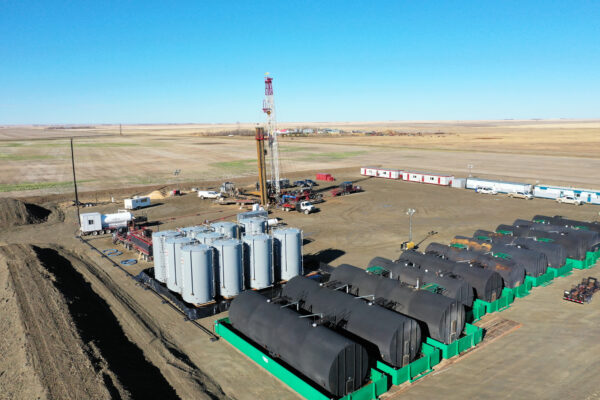
Oilwell battery construction in southeast Saskatchewan, fall of 2022. Photo by Brian Zinchuk

Back in the lofty, pre-Trudeau government days of 2014, back when oil was booming, pipelines were planned to east and west coasts, and Alberta and Saskatchewan were swimming in money, around $81 billion was spent in capital expenditures (CAPEX) in the Canadian petroleum industry. On Wednesday, the Canadian Association of Petroleum Producers (CAPP) forecast CAPEX of $40 billion, which is just about double the disaster year of 2020, but half of 2014. And that’s before #justinflation. What would it be if we had a federal government supportive of the industry, instead of trying to make it disappear?

Curiously, Enbridge announced on the same day its spending a lot of money in Texas, including a port facility for Houston. Funny how it’s not talking about Northern Gateway to Kitimat, or Churchill, or even Valdez, Alaska? Wonder why?

And here’s Brian Zinchuk’s column analyzing all this.

Alberta’s wind power failed, yet again, on Thursday

Alberta wind generation fell to 0.3 per cent capacity at supper last night. And the batteries that are supposed to back them up? Yeah, in the last 30 days, they output power a cumulative 0.09 per cent. That’s not 9 out of 100. That’s 9 out of 10,000. But the public thinks they will be used every night when the sun goes down or the wind doesn’t blow.

Wonder how SaskPower’s doing? We won’t be told for another two days.

Newfoundland will continue to get screwed by Quebec for another nearly 2 decades, just watch

Story: Ahead of Quebec premier’s visit, provincial panel recommends new Churchill Falls deal

The notion that Quebec will change this deal one minute before 2041 is laughable. Quebec locked in a fixed price, with no escalator clause for inflation, in the early 1970s. And then they were able to extend it until 2041, despite Newfoundland’s protests to the Supreme Court of Canada, which backed Quebec. It is perhaps the most lopsided, unfair deal in Canadian history. Quebec gets rich, Newfoundland starves.

Churchill Falls Hydroelectric Generating Facility, with 5,428 megawatts capacity, has more power generating capacity than the entire province of Saskatchewan, combined, if every single coal and gas turbine, every wind turbine are running at 100%, and every solar panel is entirely lit at noon. If Newfoundland actually got a fair deal from its power sales over 50 years ago, it would not have been a have-not province for the last five decades. However, numerous court cases, up to the Supreme Court of Canada, have locked Newfoundland into the deal until 2041, selling power to Hydro Quebec for $2 per megawatt-hour. In New York (which buys power from Hydro Quebec), “Higher fuel costs have led to higher average wholesale electricity prices as well. In February 2022, the average year-to-date wholesale electricity cost was $118.36/Megawatt-hour (MWh), according to NYISO data.” Where do you think they buy wholesale power from?

Teck was going to spend $20 billion in the oil sands, now it’s totally out. Blame the feds

Teck, one of Canada’s largest mining companies, has been around for over 100 years. But even with all that experience, they couldn’t handle the federal government’s Impact Assessment. They were going to spend $20 billion on their Frontier Oil Sands Project. The initial application was in 2012, but eight years later, they didn’t have an answer, so they pulled it. On Thursday, they sold off their last oil sands interests and are out of the oil sands entirely. Wonder why?

Carbon capture, utilization and storage coming to the fore

Three stories on carbon capture and storage (CCUS): On Wednesday, the feds announced an intake for projects related to CCUS.

And the Petroleum Technology Research Centre announced recently they were including a CCUS summit in this spring’s Williston Basin Petroleum Conference.

And then there’s the oilsands efforts in CCUS. Bonus points for the Canadian Press story including the Canadian Centre for Policy Alternatives.

Two days in a row, wind power was negative in Sask

Southwest Power Pool generation at 15 minutes after midnight, last night.

The fog and calm winds have not gone away. Four days in a row, wind power in Saskatchewan was either negligible or negative. Two of those days were negative.

And remember that SaskPower is beefing up its interconnect to North Dakota and the Southwest Power Pool, from 150 to 650 megawatts? Well, as of 12:15 a.m., SPP’s power was 45% coal. So we will give up coal power here, and have option to buy coal power from the US. Because that’s what they rely on when the wind decides not to blow there, either.

Wind power production in Saskatchewan went into negative territory

Turns out there’s a new development out of the story that took place on Monday.

Justin Trudeau on Monday didn’t think much of Saskatchewan’s clean energy projects.

On that very day, characterized by fog throughout much of southern Saskatchewan (where the wind turbines are located), SaskPower’s total wind power generation fell to “-1 megawatt,” as in negative one megawatt, according to the Crown corporation’s Where Does Your Power Come From web page. This is the lowest number Pipeline Online has seen since the page went online in September, 2022. It’s also an average throughout the entire day, not just at a particular moment.

According to SaskPower, “The turbines were iced up and unable to produce. The -1 megawatt was load to service the facilities.”

Saskatchewan has 617 megawatts of installed grid-scale wind power generation.

Also, SaskPower is now paying people extra just to stay in Coronach instead of walking away early from the doomed coal plant.


Just as the world cries out for Canadian LNG, “No business case” Trudeau has totally failed us

First Germany comes to Canada, looking for LNG (liquefied natural gas). Then Japan. And we have nothing to give them. Why?

Justin Trudeau. That’s why. And his merry band of anti-energy protestors and ministers.

While the US has moved fast and hard to get LNG export facilities in place over the last decade, Canada has dragged its feet and stubbed its toe. We let protestors (Coastal GasLink), provincial governments (Quebec) and the federal government (Energie Saguenay) get in the way. Now, while the world is crying for LNG from Canada, we have nothing – NOTHING – to give them.

What else would you expect from a government who killed the Northern Gateway and Energy East pipelines? That scared off Teck from its $20 billion Frontier oil sands project? That hardly whimpered when Biden killed Keystone XL?

The only way this will change is if we have a change in government in Ottawa, and a change in attitude in this nation. We can’t be Can’tada any longer. The world needs us.

Navigation