
“I was attacked in The Atlantic because I was on the side of peace”.
Little Rocket Man
Those were the days, eh? North Korea fired an unspecified ballistic missile off its east coast on Tuesday, South Korea’s military said.
Japanese government tweet (1 hr ago)
Barbarians at the gates
“Gating” is a phenomenon of the financial world whereby an investment fund stops you from withdrawing your capital. Usually this is due to them having, well, having been caught on the wrong side of economic trends. You can thank zero percent interest rates for creating a lot of such incidents in the coming days.
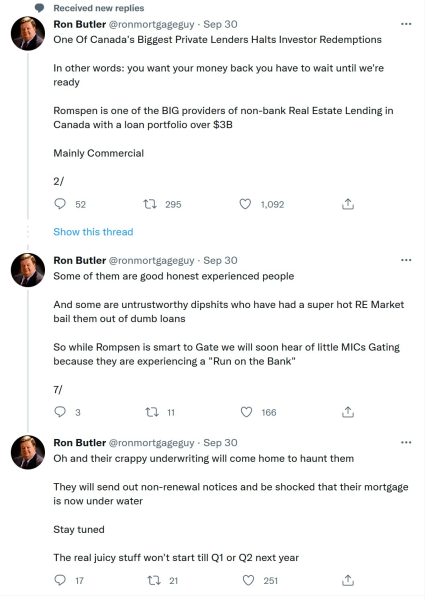
Ron Butler is a Canadian mortgage analyst who is well worth following.
We Said, No Talking
Zerohedge- VPN Usage Surges Amid Protests, Conflict, & War In 2022
In Iran, demand for VPN downloads increased by more than 3000 percent in September, according to TopVPN100.com.
Yet, other countries too have seen surges this year. For instance, Sri Lanka saw a 17,000 percent increase in VPN downloads on April 3 2022, when social media platforms Facebook, YouTube, Twitter, Instagram and WhatsApp were banned.
The internet blackout came as the government enforced a curfew, attempting to keep protesters from hitting the streets over a disastrous economic downturn, mainly attributed to governmental mishandling, which led to major food and fuel shortages.
Ramen? Heck, just eat bugs…
You have to look anywhere but the mainstream financial media for accounts like this. There’s a tsunami coming in the Canadian mortgage market, but almost no one will recognize it until it hits.
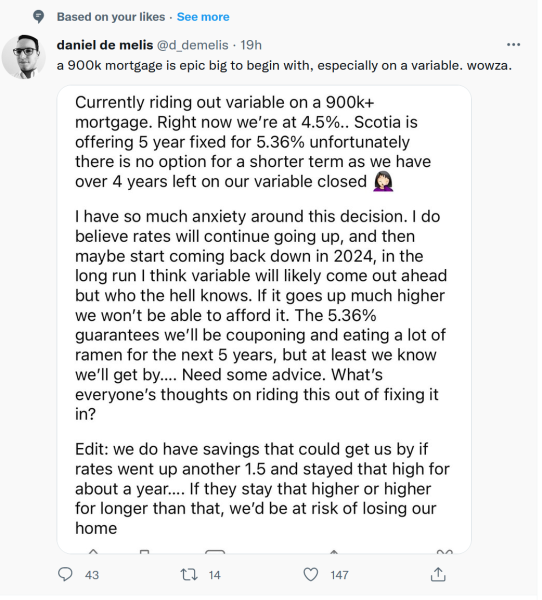
Twitter thread here.
It’s Only Food
Fire Breaks Out at World’s Biggest Produce Market in Paris
Capt. Marc Le Moine, a spokesman for the Paris fire service, said no one was injured. The fire was brought under control and there was no risk of it spreading from the soccer field-sized warehouse, covering an area of 7,000 square meters (1.7 acres), he said.
The cause of the blaze was unknown but will be investigated, he added.
I’ve known the unknowns since the days they were torching cathedrals.
Triggers
A few months from now, when people hear the word “trigger” it won’t conjure thoughts of how someone’s words injured your psyche, but rather about what happens when your variable rate mortgage interest is more than your payment. This is going to get ugly, folks.

Twitter thread here.
Housing Bubble 2.0
If you believe that the housing crisis of 2008 could never, ever happen again, you might just be mistaken.
Opendoor is on the hook for properties it picked up in a historically hot market. A Bloomberg analysis of Yipitdata says that as a result, the company lost money on 42 percent of its sales in August.
Opendoor’s buy-to-sale premium — the difference between the price at which it buys a home and the price it sells it for — had never fallen below 1 percent, including at the height of the pandemic, when it bottomed out at just under 4 percent. But Yipitdata cited by DelPrete show that after peaking near 12 percent earlier this year, the premium has fallen to just below zero.
More Like A Hard Thud
The 5 largest economies in the world are experiencing the fastest slowdown in credit creation in over 20 years.
History suggests that earnings and economic activity will follow.
Soft landing my a** pic.twitter.com/zU4LUzSWWV
— Alf (@MacroAlf) September 17, 2022
A path to insolvency
A central bank losing money? Maybe that’s what happens when you combine Covid lockdowns and green energy mandates with years of zero percent interest rates. It’s all part and parcel of the death throes of a fiat currency.
The Bank of Canada deployed QE for the first time during the COVID crisis, flooding the financial system with the equivalent of hundreds of billions of dollars to help keep downward pressure on interest rates and to increase the capacity of banks to lend money.
An unintended consequence of that policy is that for the first time in its 87-year history, the Bank of Canada is on track to lose money for an extended period, as interest expenses on deposits climb in tandem with the benchmark interest rate, which Macklem has raised by three percentage points since March….
Protecting the Vulnerable
Just take your pills, grandpa.
CBC- Nearly a quarter of Winnipeg care home residents given antipsychotic drugs with no diagnosis
Winnipeg nursing home residents are being prescribed powerful antipsychotic drugs at an increasing rate to treat dementia and control behaviour, rather than what the drugs are meant for — to manage symptoms of schizophrenia or bipolar disorder.
Elderly patients with dementia who are treated with antipsychotics have an increased risk of death, mostly due to cardiovascular concerns and infections, according to Health Canada.
Other studies have shown the drugs can increase the risk of falls and fractures in older adults. “You almost put this person into a zombie-like state,” said Dr. Samir Sinha, director of geriatrics at Sinai Health and University Health Network in Toronto.
An “influx of admissions” to nursing homes this year after capacity was reduced during the start of the COVID-19 pandemic is partly to blame, according to the spokesperson.
However, Sinha says the problem may be linked to staffing issues at care homes. “It’s why these behaviours become more problematic for example, and harder to manage — especially when you’re short-staffed,” he told CBC.
We’re All In This Together
Armstrong Economics- Global Recession
Neither China nor Russia are to blame for Germany’s situation. Russia was simply a diversion to draw attention away from the collapse of the European economy. Negative interest rates beginning in 2014 wiped out pension funds and proved that the central bank was not thinking long-term. COVID restrictions killed the supply chain, and Germany’s insistance in backing Ukraine eliminated what could have been a lucrative pipeline. Had the pipeline gone through, Europe would not have an energy crisis! Ever since COVID, we have witnessed a rising trend of civil unrest.
Moments in history
Economics used to be the study of human action, with particular emphasis on discovering timeless principles and laws via historical research. Modern economics, with its emphasis on mathematical models bereft of rational principles, regards past experience as nearly useless. If you can’t think in terms of principles, you will just keep stumbling from disaster to disaster.
For European utilities, the peril is more complex than Nord Stream going dry. Some are wondering if this marks a sort of “Lehman Brothers” moment for Euro power providers, recalling the days of the United States 2008 housing crisis when risky loans came due on mortgages that buyers ultimately couldn’t afford.
With prices rocketing up, brokers are making margin calls and forcing utilities to shop around for cash.
The recession cometh
As far as recession indicators go, this is far more reliable than any GDP measures.
Canada’s unemployment rate was 5.4 per cent in August, ticking up for the first time in seven months.
The economy lost 40,000 jobs last month, Statistics Canada reported in its latest labour force survey, with the losses concentrated in the public sector.
In July, the unemployment rate was 4.9 per cent, the lowest rate since comparable data first became available in 1976.
It’s Probably Nothing
Just Two Weeks to Flatten the Humans
It’s deja vu all over again!
NOW – EU will propose a "mandatory target for reducing electricity use at peak hours" in order to "flatten the curve." pic.twitter.com/Q6EuLLTM0L
— Disclose.tv (@disclosetv) September 7, 2022
That’ll show Putin…oh, wait….
That sanctions against Russia would result in the de-industrialization of Europe probably didn’t occur to those who promoted that strategy, but this war is resulting in a whole lot of unintended consequences these days.
ArcelorMittal will shut one of its two blast furnaces at its steelworks site in Bremen, Germany, from the end of September until further notice, due to the “exorbitant rise in energy prices,” the company said in a statement on Friday.
That’ll show Putin!
Most wars start out with the widespread belief that victory will be quick and easy. When things drag on with no prospect of victory, the economic damage eventually forces some sort of reckoning. It looks like the price of that reckoning is getting steeper by the minute.
As of Friday, 70% of capacity is offline across the continent, according to Fertilizers Europe, representing top regional producers.
“The current crisis begs for a swift and decisive action from EU and national policymakers for both energy and fertilizer market,” Jacob Hansen, director general of Fertilizers Europe, said in a statement.
Producers from Norway’s Yara International ASA to CF Industries to Borealis AG recently reduced or halted production because European NatGas prices hit a record high of 343 euros per megawatt hour, making it uneconomical to operate.
Sand in the gears
By now it’s obvious that central banks are going to continue raising short term interest rates. It seems likely they will continue until the housing market finally snaps.
Albritton is booked out 30 days in advance, compared to the usual 90 to 160 days. Meanwhile, his costs have gone up by more than 30% across the board. Plywood he uses jumped from $72 to $140 a sheet around Christmas. It has gone back down to $85 a sheet, but that’s still higher than it used to be. And he has trouble finding hinges at any price.
The average rate on a 30-year mortgage is 5.55%, according to Freddie Mac. A year ago, the average was 2.87%. The increase is forcing some would-be buyers out of the market and sales of previously owned homes have fallen for six straight months.
Temporarily Unexpected
Fed’s dilemma… debt/gdp is 3x higher than in the 1970s… interest rates must go up to avoid hyper inflation…
But with govt revenue of only $4 trillion and debt of $31 trillion, it would only take an interest rate of 13% for interest expenses to equal ALL government revenue… pic.twitter.com/ueFIyW7acH
— Wall Street Silver (@WallStreetSilv) August 22, 2022
OTOH, if they go full Zimbabwe with the money printing, that national debt could be paid off with a couple loaves of bread.