Tag: 100% renewables

Those carbon capture people keep coming back to Saskatchewan

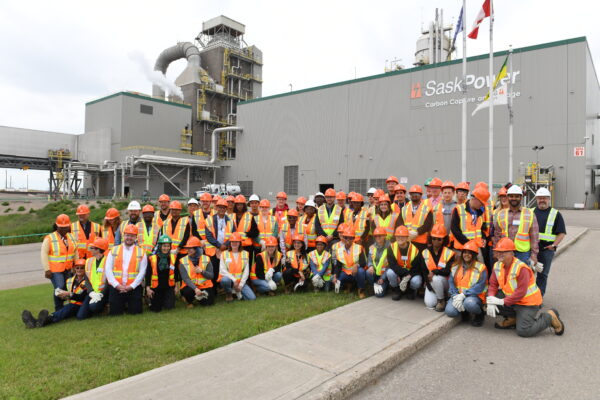
That’s a whole lot of PhD students at Boundary Dam. Photo by Brian Zinchuk

Why? Because we are the leaders, worldwide. Every second year the IEAGHG summer school returns to Regina and Estevan, because we’ve got the most significant, commercial-scale carbon capture facility on a coal plant in the world, and we’ve learned a lot from it. That’s from the general manager of the IEAGHG.

Say what you want about carbon capture and storage, but Saskatchewan’s a big deal in this field.

I also asked him about when the glaciers covered Canada, and it wasn’t my SUV or the two coal fire power plants near my house that caused them to melt.

Steven Guilbeault starts talking about $247 per tonne “social cost on carbon”

Environment Minister Steven Guilbeault announces “social cost on carbon.” Could this mean a $247/tonne carbon tax? Could it even hit $294/tonne?

Some more details in this Canadian Press story.

This is a big deal, and a huge threat to Saskatchewan and Alberta. In this Twitter video, Environment Minister Steven Guilbeault first provides the justification for why the carbon tax was originally $50, noting the government calculated the cost to be $54/tonne. Now he says they are implementing a “social cost of carbon,” and says it’s $247 per tonne. “ He calls it a “new tool the federal government is going to use on the fight against climate change.”

Is this the next threshold for the carbon tax? Sure sounds like it. Also sounds like justification for the proposed Clean Electricity Standard, to rid Canada of all coal and natural gas power generation. That’s a driving factor behind the Saskatchewan First Act. It also sounds like after the nine federal initiatives listed in the Drawing the Line White Paper, Clean Electricity Standard being No. 10, this is likely No. 11.

And have the provinces been consulted?

What the other side is thinking: no more fossil fuels, period

Eric Galbraith. McGill University

In the interest of publishing what the true believers of climate change think, Pipeline Online published this op-ed from two university professors, one from Concordia, the other from McGill. They want to shut down all fossil fuels – coal, oil, natural gas, now. Period. The article came from The Canadian Press.

If we don’t end the use of fossil fuels, all of the rest adds up to little more than branches piled on the tracks in front of a runaway train. They might slow the train temporarily, but until we get inside the engine and shut off the throttle, the train will keep accelerating.
– Eric Galbraith, H. Damon Matthews

And, in a related note: the assault on art continues, this time in Vienna, in the name of saving the planet from fossil fuels.

Californian Turkeys Vote for Christmas

The California legislature just passed Assembly Bill 100 (AB100), which according to the inset calls for “100% clean energy by 2045”. The brief review presented in this post shows that AB100, which targets electricity, not energy, will cut California’s greenhouse gas emissions by only about 16% even in the unlikely event its target is met. Its main impact will be to add to the regulatory overload from which California’s electricity providers already suffer. The fact that the bill was passed at all indicates that California legislators, as well as being unable to tell the difference between megawatts and megawatt-hours, are also unable to tell the difference between electricity and energy.

Assembly Bill 100 and a 100% renewable California

California’s progress in cutting emissions

The California Air Resources Board (CARB) recently published its 2018 inventory of greenhouse gas (GHG) emissions, according to which the state achieved its goal of cutting GHG emissions below 1990 levels in 2016, four years in advance of the 2020 target date*. Gov. Jerry Brown claims that this proves that the state’s anti-carbon laws and regulations are “succeeding”, but are they really? Here we take a brief look at CARB’s data, concluding a) that success has not yet been achieved and b) that California’s long-term emissions targets remain as elusive as ever.

…where does the truth lie?

Navigation