For your late evening weekend entertainment, this 2001 National Press Club Event (2 hours — the kooks appear near the end). I’m somewhat surprised this has fewer than 30K views.
Thread open.

For your late evening weekend entertainment, this 2001 National Press Club Event (2 hours — the kooks appear near the end). I’m somewhat surprised this has fewer than 30K views.
Thread open.

h/t Bill
An eclectic mix of energy and climate news stories from around the world compiled by Roger Andrews.
This week we feature the impact of renewable energy on electricity prices. The question is, if renewables are so cheap why are electricity rates increasing? To follow: OPEC achieves 150% production cut compliance; 2018 oil price to average $65; US gas pipelines under threat; Gazprom pumps record gas to Europe; more US nuclear plant shutdowns; more gas plants for sale in UK; US EPA agrees biomass is carbon neutral; Taiwan’s energy shortage, hydro and geothermal in Kenya; Australia’s NEG to kill renewables; South Africa explores energy storage; Brexit won’t change UK’s “climate ambition”; cracks in Hunterston reactor; the UK’s first blockchain energy transfer (all of 1kWh), and how climate change shrinks birds.
A newly declassified report on Russian interference in the 2016 U.S. elections reveals that former intelligence chief James Clapper lied to Congress about information he shared with CNN on the infamous Steele dossier.
Finland ends its experiment with “Universal Basic Income”
Surprise ending: It was a failure.
The only surprise is that it was ended.
Here you go.

Integrating solar on to the grid is much easier when to do when you can easily turn natural gas plants up and down to accommodate their intermittency. And it’s much easier to do when it is 12 percent of your electricity instead of 20 percent.
But even at low levels, problems arise. According to the research done by Lion Hirth, solar’s value drops by 50 percent when it gets to just 15 percent of mix. While those values may be different for Nevada, the impact of unreliability is the same.
What is most remarkable about U.S. states heavy in solar and wind is that electricity prices rose so much given the huge decline in natural gas prices.
Justin Trudeau and his Liberal party are “slightly naive” on China, or even “seduced” by a country that they see as the “new Rome.” Those are the words of Ward Elcock, the man that lead CSIS from 1994 until 2004 and was granted senior appointments by the Harper government on security files after spending a decade serving the Chretien Liberals.

… police have laid 29 more charges of sexual assault against a 37-year-old man alleged to have sexually touched women on city buses after more complainants have come forward.
h/t Ottawa MJ
Hear my prayer.
h/t Raymond
Donald Trump’s October 24, 1999 Meet the Press interview with Tim Russert is a historically illuminating flash forward to the most surprising, promising and history-altering opportunity since the Soviet Union collapsed: “denuclearizing” North Korea without the could-be belligerents waging a hideously destructive war that scars East Asia and seeds a global economic depression.
Yes, those are the stakes: millions of dead and trillions of debt.
In the interview, Russert says Trump once indicated if he were president he would attack North Korea preemptively in order to end its nuclear threat.
Despite Russert’s vapors and wailing, Trump’s grammatically-challenged beer and barbecue answer is a superb twofer. One: Trump answers Russert’s core question. Two: Trump accurately summarizes the American government’s spaghetti-spined responses to North Korea’s slow but insidious quest for nuclear weapons.
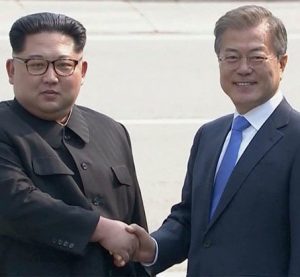
Morning news: The Koreas said they hope the parties will be able to declare an official end to the war by the end of this year.
Things you’ll never see at the CBC…
South Korea’s Foreign Minister tells me in Seoul that “clearly credit goes to President Trump” for bringing North Korea to the negotiating table. “He’s been determined to come to grips with this from day one,” Kang Kyung-wha says.
Airs 8pm CET on @cnni, 11pm ET on @pbs. pic.twitter.com/DpBExrlnc6
— Christiane Amanpour (@amanpour) April 26, 2018
Only 37 percent of 12th graders tested proficient in reading and only 25 percent in maths. Yet the inability to read or do maths seems to be no barrier to college. Unprepared students are flooding into college in record numbers. The Bureau of Labour Statistics says 70 percent of white high-school graduates and 58 percent of black graduates in 2016 enrolled in college. In his syndicated column, Walter E. Williams asks, “If only 37 percent of white high school graduates test as college-ready, how come colleges are admitting 70 percent of them? And if roughly 17 percent of black high school graduates test as college-ready, how come colleges are admitting 58 percent of them? It’s inconceivable that college administrators are unaware that they are admitting students who are ill-prepared and cannot perform at the college level.”
John Leo on standards versus appearances. One of these.
BREAKING: Prosecutors say they used online genealogical sites to find DNA match for suspected California serial killer.
— The Associated Press (@AP) April 26, 2018
Now we know why Kim Jung Un stepped over the border for a South Korean handshake today.
His side’s winning.
All your DNA are belong to us.
Many of us warned people about this when the fad began. These genealogy database systems are no different than NSA or Facebook databases. There is no privacy aspect. They were predictably going to be harvested by authorities; as they did. https://t.co/eR185TzvjP
— TheLastRefuge (@TheLastRefuge2) April 26, 2018
The thread is open.
I’m old enough to remember when Bush was Hitler… “Perhaps we should require reading ‘The Boy Who Cried Wolf’ in journalism schools.”
Where the foxes caper unmolested, the government packs your school lunch, and “this is the line of defense making sure that little Alfie Evans does not leave the British hospital where he has been sentenced to die.”