
SaskPower president and CEO Rupen Pandya was in Estevan on Monday, and there’s a lot to unpack from that. He told city council how many reactors are being considered at Estevan and Elbow (SaskPower is currently planning for their first 2). And converting Estevan area power stations to natural gas could allow us to test carbon capture on natural gas exhaust. But that would mean the end of coal at Estevan.
Eco zealots and going big into nuclear
All the hacking issues last week means there’s a lot to catch up on in the world of energy.
First, a column this morning from U of R professor Jim Warren: Guess what happens when eco-zealots are put in charge of making climate policy?
Here’s another verbatim press release from Steven Guilbeault about cutting oil and gas emissions by 75%.
If you didn’t catch it last week, Sask Polytechnic is getting a brand spanking new campus. Too bad it won’t be anywhere close to finished before my daughter finishes her journeyman heavy duty mechanic ticket. (She just started her 4 year apprenticeship, if that give you a hint.) Maybe my 16-year old son will get to attend the new site in his fourth year of apprenticeship?
Did you know Manitoba has an oilpatch? Often their own politicians don’t really clue in on it, including former Premier Brian Pallister. I can’t find it now, but when he flip-flopped on fighting the carbon tax, he made accusations against “oil producing provinces.” Manitoba produces around 38,000 barrels per day. Anyhow, the largest oilfield in Manitoba is now 19 years old.
Oil prices look like they’re heading for $100/ barrel US.
Dams aren’t so green, after all.
And the big one for last week: my column on how Saskatchewan goes big into nuclear. Funny thing is I’ll be speaking to the SaskPower CEO on Monday. We’ll see if I’m on the mark or not.
The impact of CO2-enhanced oil recovery is huge
It turns out that carbon dioxide-enhanced oil recovery is more significant than even I thought, and I’ve been writing about if for 15 years. It accounts for a huge number of the top 100 conventional oil wells in Saskatchewan. Huge. And it proves out the significance and importance of CO2-EOR. Imagine what we could do across Saskatchewan with access to a lot more CO2? That’s going to have to be a column, methinks.
Also, oil is over US$90/barrel for the first time in quite a while. That’s going to be pretty important for Saskatchewan, as I was made aware today that potash prices have tanked. They are down by half year over year.
Explaining the “inside baseball” on Crescent Point
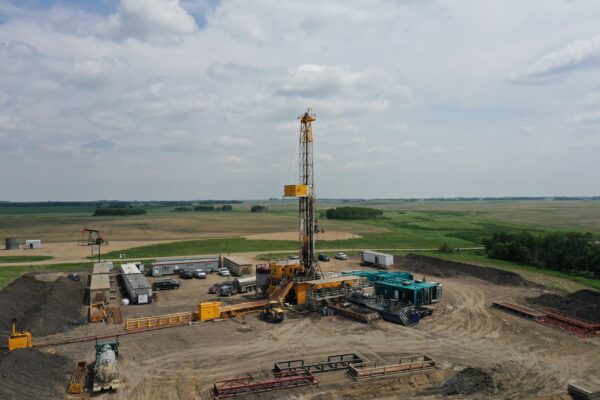
One commenter wondered what the post about Crescent Point yesterday was all about, and seeing by the lack of comments, he was right to suggest it might be a bit of “inside baseball.” So let me lay out some context for the average Saskatchewan resident:
- The “Bakken Boom” of 2008-2014, which included over a billion dollars of land sales in 2008, was largely driven by Crescent Point. Most of that billion dollars in land sales that year, the year Saskatchewan paid off a huge chunk of debt, was directly from Crescent Point. Remember when the provincial government had that huge surplus in 2008? Crescent Point was a huge factor in that.
- Their prodigious activity drove thousands of high paying jobs in Estevan, Weyburn, Carlyle, Carnduff, Midale, Stoughton, Torquay, Lampman, Benson, Arcola, Redvers, Gainsborough, Oungre and more, literally spending billions per year, mostly with oilfield service companies, who in turn paid wages. See, in Saskatchewan, the oilpatch isn’t really about the oil companies, but the hundreds of oilfield services companies who employ thousands of people that work for those oil companies. And those people then bought trucks, quads, boats, RVs, houses, Riders tickets, restaurant meals and more.
- Millions of people across Canada, through mutual funds or direct stock ownership, or pension plans or other institutional investors, made billions off Crescent Point.
- At one point, Crescent Point accounted for roughly one out of every four barrels of oil produced in Saskatchewan. And at that time, oil royalties were paying up to 20 per cent of the provincial budget’s revenues, while health care was consuming about 39 per cent of the budget’s expenses. That meant that oil was paying for roughly every single doctor, nurse, hospital, old folks home, Xray, MRI and more south of Lumsden – including Regina – and Crescent Point was paying for roughly one quarter of that.
- On health care – it was Crescent Point that got the ball over the line in leading the fundraising to get STARS air ambulance finally going in Saskatchewan. While Potash Corp eventually donated more money, Crescent Point was the leader in that endeavor. If they hadn’t done that, it might have been several more years before getting a helicopter air ambulance here. If we had STARS in 1997 when my grandfather had a stroke, maybe he wouldn’t have turned into a vegetable and died a slow death. STARS responded the night my sister died. It matters.
- Before they started selling off land in 2018, Crescent Point controlled huge swaths of land across southeast and southwest Saskatchewan. Over the course of something like 30 acquisitions, almost every one of those made the sellers rich, and those sellers often went on and reinvested a large portion of that money back into Saskatchewan.
- They were really hard on oilfield service providers to cut costs when the 7-year downturn hit around Christmas of 2014. But when nearly all other oil companies pulled their horns in and stopped spending money, Crescent Point did not. They kept going, even if they were paying less. That kept a huge portion of the industry afloat for several years, even if begrudgingly. For several of those years, Crescent Point employed more drilling rigs in Canada then the No. 2 and No. 3 oil companies combined. They may have been lean times, but lean was better than starvation, which is what most of the rest of the oil business was doing. In February, 2018, Crescent Point employed 29 drilling rigs, 27 of which were in Saskatchewan. They kept the industry afloat when no one else was.
- Despite being based in Calgary, Crescent Point, along with Husky, were our oil industry corporate champions – Crescent Point for a decade, Husky for decades.
- And now, Crescent Point’s activity and involvement in Saskatchewan is a shadow of its former self. While Whitecap Resources has in a small way picked up where Crescent Point left off, at this point it’s nowhere close. And as a result, all those towns listed above, and the province as a whole, are feeling the difference.
- You may not realize it, but without Crescent Point from 2008-2018, almost everyone in Saskatchewan, and Saskatchewan itself, would have been poorer as a result.
I hope that explains it a bit more.
Crescent Point is spending 70% of its CAPEX in Alberta. Not that long ago, it was more like 80+% in Saskatchewan
I’ve been saying for a long time now, Crescent Point has been increasingly losing interest in Saskatchewan. Monday’s CAPEX budget solidifies that, as they’re spending 70 per cent of a billion dollar budget in Alberta. They used to easily spend a billion in Saskatchewan per year, and often a lot more. So anyone who relies on Crescent Point should take note, including the province of Saskatchewan.
As recently has February, 2018, Crescent Point had 27 rigs drilling in Saskatchewan. Today that number is 4.
If you want to know why things are slower in Saskatchewan, even with higher oil prices, here’s your first clue.
And How Was Your Day?
The electric chip truck catching a ride on the diesel semi. pic.twitter.com/SsHCzCiczP
— Robin Speer (@rcspeer) September 12, 2023
Why aren’t drilling rigs flying out the door?
Oil prices are up, but drilling activity in Saskatchewan is meh. Anyone care to guess why that might be?
Cry Harder, Groomer
Education Minister Dustin Duncan today announced new parental inclusion and consent policies for Saskatchewan schools.
As of today:
– Schools must seek parent/guardian permission when changing the preferred name and pronouns used by students under the age of 16 in the school;
– Parents/guardians must be informed about the sexual health education curriculum and have the option to decline their children’s participation; and,
– Boards of education must immediately pause involvement with any third-party organization, such as ARC Foundation and the SOGI 1 2 3 Program, connected to sexual health education as the ministry undertakes review of educational resources to ensure alignment with curriculum outcomes. Only teachers, not outside third-parties, will be able to present sexual education materials in the classroom. This directive does not include professionals employed by government ministries or the Saskatchewan Health Authority.“Our government has heard the concerns raised by Saskatchewan parents about needing to be notified and included in their children’s education in these important areas,” Education Minister Dustin Duncan said.
Predictably, the NDP return to their roots.
Honey, I Finished The Internet
A Saskatchewan horse thieving vacation.
Honey, I Finished The Internet
Ghost Towns Of SW Saskatchewan (h/t Yeti)
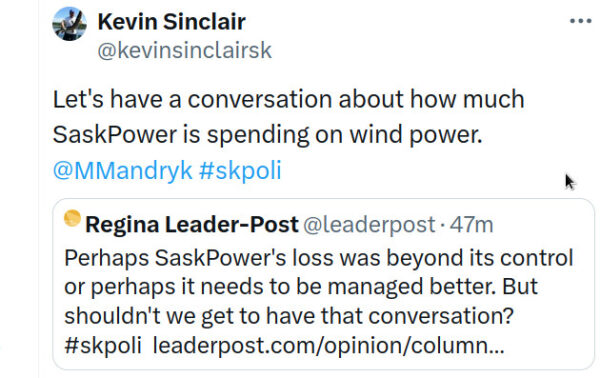
Wind produces zero power in Sask three times on Sunday

Total flatline: For 3 hours, 17 minutes on Sunday, not one lightbulb in Saskatchewan was powered by grid-scale wind. Three times wind power went to zero. Not 1 per cent. Not half a per cent. Zero.
Math on how Saskatchewan can grow a multi-billion dollar lithium industry
I’ve been talking for a while now about how lithium has to potential to become a multi-billion industry in Saskatchewan in a few years. Here’s a big chunk of how: Lithium in SK, Part 19: Grounded Lithium’s Kindersley project could cost $447 million to build, but bring in $350 million per year
Also, Brian Zinchuk on Gormley. Up for discussion this month: current oil prices and drilling activity, TC Energy spinning off the Keystone Pipeline system, Public Policy Forum’s paper on doubling the electrical grid, vilification of the oil sector.
And about those two billion trees…
The Chickens Come Home To Roost
Honey, I Finished The Internet
Take a Saskatchewan golf vacation with my friend Karen.
Peak demand, an anniversary and a merger
SaskPower hits record summer demand on Monday.
50 year anniversary for a stalwart of the Saskatchewan oil industry.
One of Saskatchewan’s largest oil producers makes a big deal in the Montney.
Nice story about innocent kid shows some people are full of hate
So on Saturday morning, Premier Scott Moe’s social media team posted this Pipeline Online story on a young Estevan kid who launched an ice cream bike business at the age of 11. She had the help of her oilfield business-owning dad. A nice, feel good story about an innocent little girl and her ice cream bike.
Saskatchewan is full of outstanding entrepreneurs just like Anna!https://t.co/rOvxyiBC3t
— Scott Moe (@PremierScottMoe) July 22, 2023
And this is the sort of reaction people full of hate tweeted in response:
https://twitter.com/SaskaRocks/status/1682787028012810240?s=20
Ffs.. kids promoting dirty oil..how effing low will scumbag cons go
Country is on fire
3 firefighters have died in the last week
You make me sick— sherry prattle (@sherryp12417633) July 22, 2023
Unbelievable.
A Saskatchewan Son
Colter Wall’s new album dropped a few days ago.
Those carbon capture people keep coming back to Saskatchewan
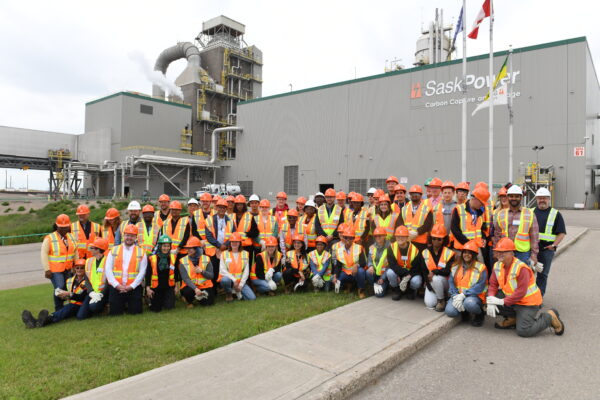
Why? Because we are the leaders, worldwide. Every second year the IEAGHG summer school returns to Regina and Estevan, because we’ve got the most significant, commercial-scale carbon capture facility on a coal plant in the world, and we’ve learned a lot from it. That’s from the general manager of the IEAGHG.
Say what you want about carbon capture and storage, but Saskatchewan’s a big deal in this field.
I also asked him about when the glaciers covered Canada, and it wasn’t my SUV or the two coal fire power plants near my house that caused them to melt.
Kipling wind project gets $50 million in fed money, kinda
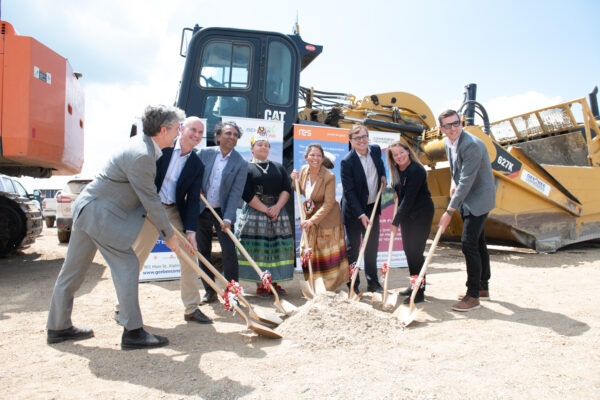
Basically, Saskatchewan large GHG emitters are forced to pay a form of carbon tax called “Output Based Pricing”. Some of the money from that is what was provided, from the feds, to Cowessess, for their investment equity into this project which cost hundreds of millions of dollars.
Also, Enbridge doesn’t build a lot of pipelines in Canada anymore. But they are building wind turbines off the coast of France.