Here you go, fwiw.
That was over fast, election called for Ford’s PC’s.

Here you go, fwiw.
That was over fast, election called for Ford’s PC’s.
Phone transcript between Trudeau and Ford just entered as evidence at #POEC.
Expect headlines.
— Noé Chartier (@NChartierET) November 8, 2022
Update: Read out here.
Tonight is the big debate between the socialist leaders of Ontario. Who will promote the most free stuff? Because that is one of the reasons our Dear Leader Justin keeps getting re-elected. I wonder if there will be any mention of gas prices.
GUEST OP-ED: Ontario taxpayers set to choose from three unpalatable options
It is now illegal to use a math test to make sure that math teachers know the material they would be teaching.
On Seattle’s woke, broke public transport; the steep downward trajectory of Swedish schooling; and, quoted above, on super-progressive Ontario, where “diversity” trumps standards.
The National Post has learned Ontario’s PC government will introduce new measures at Queen’s Park on Monday, meant to prevent a repeat of last month’s freedom convoy blockades.
If passed, law enforcement will be able to direct owners and operators to remove their vehicles from illegal blockades, be able remove items used to illegally block roads, and be given the power to suspend both drivers’ licences and vehicle registration of participants.
The Ford government will also announce $100 million in new spending, including public order training for law enforcement agencies and establishing a permanent Ontario Provincial Police emergency management team.
The money will also go towards provincial procurement of what the government described as “critical equipment” — which according to a government source includes the purchase an undetermined number of tow trucks.
We need a new country.
In Northern Ontario is located the Ring of Fire, a geological feature in the James Bay Lowlands that holds a massive chromite deposit and a nickel-copper deposit known as the Eagle’s Nest. Exploration in 2007 led to the discovery of these ore deposits and they have yet to be mined. The area is remote from existing infrastructure with the nearest “town” of Nakina more than 300 km to the south.
Local indigenous communities such as Webequie have very small populations. Webequie, for example, is home to less than 1,500 Ojibway.
To mine the ore from the Ring of Fire will require a railway, a roadway and electrification. Early estimates of the cost for such infrastructure were $2-$4 billion and were scoffed at as being too high. Now the cost estimates are starting to trickle in.
To build a hydro line into the Ring of Fire is estimated to cost about $1.7 billion.
https://www.linkedin.com/pulse/ring-fire-electrical-infrastructure-capex-study-finds-kevin-thomsen
The so-called “massive nickel deposit” that is the Eagle’s Nest is estimated at 20 Mt. This compares to Voiseys Bay at over 100 Mt, Thompson Manitoba at over 200 Mt and the mighty (now mostly mined-out) Sudbury Basin at over 1 Bt (B=billion).
The total cost to provide infrastructure to the Ring of Fire will exceed $4 billion – easily. The total value of the Eagle’s Nest has been estimated at $5-$7 billion in-situ (as if the ore was sitting on the ground processed and ready to ship to eager markets). The cost of mining is typically 50% of the value of the ore. This means the nickel deposit will be mined by an Australian company at a gross profit of $3.5 billion for infrastructure costs of $4 billion (and more).
It is very likely the project will go ahead. I just thought the fine taxpayers of Ontario would want to know that $4 billion of their tax revenue is being spent on a few thousand people in Northern Ontario and an Australian mining company without any discussion of who will pay to maintain the infrastructure after the mines have closed.
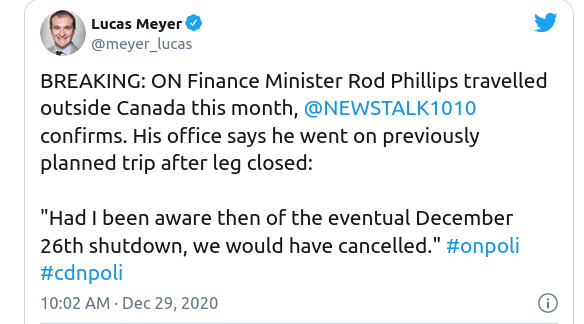
That’s different, because shut up.
Dr. Yaffe: "I just say whatever they write down for me."
Dr. Williams: "Yeah, same." pic.twitter.com/cdsw4n1Ax0
— CrasHTalk (@CrasTalk) December 15, 2020
Ontario’s new Progressive Conservative government is cancelling 758 renewable energy contracts, in what it says is an effort to reduce electricity bills in the province. […]
“For 15 years, Ontario families and businesses have been forced to pay inflated hydro prices so the government could spend on unnecessary and expensive energy schemes,” Rickford said. “Those days are over.”
They don’t need no flaming sparky cars, either.
(h/t raid)
“The elites said it couldn’t be done. But the entire Hydro One Board is now on the way out.“
h/t raid
What the Doug Ford Government means for the Energy Sector – the great unwynnding;
“Premier Doug Ford ran and won on a platform labeled For the People: A Plan for Ontario. The platform set out Ford’s energy plan, in its entirety, as follows:
• Clean up the Hydro Mess and fire the board of Hydro One and its $6-million-dollar CEO.
• Our first act will be to end the Liberal practice of making millionaires from your hydro bills!
• Stop sweetheart deals by scrapping the Green Energy Act.
• Cut hydro rates by 12% for families, farmers, and small businesses by:
• Returning Hydro One dividend payments to families.
• Stopping the Liberal practice of burying the price tag for conservation programs in your hydro bills and instead pay for these programs out of general government revenue.
• Cancel energy contracts that are in the pre-construction phase and re-negotiate other energy contracts.
• Declare a moratorium on new energy contracts.
• Eliminate enormous salaries at Ontario Power Generation and Hydro One.
h/t raid
Blaming Prime Minister Justin Trudeau’s government for creating “a mess,” Premier Doug Ford’s new Progressive Conservative administration is withdrawing Ontario’s co-operation with Ottawa on resettling asylum seekers, the Star has learned.
Ontario Children, Community and Social Services Minister Lisa MacLeod told federal Immigration Minister Ahmed Hussen that Queen’s Park is stepping back from the migration crisis. […]
That could sound the death knell for the Canada-Ontario Immigration Agreement signed by former premier Kathleen Wynne last November.
You don’t say.
She may be gone, but the socialism lingers on: Ontario’s Minimum Wage Hike Has Been Disastrous, Especially for Disabled Workers
If Andrea Horwath wakes up as Premier of Ontario on June 8, she may have a shadowy foreign-funded group out of Vancouver to thank for her win.
Kathleen Wynne on Saturday acknowledged that she will no longer be premier after the June 7 election and encouraged voters to elect Liberal candidates to prevent the NDP or PCs from securing a majority.
“Even though I won’t be leading this province as premier, I care deeply about how it will be led,” the Liberal leader said during a campaign stop in Toronto.
“People want change, but by and large they’re confident about where Ontario stands and where Ontario is headed. For this reason, many voters are worried about handing a blank cheque to either Doug Ford or the NDP,” she continued.
Oh.
Remember NDP leader Andrea Horwath saying May 14 she “unequivocally” had “no interest” in forming a coalition gov’t with Wynne? Guess what? She changed her mind: Horwath now open to coalition government with Wynne https://t.co/KKHOurkb3V #onpoli https://t.co/Yc9EYXgy0N
— Lorrie Goldstein (@sunlorrie) June 2, 2018
The latest Ontario polls show … confusion?
EKOS reports a dead heat.
Innovative Research shows a 5 point PC lead.
Forum alleges a 14 point NDP lead, with the Liberals half of what’s reported in the other two polls.https://en.wikipedia.org/wiki/Ontario_general_election,_2018
We need to ask at this point — do these pollsters do their surveys on the same planet? Or do they make them up as they go along?