Category: Venezuela

Tax me harder

Rather than reconsider the usefulness of skyrocketing borrowing for Covid stimulus, overpriced pipelines, battery plant subsidies and a war in the Ukraine, among many other programs, the federal government seems intent on making sure that productive individuals pay far more tax than they already do.

If these measures don’t trigger a recession, nothing will.

If enacted, this could bring the top combined marginal tax rate, once provincial tax is factored in, to approximately 56 per cent in British Columbia, Ontario, Quebec and Nova Scotia, and to 57 per cent in Newfoundland and Labrador.


A gusher of losses

If an oil company can’t make money in a period when oil prices skyrocket, it’s probably safe to say that there’s no hope for them. The darling of Mexican socialism seems to have fallen into that rut. How long until the defaults start and the country becomes another Venezuela?

The Mexican state oil company said Monday it had a fourth-quarter net loss of 172.4 billion pesos ($9.4 billion) compared with a net loss of 52 billion pesos in the third quarter, once again foregoing profits at a time when many major oil companies are raking in record billions.

Pemex is struggling to pay down debts that have risen to the highest of any oil major in the world. It must find the means to pay for about $8 billion in maturing debt this year.


Power struggle

So your main political party spent decades promoting plans to “nationalize the mines, banks and monopoly industry”? How’s that working out for you these days?

South Africa has reached an unprecedented level of rotational power cuts.

According to Mantshantsha, South Africa’s total demand at 19:25 on Tuesday evening was 30,480MW, while the available generation capacity was 23,289MW.

Virtual Energy and Power director Clyde Mallinson noted that only 40% of Eskom’s coal fleet is currently operational. Based on current performance, he said there could be stage 7 power cuts in February and stage 11 by June or July.

A nation run by “comrades” whose main concern seems to be the fate of the Lumpenproletariat.

Confiscation Without Conviction

They don’t need no stinking due process. They don’t need a justice system at all

A civil liberty group is sounding the alarm after British Columbia’s New Democratic Party (NDP) Premier David Eby announced a forthcoming new law that would permit the government to take away one’s property or goods prior to being charged with a crime.

The soon-to-be introduced “unexplained wealth order” (UWO) was announced by Eby on Sunday as part of a broader “public safety plan.” The government says the law is intended to target gangs and criminals who “profit on misery,” but experts warn that such a law would be a severe “infringement” on one’s constitutional rights as defined in the Canadian Charter of Rights and Freedoms. […]

While the full details of the UWO won’t be released until next year when it is formally presented to the province’s legislature, the NDP government has already attempted to justify the proposal by saying that the law would help deal with “young people [who] are attracted to gang life by images of fast cars, fancy homes and luxury goods.”

“By seizing this property from high-level, predatory criminal organizations and individuals, the province can take away this incentive and send a clear message to organized crime,” the government added.

This isn’t new. It’s an expansion of the BC government’s lucrative Theft Under $75K Program.

h/t Jim

And The Inflation Will Deflate Itself

Money from trees;

The new measures are “sufficiently targeted that we are confident they will not contribute to inflation,” Trudeau said Tuesday in St. Andrews, New Brunswick, where his caucus is meeting. “We are retaining fiscal firepower and at the same time ensuring that those who need support don’t get left behind.”

Economists have already begun to warn Trudeau against measures that could worsen inflationary pressures. Since last week, three of the country’s largest commercial lenders — Canadian Imperial Bank of Commerce, Bank of Montreal and Bank of Nova Scotia — have released reports expressing concern over using revenue windfalls for additional spending. […]

The government’s affordability measures come as the central bank aggressively tightens policy, raising the benchmark overnight interest rate by 75 basis points to 3.25 per cent last week. That move gave Canada the highest policy rate among major advanced economies.

Everything is transitory: New Inflation Numbers Mean the U.S. Economy Is Destined for ‘Hard Landing’

How Deep, Señor Maduro?

Saving the planet, one failed socialist state at a time.

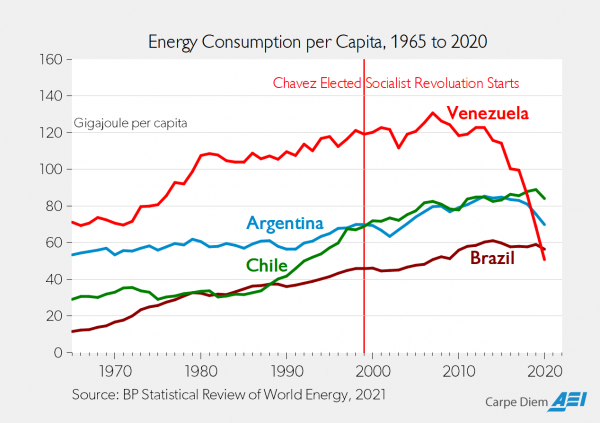
Thousands of workers are fleeing Venezuela’s state-owned oil company, abandoning once-coveted jobs made worthless by the worst inflation in the world. And now the hemorrhaging is threatening the nation’s chances of overcoming its long economic collapse, union leaders, oil executives and workers say.


Desperate oil workers and criminals are also stripping the oil company of vital equipment, vehicles, pumps and copper wiring, carrying off whatever they can to make money. The double drain — of people and hardware — is further crippling a company that has been teetering for years yet remains the country’s most important source of income.


The timing could not be worse for Venezuela’s increasingly authoritarian president, Nicolás Maduro, who was re-elected last month in a vote that has been widely condemned by leaders across the hemisphere. Prominent opposition politicians were either barred from competing in the election, imprisoned or in exile.


How deep Señor Maduro?

CNN;

Venezuela, a nation spiraling into a humanitarian crisis, has missed a debt payment. It could soon face grim consequences.
[…]
Venezuela has no other meaningful income other than the oil it sells abroad. The government, meanwhile, has failed for years to ship in enough food and medicine for its citizens. As a result, Venezuelans are waiting hours in line to buy food and dying in hospitals that lack basic resources.
If investors seize the country’s oil shipments, the food and medical shortages would worsen quickly.
“Then it’s pandemonium,” says Fernando Freijedo, an analyst at the Economist Intelligence Unit, a research firm. “The humanitarian crisis is already pretty dire … it boggles the mind what could happen next.”

All is unfolding as predicted.

Navigation