Category: Tommy Douglas: Not Dead Enough

Best Healthcare System in the World

Global- Patients waiting more than a day to be admitted in Winnipeg hospitals: ‘It’s absolutely terrifying’

Data released by Shared Health from May 4 show the average total wait time for patients who end up being admitted, from triage and registration to being placed in a medicine bed, was 22.1 hours at the Grace, nearly 29 hours at Health Sciences Centre and a whopping 31.5 hours at St. Boniface.

“As the numbers presented are averages, some patients will unfortunately wait longer periods of time for admission – some significantly so – while others may have shorter waits,” a spokesperson from Shared Health said.

A mouthful of free stuff

Things are getting really bad in Canada when the biggest criticism of a plan to give everyone “free” dental care is that it will create jurisdictional disputes with the provinces. The fact that it will add vast amounts of fuel to our ongoing borrowing blaze does not seem to bother anyone in the chattering classes.

Davies said the program would be akin to employment insurance. With dental care, the federal government will provide an insurance plan that allows dentists to send a bill to the federal government. “No different than the federal government sending an EI check every two weeks,” he said.

Whatever word could possibly be used to describe this program, “insurance” is not that word.

Greatest Health Care System in the World

Licia Corbella- “Canada has one healthcare administrator for every 1,415 citizens. Germany: one healthcare administrator for every 15,545.”

The amount of money spent on public health care is essentially the same in each country. Yet international studies show that Germany has more physicians, more specialists, and many more acute care and psychiatric beds. It far surpasses Canada in its inventory of diagnostic equipment (CT, MRI, and PET scanners) and just one per cent of its population waits more than four weeks to see a specialist, compared to 17 per cent in Canada.

Its well past time to start culling the herd.

When You Combine The Best Healthcare System in the World With The Best Vaccine in the World

CBC- Manitoba plans to send as many as 300 spinal-surgery patients to Fargo

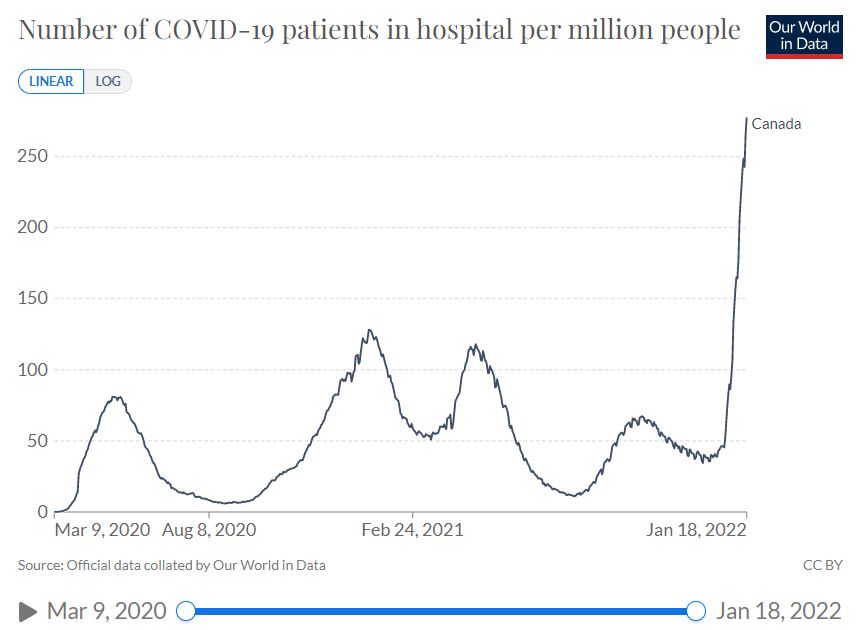
“We acknowledge the suffering. We acknowledge the waits,” said Dr. Ed Buchel, the provincial surgery lead for Manitoba Shared Health, adding there was no option to send patients elsewhere in Canada because every province is struggling to meet the health-care demands of the Omicron surge.

The popular scapegoat for over a year now  has been the unjabbed. But as can be clearly seen, Manitoba is one of the most jabbed places in the world. Back in the beginning of December when they still reported such things it became apparent that the double and triple jabbed were clogging up the system. Quebec who still makes the numbers public confirms this is what’s going on.

Click on image for full screen.

Nothing “they” said would work has worked. Its well past time to get rid of the useless masks, the ridiculous mandates and the stupid passport to nowhere system. While they’re at it the multi-millionaire, laptop class administrators in charge of the whole mess should be thrown out on their ears without the golden parachutes they didn’t earn.

Update: The big picture


This Is Not The Two-Tier Health Care System I Was Promised

Tommy Douglas, finally dead.

Soviet medicine

Several Canadian doctors discuss their frustrating interactions with the Covid cops in the health care regulatory authority in this video. The interactions would be better characterized as harrassment.

Patrick Phillips and Sam Dube discuss the premise that we are in the midst of a mass psychosis.

Patrick Phillips relates an anecdote about being denied the right to prescribe vitamin D to his Covid patients. Just the Covid cases, mind you. He can prescribe it to anyone else.

Simple, cheap and effective

I had not heard of South African doctor Shankara Chetty prior to this interview, but since the beginning of the pandemic he claims to have successfully treated over 7000 Covid patients with widely available and cheap antihistamines and steroids. What stands out in the interview is his basic approach to the pandemic: see the patient in person and take time to understand the progression of the disease. This stands in stark contrast to the approach in Europe and North America where we are suffering from an obsession with data and randomized clinical trials while completely ignoring the efforts of medical innovators like Dr. Chetty.

Best Health Care System in the World

Global- Manitoba man travels overseas for knee surgery, bills province for cost

The cost of the trip to Lithuania, which included the knee replacement and full two weeks in rehab, was $14,500, compared to the over $21,000 price tag for the surgery at home in Manitoba.

Johnson said part of the problem is that the term ‘elective’ doesn’t necessarily reflect the seriousness of many Manitobans’ conditions.

“‘Elective’ sort of implies somehow it’s voluntary, not totally necessary. But there are many people in this city, in this province, who are waiting for hip and knee surgery who are simply immobile.

“They call it a waiting list, but that implies management, and in reality, it’s more akin to a large corral that they put people in.”

Update: ‘I won’t be here next year’: Canadians robbed of life by delayed diagnoses amid pandemic

She said the situation is frustrating for doctors because COVID-19 restrictions imposed by federal and provincial governments are “really out of our control,” she says. Despite this, Malak said it is usually the doctors who get the brunt of a patient’s anger over these disruptions to health services.

Pandemic of the Untreated

Slowly the tune is a changing.

Globe and Mail- Doctors concerned they can’t access COVID-19 treatments that can prevent hospitalizations

Health Canada has authorized a handful of treatments called monoclonal antibodies that can reduce severe illness when given to people within a few days of symptom onset. However, treatment with monoclonal antibodies, which must be administered intravenously, is not widely available to those who would benefit most in many parts of Canada, according to Andrew Morris. “It’s almost random how people can get access to it,” said Dr. Morris, who is also a member of Ontario’s COVID-19 Science Advisory Table. “Most doctors and other health care providers have no idea how to access it.”

CBC- Alberta rolls out its first outpatient COVID-19 treatment as experts warn it’s not a vaccine substitute

Alberta began a phased roll-out on Tuesday which initially includes people 65 and over who test positive but have not received any doses of the COVD-19 vaccine as well as solid organ transplant and stem cell transplant recipients who are COVID-positive regardless of their vaccination status. Community paramedics administer the IV therapy in patients’ homes in regions where these teams are in place. The treatment will be offered in an Alberta Health Services clinic for people living in the Fort McMurray area.

CTV- ‘Good news,’ says doctor: Some Quebec COVID-19 patients to soon have access to monoclonal antibody treatment

CBC- Sask. has treated 6 people with monoclonal antibodies for COVID-19, despite hundreds of available doses

Francisco- If they really wanted to put a dent in the seasonal winter surge they’d be telling everyone to load up on Vitamin D and allowing them access to already proven outpatient treatments. But no, the maniacs in charge are still trying to dazzle us with their “brilliance”.

Beginning Saturday, November 13 at 12:01 am, religious gatherings in this region will be limited to 25 persons unless the facility can physically divide their space into separate areas, in which case there can be several cohorts of 25 people. The total number of attendees can not exceed 25 per cent capacity to a maximum of 250 people.


Best Healthcare System in the World

Be prepared to wait’: Kingston emergency care sees record high patient volumes

But unlike in the last two years, COVID-19 is not to blame. Rather, KHSC is dealing with a sudden influx of critically ill patients suffering from things like strokes, heart attacks and traumatic injuries. Over the last few weeks, the emergency department has been seeing more than 200 patients a day and the urgent care centre is seeing upwards of 140 patients per day. Normally, those numbers would sit at 170 and 110 respectively, the hospital organization said.

It’s Been a Nightmare’: BC Health Workers Describe Staff Shortages Due to Vaccine Mandate

Anthony Furey interviews a nurse who chose firing over vaccination

Capacity restrictions return as Greater Sudbury tries to get soaring COVID-19 cases under control

Navigation