Author: Dennis

Narrative collapse

When the left-wing corporate media starts to become aware of the fact that the economy may not be as rosy as they imagined it to be, you know that efforts to hide the economic consequences of Covid mandates, supply chain snarls and the war in the Ukraine are failing.

“You know, I said there’s storm clouds but I’m going to change it … it’s a hurricane,” Dimon said Wednesday at a financial conference in New York. While conditions seem “fine” at the moment, nobody knows if the hurricane is “a minor one or Superstorm Sandy,” he added.

“You’d better brace yourself,” Dimon told the roomful of analysts and investors. “JPMorgan is bracing ourselves and we’re going to be very conservative with our balance sheet.”
Happy travels?

Now that some airlines are beginning to push back on the vaccine mandates for air travel, it’s possible that the restrictions might end next month. In the meantime, putting the economy through the blender remains official federal government policy. Almost no one in authority seems to care about the impact.

In April, the Greater Toronto Airports Authority said it held 2,204 planes from abroad on the tarmac, versus just eight in the same period pre-pandemic. In the second week of May, 18,000 arriving international passengers were held on board for longer than 30 minutes and 3,000 for longer than 75 minutes. The Canadian Airports Council said it is taking four times as long to process people as it did before the pandemic.

Default Express

What could possibly go wrong now that a nation possessing nuclear weapons sits on the verge of bankruptcy? As fiat currencies continue their death spiral, the specter of debt default is moving from the truly marginal economies to the less marginal ones. In this case, things are more worrisome thanks to Pakistan’s chronic association with some notable Islamic terrorists.

Amid the depleting foreign currency reserves and crashing economy, Pakistan is in dire need of USD 36-37 billion in foreign financing in the next fiscal year.


Broad cultural narratives

It has often been said that the course of a culture can be predicted by its artistic trends. When the dominant art purveyors promote the ideals of malevolent nihilism, should anyone be surprised when impressionable youngsters act on those ideals? If a teenager is bombarded with the notion that values as such are not worth achieving, what options will they feel are left other than to engage in the destruction of values for the sake of that destruction?

Last Friday, Netflix released the first eight minutes of the “Stranger Things” Season 4 premiere as a sneak-peek video ahead of the official launch of Volume 1 this Friday. This opening scene depicts a massacre that involves Millie Bobby Brown’s psychokinetic and telepathic character Eleven and shows the dead bodies of several children covered in blood.


A black hole for capital

With Europe on the verge of a severe recession thanks to green energy boondoggles, two years of catastrophic lockdowns and embargos on much of their outside energy supplies, don’t expect the goal of getting interest rates above zero to be achieved for very long, if at all.

When forced to reverse course back to even deeper negative rates, Keynesian apostle Christine Lagarde may conveniently forget that she ever said the following:

Against the backdrop of the evidence I presented above, I expect net purchases under the APP to end very early in the third quarter. This would allow us a rate lift-off at our meeting in July, in line with our forward guidance. Based on the current outlook, we are likely to be in a position to exit negative interest rates by the end of the third quarter.

Banging your head against the wall

Since the last two centrist/Red Tory federal leaders got nowhere electorally, one could reasonably expect that a different approach might be warranted. But not according to those whom Margaret Thatcher famously referred to as “the wets”. Mimic the Liberals, they say, or else…

“There will not be a new political party or anything until the next election because this leader has to be given a shot, right? But if we fail for the fourth time in a row, if we lose the next election, then, you know, all the cards are off the table,” predicted Peterson.

The only way to win, he argued, is to find a way to appeal to “moderate, pragmatic, middle-of-the-road Canadians” who do not see themselves in the other more progressive parties.”


Centrally planned havoc

The idea that a monetary system can be centrally planned has about the same chance of success as centrally planned automobile manufacturing or farming. But that doesn’t stop Keynesians from insisting that things would be better if the central planners would only adopt their particular tweak-of-the-week.

A central bank digital currency theoretically allows for micro-targeting — perhaps by sector, perhaps by region, perhaps by socio-economic class — with real-time feedback, and that could be invaluable the next time the economy needs stimulating.

Stimulating, in this case, meaning ushering in yet another round of capital destruction.

Watch out for the bears

If anyone thought that the economy could be shut down for two years, inundated with green energy boondoggles, get involved in a war and just seamlessly recover, we have news for you. It turns out that the economy is not just like a VCR where you can hit “pause” and “play” as often as you like.

US stock futures slumped again, extending yesterday’s brutal selloff that erased $1.5 trillion in market value on concerns about everything from slowing growth, to Chinese lockdowns, to soaring inflation and tightening monetary policy. Contracts on the S&P 500 were down 1.2% 7:30 a.m. in New York, having earlier dropped to 3,856, one point away sliding 20% from January’s all time highs, and triggering a bear market.


Headed for default

A fiat monetary system characterized by exponentially rising debt is not a “healthy” economy, so no, it won’t tolerate half percent rises in interest rates without triggering an unmanageable collapse in asset values. These clowns need to stop promoting the “Goldilocks” narrative while they still have some credibility left.

Responding to the worst inflation the U.S. has seen in more than 40 years, the central bank official said she foresees “an expeditious march” through the year toward benchmark interest rates that would neither stimulate nor repress growth — the “neutral” rate, in Fed parlance.


Mugabe rules from the grave

Consumer prices rising too fast while your currency craters? That citadel of sensibility, Zimbabwe, has discovered the solution: just stop all bank lending. What could possibly go wrong?

President Emmerson Mnangagwa ordered banks to stop lending with immediate effect on Saturday, saying the unprecedented move was meant to stop speculation against the Zimbabwean dollar, which has been rapidly devalued on a thriving black market.

Before Mnangagwa’s announcement, the Zimbabwean dollar was officially quoted at 165.94 against the U.S. dollar, but had been trading at an exchange rate of between 330 and 400 to the greenback on the black market.

Blast from the past

Who can forget the heady days of November, 2021? It all seems so long ago…

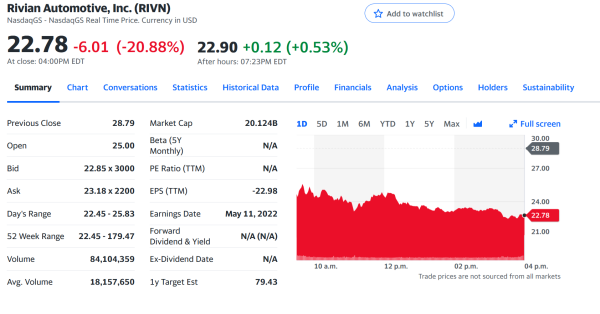
Rivian went public on Wednesday, marking the largest IPO in the United States since 2014. The electric pickup and SUV manufacturer priced its stock at $78 a share and raised about $12 billion, which the company plans to spend on boosting production and designing more vehicle models. While that price set Rivian’s valuation at around $70 billion, the carmaker’s market capitalization surged above $90 billion, after the stock started trading at nearly $107 a share on its first day.

I’m guessing there are more than a few investors out there wishing they had never heard of Rivian in the first place. After all, the price didn’t get to $179 unless someone ponied up that much money.


Calibrating the housing market

I doubt that a mortgage holder facing foreclosure is going to get much comfort out of viewing his situation as a “recalibration”. Because it takes time for rising interest rates to have an impact, in the interim we will continue to see the mainstream financial media parrot the notion of a “soft landing”. None of these pundits will recognize the train wreck until the moment it actually occurs.

Higher rates may cause a strain for highly indebted borrowers in the short run, but over time they may also help recalibrate housing budgets for borrowers based on real life monthly payments. This may also help stabilize the housing market, hopefully leading to a soft landing instead of a housing crash.

Freezing sparky cars

Maybe EVs should come with a small propane heater for your trip. If Shiny Pony has his way, a winter car ride is going to become a race to arrive at your destination before hypothermia sets in.

But it wasn’t just the duration of the journey that was appalling – the temperature during the journey was anything but funny: the heating stayed off for almost the entire return journey in freezing temperatures: Because the colder it is, the more the operation of the heating systems puts a strain on the electric car battery.

For the trip, Brack covered herself with a hat, scarf, gloves and generally warm clothing, because after the first full charge, the VW e-Up shows a range of just 216 kilometers. And even this information is not guaranteed, which is why Brack opts for the so-called Eco-Plus mode and, of course, for the heating to be switched off. When the windscreen is frosty, heating wires ensure a clear view, so the reporter driving the test can do without the power-guzzling fan heater completely.

Collateral damage

It’s always a shock when even the CBC publishes a piece where no attempt is made to sugarcoat bad news about the effects of the lockdowns and supply chain snarls. More people are waking up to the reality that the economy is not a VCR which can be seamlessly paused and restarted at will.

Over the years, the business occasionally struggled with slim profit margins, but it started seeing success when it started serving the hospitality industry a decade ago.

That work evaporated once the pandemic hit. While business started to rebound, DeFehr Furniture was hit by supply chain disruptions. There were shortages of the raw materials the company required, and the competition for those products was fierce.

In the last month, DeFehr shut down its plant for four days because it did not have handles.

Who cut the elevator cables?

Given an economy that was supposed to be rebounding strongly from the pandemic, this probably comes as a surprise to mainstream politicians and their media lapdogs. For SDA readers, not so much.

According to preliminary data, the S&P 500 lost 148.70 points, or 3.51 per cent, to end at 4,149.31 points, while the Nasdaq Composite lost 635.21 points, or 4.90 per cent, to 12,329.65. The Dow Jones Industrial Average fell 1,033.07 points, or 3.03 per cent, to 33,027.99.

Only a small number of the S&P 500’s constituents were in positive territory, one of which was Twitter Inc.


Navigation