Why this blog?
Until this moment I have been forced to listen while media and politicians alike have told me "what Canadians think". In all that time they never once asked.
This is just the voice of an ordinary Canadian yelling back at the radio -
"You don't speak for me."
email Kate
Goes to a private
mailserver in Europe.
I can't answer or use every tip, but all are appreciated!

Katewerk Art
Support SDA
Paypal:
Etransfers:
katewerk(at)sasktel.net
Not a registered charity.
I cannot issue tax receipts
Favourites/Resources
Instapundit
The Federalist
Powerline Blog
Babylon Bee
American Thinker
Legal Insurrection
Mark Steyn
American Greatness
Google Newspaper Archive
Pipeline Online
David Thompson
Podcasts
Steve Bannon's War Room
Scott Adams
Dark Horse
Michael Malice
Timcast
@Social
@Andy Ngo
@Cernovich
@Jack Posobeic
@IanMilesCheong
@AlinaChan
@YuriDeigin
@GlenGreenwald
@MattTaibbi
Support Our Advertisers

Sweetwater
Don't Run

Polar Bear Evolution
Email the Author
Wind Rain Temp
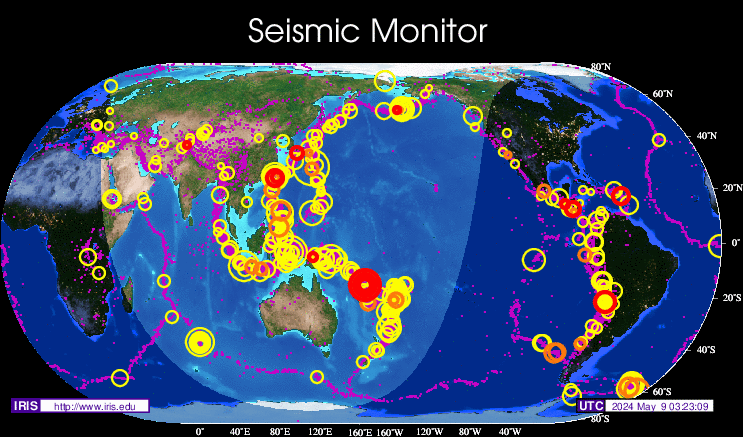
Seismic Map
What They Say About SDA
"Smalldeadanimals doesn't speak for the people of Saskatchewan" - Former Sask Premier Lorne Calvert
"I got so much traffic after your post my web host asked me to buy a larger traffic allowance." - Dr.Ross McKitrick
Holy hell, woman. When you send someone traffic, you send someone TRAFFIC.My hosting provider thought I was being DDoSed. - Sean McCormick
"The New York Times link to me yesterday [...] generated one-fifth of the traffic I normally get from a link from Small Dead Animals." - Kathy Shaidle
"You may be a nasty right winger, but you're not nasty all the time!" - Warren Kinsella
"Go back to collecting your welfare livelihood." - Michael E. Zilkowsky

Here’s a related article:
http://dailycaller.com/2016/06/11/13-of-the-dumbest-academic-papers-to-actually-get-published/
Isn’t academe wonderful?
http://dilbert.com/strip/2016-06-16
Today’s Dilbert seems appropriate
Academics, like their students, resemble delicate snowflakes/cry bullies rather than critical thinkers and debaters. Defending their work and ideas was obviously too difficult, it’s so much easier to regulate out dissent and challenging ideas. Another example:
MARINE SCIENTIST CENSURED BY JAMES COOK UNIVERSITY FOR QUESTIONING MISLEADING CLAIMS
Date: 13/06/16 Graham Lloyd, The Australian
When marine scientist Peter Ridd suspected something was wrong with photographs being used to highlight the rapid decline of the Great Barrier Reef, he did what good scientists are supposed to do: he sent a team to check the facts.
After attempting to blow the whistle on what he found — healthy corals — Professor Ridd was censured by James Cook University and threatened with the sack. After a formal investigation, Professor Ridd — a renowned campaigner for quality assurance over coral research from JCU’s Marine Geophysics Laboratory — was found guilty of “failing to act in a collegial way and in the academic spirit of the institution”.
I suspect that most academics would never survive in the private sector, industrial world or any place where you are required to be accountable and competent.
The private sector also has a lack of accountability and competency. I know because I worked for people who were like that. And, yes, one can be a complete failure ans still keep one’s job if one happens to know the right people. I saw that first-hand at some of the outfits I was with.
Questionable conduct by academics is nothing new. I noticed that soon after I started grad studies in the late 1970s. Some people are clever and aren’t caught. Some people have unassailable reputations and, thereby, have immunity.